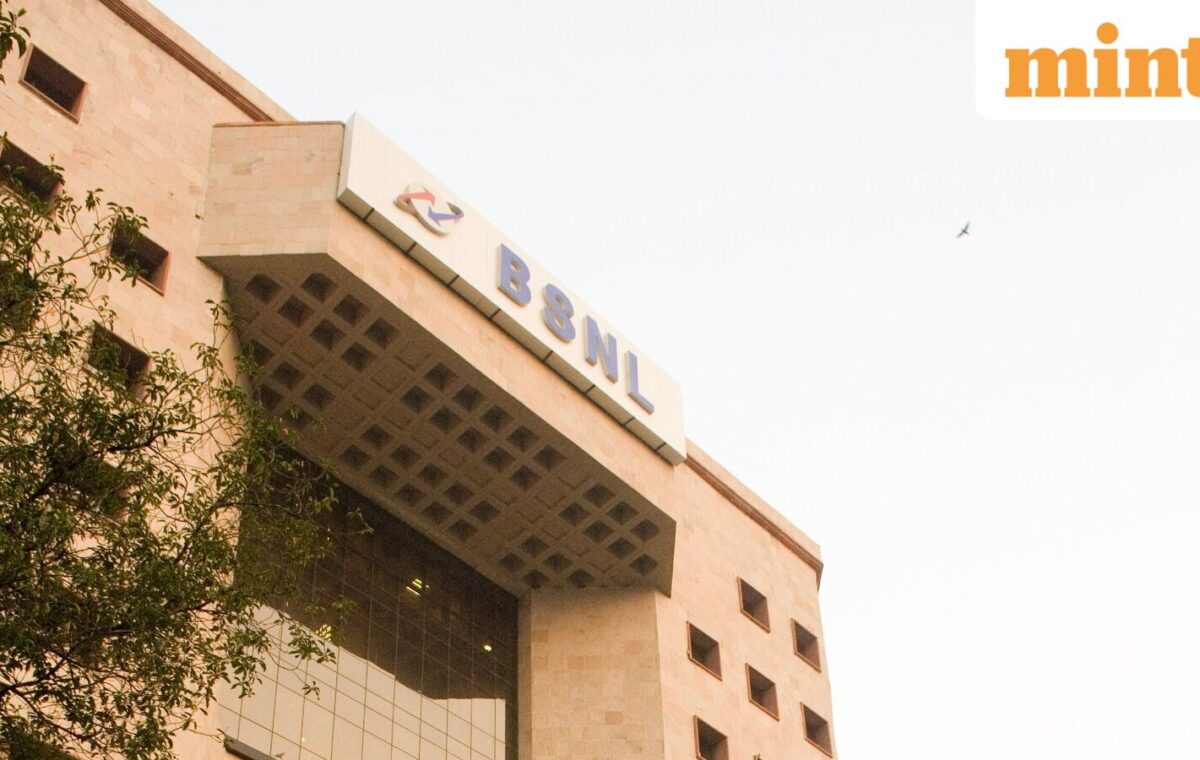
State-owned telecom operator Bharat Sanchar Nigam Limited (BSNL) continued to post losses in the April-June quarter (Q1) of financial year 2026-27 (FY27), with the loss widening from a year earlier as higher expenses outpaced modest revenue growth.
BSNL reported a consolidated net loss of ₹1,280 crore in the first quarter of FY27, rising from ₹1,007 crore a year earlier, according to the company’s financial statement published on its website. Sequentially, however, the losses narrowed from ₹1,419 crore in January-March quarter.
To be sure, BSNL has restated its financial statements for FY26 to include those of merged entity Bharat Broadband Network Ltd, after the corporate affairs ministry in May approved the scheme of merger between the entities. The Cabinet had given its approval to the merger in July 2022.
Excluding the BBNL financials, BSNL in the March quarter reported a net loss of ₹1,269 crore.
The company's total expenses rose 5.5% year-on-year in the June quarter to ₹7,242.5 crore.
Employee costs, which account for 37% of the company’s revenue from operations, rose 1.8% year-on-year (y-o-y) to ₹1,974.5 crore. Network expenses increased 28% from a year earlier but fell 5% sequentially to ₹1,761 crore. Depreciation and amortization expenses rose 9.6% year-on-year but declined 18.6% sequentially to ₹2,394.5 crore.
The company's revenue from operations rose 4.2% year-on-year and 2% quarter-on-quarter to ₹5,306 crore. BSNL’s mainstay consumer mobility business grew 12% year-on-year but fell 7.5% sequentially to ₹2,282 crore.
The enterprise services business also grew 12% from a year earlier but fell marginally on-quarter to ₹1,736 crore. The third vertical – consumer fixed access- declined 14.5% year-on-year but rose 29.5% sequentially to ₹1,290 crore.
BSNL's results come at a time when it is working to expand its 4G network. However, service quality issues continue to affect its users. According to drive test reports by the Telecom Regulatory Authority of India (Trai), BSNL’s mobile network performance has been weak compared to private operators, often below the quality of service benchmarks set by the regulator at most of the places.
The telecom operator had installed 105,290 4G indigenous sites by April-end and is rolling out its 5G network in Delhi, according to its response to a parliamentary panel.
“BSNL's 3 core business verticals—Enterprise Business, Consumer Mobility and Consumer Fixed Access (CFA)—continue to drive the company's growth,” communications minister Jyotiraditya Scindia said last month in a strategic review meeting with BSNL executives.
“Arpu (average revenue per user) has grown from ₹100, which is where we closed at FY2025-26. (In) Q1, it has increased to about ₹102.7,” Scindia had said.
To be sure, the communications ministry, in a statement dated 23 April, said that BSNL’s Arpu rose 42% to ₹101 in FY26 from ₹71 in the previous year. The growth in Arpu was in sharp contrast to BSNL’s revenue growth of 1.7% in FY26. Mint reported on 30 April that while BSNL maintained it was entering a growth phase driven by rising 4G data usage, analysts had questioned the sharp increase in Arpu.
Jatin is based in New Delhi and writes on telecom and technology with a keen interest in policy and regulation. With over five years of reporting experience across Informist Media, Financial Express and now Mint, he has extensively covered the telecom, information technology, electronics and semiconductor sectors.<br><br>A commerce graduate, Jatin's work focuses on tracking industry developments, regulatory changes and policy decisions that shape India’s evolving digital ecosystem. Over the years, he has reported on key trends and shifts across these sectors, bringing clarity to complex policy and business issues.<br><br>Known for his strong news sense, Jatin focuses on breaking stories and delivering in-depth reporting that offers readers an understanding of complex topics, policy decisions and corporate developments. His work often examines the intersection of policy and business, highlighting how regulatory decisions impact industry strategy, pricing, and consumer outcomes.<br><br>He brings a strong domain understanding for Mint and his work is widely picked up by other media firms. With a focus on accuracy and depth, he aims to break down developments into clear, accessible insights for readers, while continuing to track emerging trends shaping the future of India’s telecom and technology sectors.
Catch all the Business News , Corporate news , Breaking News Events and Latest News Updates on Live Mint. Download The Mint News App to get Daily Market Updates.