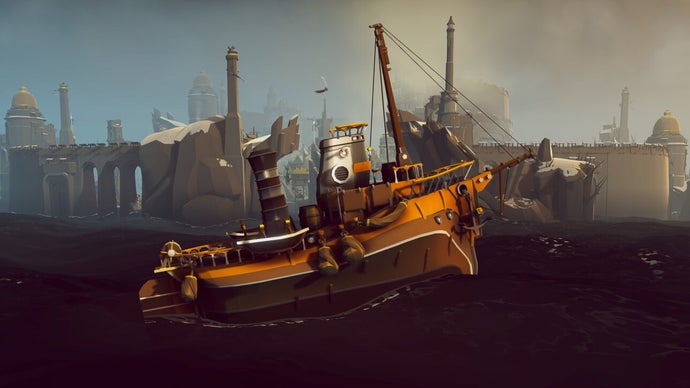
GTA6 is messing with Tomas Sala's plans. He'd intended to launch ShipShaper earlier this year, but "life got in the way," he tells GamesIndustry.biz. "And then I saw all this stress about, 'Oh my God, GTA is coming, you have to pack it before September'."
The game is now set to launch into Early Access on September 2, suitably far off from GTA6's launch on November 19. Not that Sala thinks indies should be particularly worried about releasing near GTA6, which, as he points out, isn't launching on PC.
"I don't see why people are scared of it. It has its own fucking audience that doesn't go around buying nerdy niche sailing games or nerdy puzzle games or tiny story-driven emotional deckbuilders. They just want to play GTA." He points out that most players don't buy indie games – indeed, a 2025 Circana survey found that 63% of US players buy a new game once every six months or less (with 33% buying a game less than once a year), while only around 14% buy a game once every month or more. It's likely that this small percentage of enthusiastic repeat purchasers represents the main buyers of indie titles. "I'm pretty sure that's not the GTA audience," says Sala.
He also doesn't think that the blanket media coverage of GTA6 around its launch will have much of an effect. "The media doesn't cover indies anyway, except the flavour of the week – everything's Meccha Chameleon now. It's not like they're covering the top ten games that came out this month. There's some real fucking great indie games that came out, which got a review maybe on RPS or Eurogamer, and that's about it. That's all the coverage they're ever going to get."
Many indie hits don't make it into articles or influencer streams, he says. "And they're still very successful, because they find their audience."
More generally, he thinks we're living through a period of astonishing indie creativity. "We can talk about the industry as if it's in a downturn – and for many people it is – but if you look at what gets made and put out, it's a golden age."
Sala rose to fame for creating The Falconeer, a 2020 third-person aerial combat game. He followed it up with Bulwark: Falconeer Chronicles in 2024, a casual sandbox-style building game set in the same universe. The Falconeer is by far the better known game – thanks to being available on streaming platforms like Game Pass and Luna, as well as launching on consoles and being given away for free in a limited promotion – but Sala says Bulwark has actually sold far more units. "It outsold The Falconeer in raw sales every day. It still outsells it."
The point is that fame doesn't necessarily equate to financial success – and Sala is under no illusions that the boat-creation game ShipShaper will go viral as the latest indie darling of the week. "If you're making something that's as nerdy, as geeky, and as niche as designing your own tall ships and steamships," he says, "you're not in the running for that."
But he thinks that it's possible to tick along nicely without grabbing the headlines, instead relying on niche fans and word of mouth. "Which I think is the best place to be," he says. "Small but stable."
So many games on Steam rarely get written about, but are "quietly huge," he says. Project Zomboid springs to mind, which has sold more than 15 million units since 2013. But he says a game doesn't have to sell millions to be successful. If, like him, you have a studio consisting of one person, "you don't need to make a lot of money."
As Mike Bithell touched on recently, it comes down to product/market fit – matching the scale of development with the potential audience size. "Before you start, you've got to look at what you're making, what your audience is going to be, how that fits together, what they're willing to pay," says Sala. "All these very basic questions about doing business, which feel incredibly dull and contrary to art and doing what we want, but it's not really. It's just a little bit of common sense."
For ShipShaper, he's done his research. "I've looked at boats and gone, 'Hey, there hasn't been a new boat game in quite some while, there's a lot of audience for that, and they're paying a lot'." Although far from glamorous, games about things like boats and trains have a dedicated and price-insensitive audience, he says, pointing out that train simulator fans will pay a premium for DLC content based on specific locomotives or lines. "Boats are the same," he says. The HMS Victory DLC for Naval Action sells for £49.99.
"You go, 'Oh, that's quite expensive'," he says. "But it's a niche. And to players there, it's not expensive. It's like their Star Citizen."
He saw it as a space he could do something in. "I love boats, I understand that emotion," he says. Then it was just a case of working out some sums. "How expensive can it be? How much time can I put in it? I've become a lot more business minded," he says. "We all have to do this, it's a basic skill now."
The notion of being a solo indie developer evokes ideas of untrammelled creative freedom, galloping down whatever creative paths pique your interest. But the reality is more about carefully choosing which projects to pursue and how much time to spend on them.