Published : Aug 14, 2026 08:24 IST – 10 MINS READ
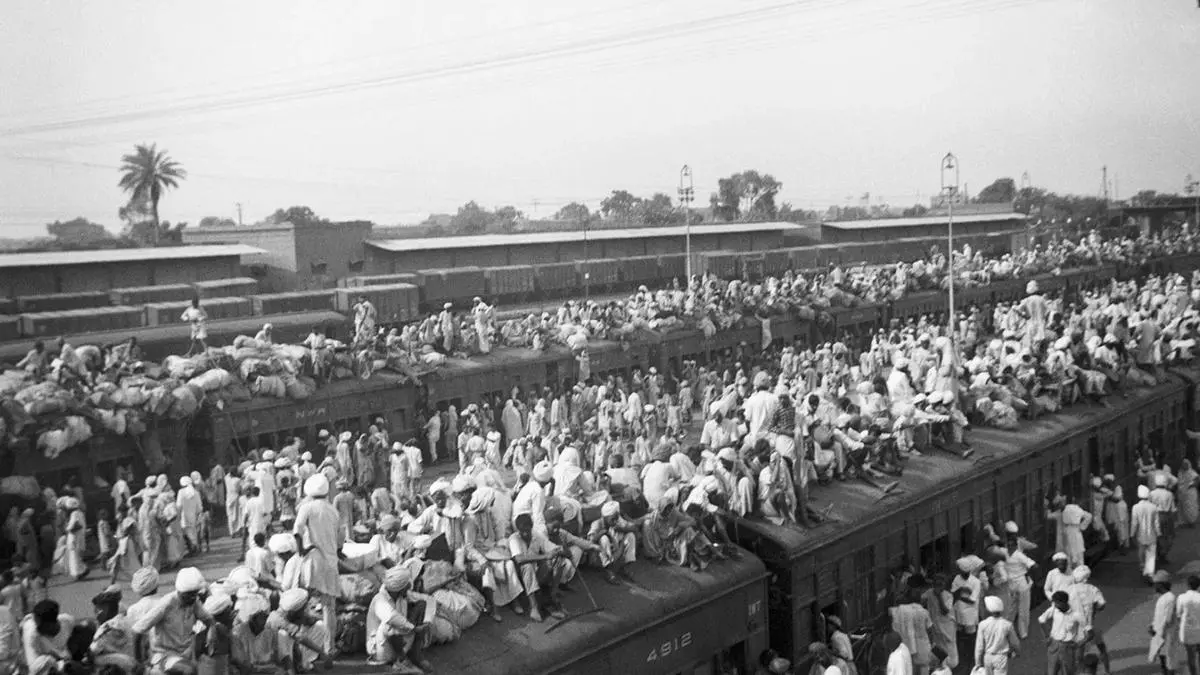
A train full of refugees during Partition.
| Photo Credit: GETTY IMAGES
There’s an old saying in Punjabi that goes, “Jinne Lahore nahi vekhya, oh jammiya hi nahi”, meaning one who has not seen Lahore has not truly been born.
The saying is an indication of Lahore’s place in the imagination of Punjab. By the time of Partition, the city had accumulated centuries of political and cultural importance. The Mughals had made Lahore a provincial capital. Maharaja Ranjit Singh made it the capital of his kingdom in 1799. Under the British, the city became the seat of provincial power, with Punjab University, colleges, the Mall, Anarkali (a bazaar), major markets, and railway workshops giving it an importance that reached well beyond the old walled city.
A growing film industry was beginning to regard itself as a rival to Bombay and Calcutta. Families from across Punjab settled in Lahore, and the city became home to much of the province’s political, commercial, and cultural life.
In 1947, that old attachment acquired a harder political edge. The question was no longer simply what Lahore meant to Punjab, but which Punjab Lahore would belong to.
The numbers gave the question its first hard edge. The 1941 Census recorded 28,418,819 people in Punjab. Muslims constituted 57.1 per cent of the population, Hindus 27.8 per cent, and Sikhs 13.2 per cent, with Christians and others making up the remainder. The Muslim majority strengthened the Muslim League’s case for a Muslim-majority western Punjab, but the provincial figures concealed a complicated distribution of communities across districts, towns, and villages.
Lahore itself presented an even more difficult picture.
Muslims had the demographic argument and saw the city as the natural capital of a Muslim-majority Punjab.
Hindus had a substantial presence in the city’s commerce, real estate, neighbourhoods, and institutions, and for them Lahore was not an outpost in someone else’s province but a city in which generations had built their lives.
Sikhs had a different but equally strong claim: Lahore, connected to the memory of Guru Arjan, formed part of a wider Sikh historical geography, linked to Nankana Sahib, Amritsar, and other centres of Sikh history.
All three communities, therefore, had reasons to regard Lahore as more than a city that could simply be assigned according to a column in the census.
Lahore had carried the memory of contested religious spaces long before 1947.
Even the Badshahi Mosque bore traces of earlier struggles over political power. During the Ranjit Singh reign, its courtyard was used as a horse stable and parts of the complex were put to military use, including as an arsenal depot, before the mosque’s religious function was restored.
The Shahid Ganj dispute was among the most bitter of the later controversies. Muslims regarded the site as a mosque, while Sikhs associated it with a gurdwara complex connected with Bhai Taru Singh. The dispute travelled through the colonial courts for decades. In July 1935, the mosque was demolished by Sikh custodians. Communal violence followed in Lahore, and the dispute remained politically charged until the Privy Council rejected the Muslim claim in 1940.