We may earn revenue from the products available on this page and participate in affiliate programs. Learn more ›
Product news, reviews, and must-have deals.
Some bikes are built for commuting. Others are built for fitness. Most e-bikes ask you to pick a lane. The 39-pound Velotric Tempo doesn’t. With configurable ride modes, switchable sensors, and heart rate-based riding, it can be a workout partner one day, and an easy errand bike the next. And all without losing the simple joy of getting outside and riding a lightweight e-bike.
Starting at $1,499, the Velotric Tempo doesn’t fit neatly into a single category, and that’s exactly the point. It can be your fitness bike, your commuter, or a chill weekend cruiser with just a few button presses.
If you’re shopping for an e-bike, it’s easy to overlook the Tempo. Its 350W motor and 374Wh battery aren’t the biggest numbers on the spec sheet, especially when 750W motors have become so common (like in the 60-pound Velotric Summit.2, if a powerful, mixed-terrain hybrid e-bike is more your speed). But after spending a few weeks riding it, I stopped thinking about the specs and started thinking about where I wanted to ride next.
I rode the Tempo the same way I ride most bikes: commuting across town, cruising mixed-use trails, running errands, and taking the occasional dirt path just to see where it led.
Velotric claims up to 60 miles of range, and as always, that number depends on terrain, assist level, and how much work you’re willing to do. Since the Tempo is designed to complement your effort rather than replace it, I found that the battery lasted longer than I expected. Even on days when I rode 20 miles or more, I could often go on a few more rides before reaching for the charger. If I were planning a long trip, I’d give a hard think about how hilly the terrain is and what assist level I expected to use. 50 miles on the mostly flat, gravel C&O canal where the lowest Eco setting would suffice? I’d feel good about hitting that range. But a hillier ride would cut that by as much as half if I planned to use the highest assist level.
Online, I’ve seen cyclists take advantage of the KENDA 700×42c eBike puncture-resistant tires and turn the Tempo into a gravel bikepacker—a much more adventurous life than city e-bikes normally star in. That’s the beauty of a bike that doesn’t lock you into a single purpose. The IPX7/IPX6-rated frame and battery are ready for rain, puddles, and less-than-perfect weather. While mounting bosses on the downtube and fork make it easy to add cargo cages, extra bottle mounts, or other accessories (beyond your essentials, like helmets and a lock).
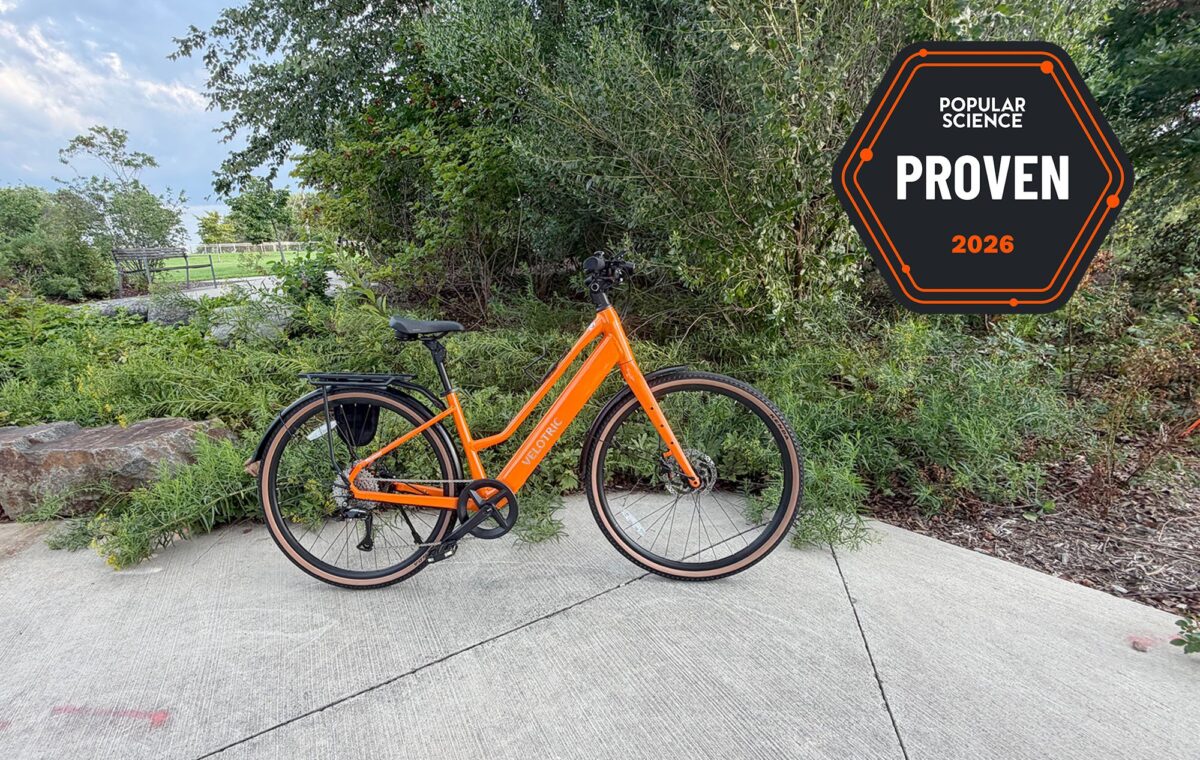
The Tempo doesn’t scream “e-bike” from a mile away. This lightweight model could easily be mistaken for a traditional bike thanks to its concealed cables and 700 x 42 cc wheels. It weighs only 39 pounds, so most folks can carry or lift it onto a car rack without spending a few months in the gym beforehand.
The Tempo also embraces a more minimal aesthetic than most e-bikes. The handlebars feature trigger shifters for the 8-speed drivetrain on the right and a small but colorful screen with a button-based control pad on the left. Select from five pedal-assist levels or cycle through Class 1, 2, and 3 modes with just a thumb. Velotric also squeezes in thoughtful commuter touches like integrated turn signals, a 500-lumen headlight with an automatic mode, torque or cadence SensorSwap, cruise control, a removable thumb throttle, and an NFC card to unlock the computer. It’s a lot to choose from on one of the easiest menus I’ve encountered on an e-bike.
Many of these features can also be controlled through the Velotric app. It also expands on features, letting you track the bike with Apple Find My or Google Find Hub, record rides, adjust ride settings, and fine-tune the bike’s assistance levels to match your preferences.
The nearly silent 350W motor delivers enough assistance to flatten hills, fight headwinds, or help you keep pace with traffic while still encouraging you to put in some effort. That’s really the Tempo’s philosophy: it’s designed for riders who still want cycling to feel like exercise, not effortless transportation. That same philosophy carries over into one of the bike’s most innovative features: Pulse mode.
Pulse mode is the kind of heart rate training feature many cyclists cobble together with third-party gadgets. Velotric builds it right into the Tempo. Connect the included heart rate armband or a compatible smartwatch, choose one of five heart rate zones, and the bike automatically adjusts its assistance/resistance to match. It’s an obvious tool for fitness, but it’s just as handy when you simply want an easy ride—the Tempo quietly manages the effort so you don’t have to.
The Tempo is available in mid-step and high-step frames, fitting riders from 4’10” to 6’4” depending on the model. The mid-step, which I received in sunset tangerine, is a better fit for shorter riders or anyone who prefers an easier mount, while taller riders or those with longer inseams will likely be happier on the high-step.
One note that probably no one but me would notice: Many e-bikes build the rear light into the rear fender, which means if you ever want to ride fenderless, you’re losing a rear light. Not the Tempo. The brake lights and turn signals are built into the rear triangle of the frame.