You have reached your maximum number of saved items.
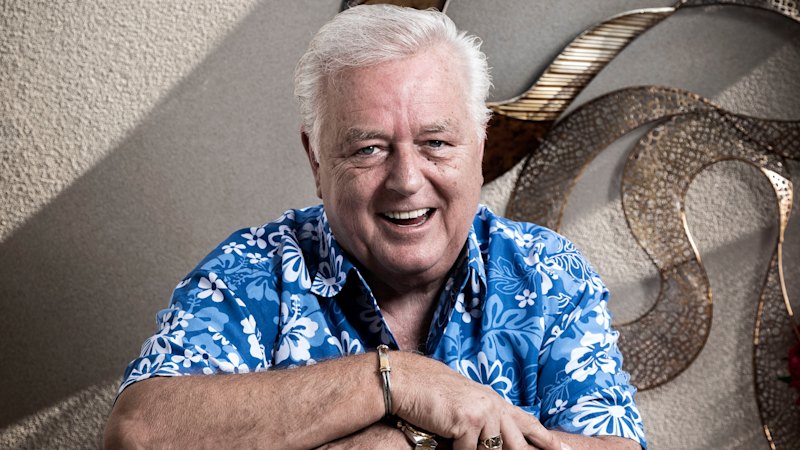
Johnny Young had three distinct – but related – claims to fame. First, he was one of Australia’s most popular teen idols of the 1960s. Years later, he co-produced and hosted the much-loved television show Young Talent Time, preparing teenagers for stardom, from Jamie Redfern to Tina Arena and Dannii Minogue.
In between, he was a successful songwriter, the composer of Smiley and The Real Thing. To many, however, his signature song was a slow rendition of the Lennon-McCartney song All My Loving, with which he would close each episode of Young Talent Time as the young singing-and-dancing cast swayed and hummed in accompaniment. For two generations of Australians, the song always belonged more to Young than to the Beatles.
Young died aged 79 following a brief battle with pancreatic cancer, his family said in a statement released on Friday. “Johnny leaves behind his wife Marisha, sister Cornelia, daughters Anna and Fleur, son Craig (dec.), seven grandchildren, and two great-grandchildren.”
He was born in Rotterdam, in the Netherlands, on March 12, 1947, the youngest of four in the family of John and Anna de Jong. During World War II, John had been forced to work in an arms factory, and Johnny was born of an affair between Anna and a 17-year-old named John de Vries (which Young did not discover until he was 12).
The family settled in Australia after the war, and he was raised in the Perth suburb of Kalamunda.
He left home in his teens. After working as a department store clerk, and a trainee radio disc jockey, he became the compere of Club 17, a Perth music show, in 1965 (quickly releasing the songs Club 17 and Go Johnny Go). In 1966 he signed with the Clarion record label and formed a backup band, Kompany.
Through Club 17, Young met the touring Sydney band, the Easybeats, at the peak of their fame. Offering to write him a hit, the Easybeats’ George Young and Stevie Wright sat down and quickly wrote the bouncy Step Back. Backed by a cover of Cara-Lyn – a rudimentary soft-rock song by US band the Strangeloves – it would be the year’s best-selling single in Australia, and the most popular Australian song since Slim Dusty’s A Pub with no Beer in 1958.
Briefly, Johnny Young and Kompany were the nation’s hottest band, scoring further hits with Let It be Me and a cover of the Everly Brothers’ When will I be Loved? Young then went solo – a decision he later blamed on ego. He replaced Ian Turpie as host of the pop TV series The Go! Show, winning his first Logie, and had a few more hits (including All My Loving). Like many other Australian acts, he was lured to the bright lights of England, leaving Sydney with a farewell concert in which he was supported by many top local bands.
Living in a London apartment with the Bee Gees, fellow refugees, he failed to impress in the UK music scene, despite recording the cute, Barry Gibb-penned Craise Finton Kirk. The truth was dawning on him. “This business is full of former pop singers who don’t know anything else,” he said in 1967, “and when they get a bit old, they haven’t got anywhere to go. I don’t want to be like that.”
He returned to Australia in 1968, a has-been at the of age 23, and became a drive-time DJ for 3XY Melbourne. Though his pop-star days were behind him, he reinvented himself as a songwriter, offering The Girl that I Love (the kind of sweet song that Young himself would have recorded) to Russell Morris, former lead singer of Melbourne band Somebody’s Image, who had also gone solo. Morris didn’t like the song and asked for something else, so Young nervously played him The Real Thing, an unfinished song that he had hoped to record himself.
As produced by Russell’s manager, Ian ‘Molly’ Meldrum, The Real Thing became a seven-minute psychedelic masterpiece. Though Young had written it as a cynical reaction to the new Coca-Cola slogan, it was adored by the Woodstock-era crowd, and was Australia’s top-selling song of 1969.
Young would write other hits: the dark – and semi-autobiographical – The Star (recorded by Ross D. Wyllie, and covered by British band Herman’s Hermits as Here Comes the Star); I Thank You, a hit for world champion boxer Lionel Rose; and Ronnie Burns’ anti-Vietnam ballad Smiley. As Young would confirm, some years later, this was about his friend and fellow pop idol Normie Rowe. “He came back from the war and the kid was gone, just gone. It was about the innocents who went to war and came back lost.”
At the same time, he developed Young Talent Time, which premiered in July 1971 on Channel Ten. Planned as a fill-in, the series would last for 18 years, in which time Young would mentor 42 children to become the Young Talent Team.
The alumni would include Debbie Byrne, Philip Gould, Jane Scali, Tina Arena and Karen Knowles. It would make Dannii Minogue a celebrity at 11, well before anyone had heard of her older sister Kylie. “The show is wholesome, clean and good fun,” Young told TV Week. “It proves there is room on television for talented youngsters performing in an adult setting.” In 1977, he started the Johnny Young Talent School, in the Melbourne suburb of Richmond.