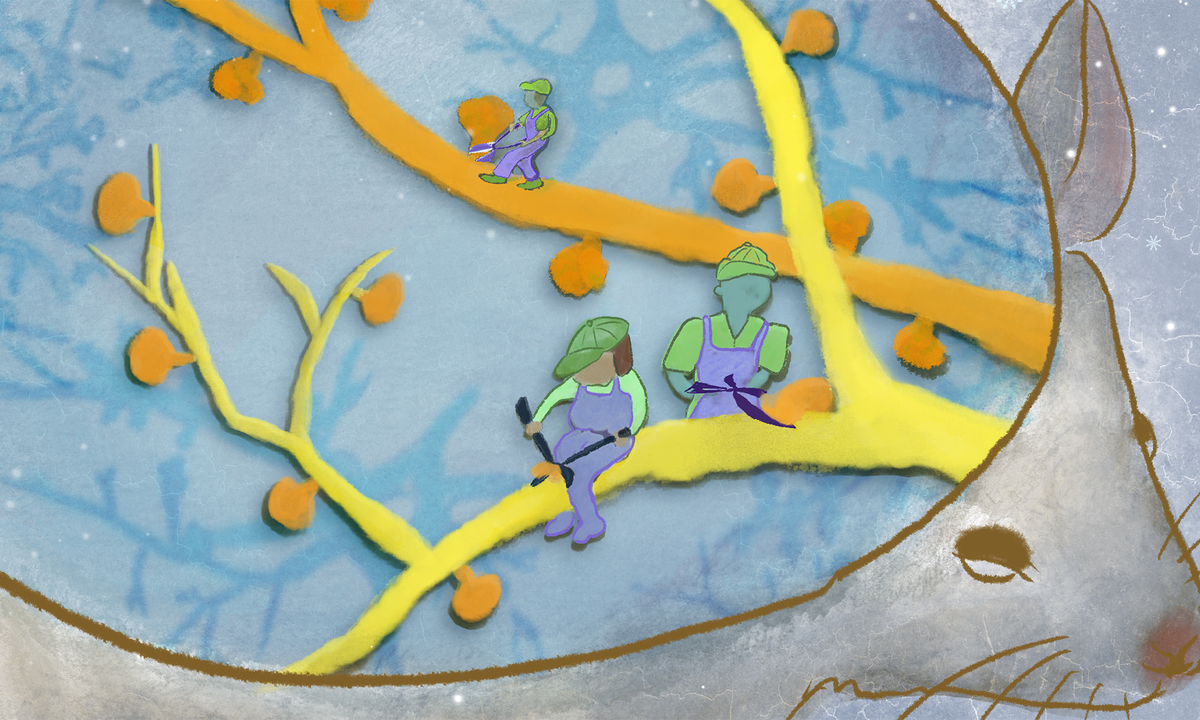
A new study induced artificial hibernation in lab mice and may have revealed something fundamental about the nature of memory.
When you purchase through links on our site, we may earn an affiliate commission. Here’s how it works.
Long-term memories may not "stick" in the brain for the reasons we thought, a study of mice in artificial hibernation reveals.
Instead of relying on many individual, strong links between neurons — which would typically be pared down during hibernation — long-lasting memories seem to require higher-level patterns in connectivity, the study found.
"This topological architecture of the broader network seems to be more important" than individual, sturdy connections, said study co-author Kazumasa Tanaka, head of the Memory Research Unit at the Okinawa Institute of Science and Technology.
The findings, published Thursday (Aug. 13) in the journal Science, may complicate the picture of how memory retention works.
Tanaka and colleagues used hibernation to study memory because past studies of hibernating animals have found that their brains shrink and pare down cell-to-cell connections during these extended periods of low metabolic activity. At the same time, the brain's activity slows to a crawl, and the loss of connections is thought to be related to this energy-saving mechanism.
Despite this brain shrinkage, hibernating animals, such as alpine marmots (Marmota marmota) and European ground squirrels (Spermophilus citellus), still retain memories they formed before they went into hibernation. "Some studies report their memories are intact, even after, so they can remember conspecifics [members of the same species], like their friends, or they can remember the locations of their food," Tanaka told Live Science.
The new study aimed to tackle the question of what allows those memories to stick around even after many connections between brain cells disappear.
Get the world’s most fascinating discoveries delivered straight to your inbox.
A central dogma of neuroscience holds that memories are made when connections between neurons grow stronger.
Through a process called long-term potentiation (LTP), neurons that send frequent chemical messages to their neighbors start to release more of those signals. In turn, their neighbors grow more sensitive to the signals by increasing their number of receptors and the size of their dendritic spines — the physical structures that receive inputs from other neurons. Ultimately, LTP forges a strong bond at the point where two neurons meet, called the synapse.
An old adage in neuroscience sums up the idea: "Neurons that fire together, wire together."
A typical synapse (left) where one brain cell connects to another (the axon of one connecting to the dendrites of the other). Each dendrite is covered in tiny protrusions called dendritic spines, which detect signals released from axons. When a particular synapse is very active, it can lead to physical changes (right).
"I don't think our study argues against this LTP hypothesis," Tanaka said, noting that many studies support the idea that LTP is critical for the brain to forge new memories. However, when it comes to holding on to memories over time, LTP may not be the most essential ingredient.