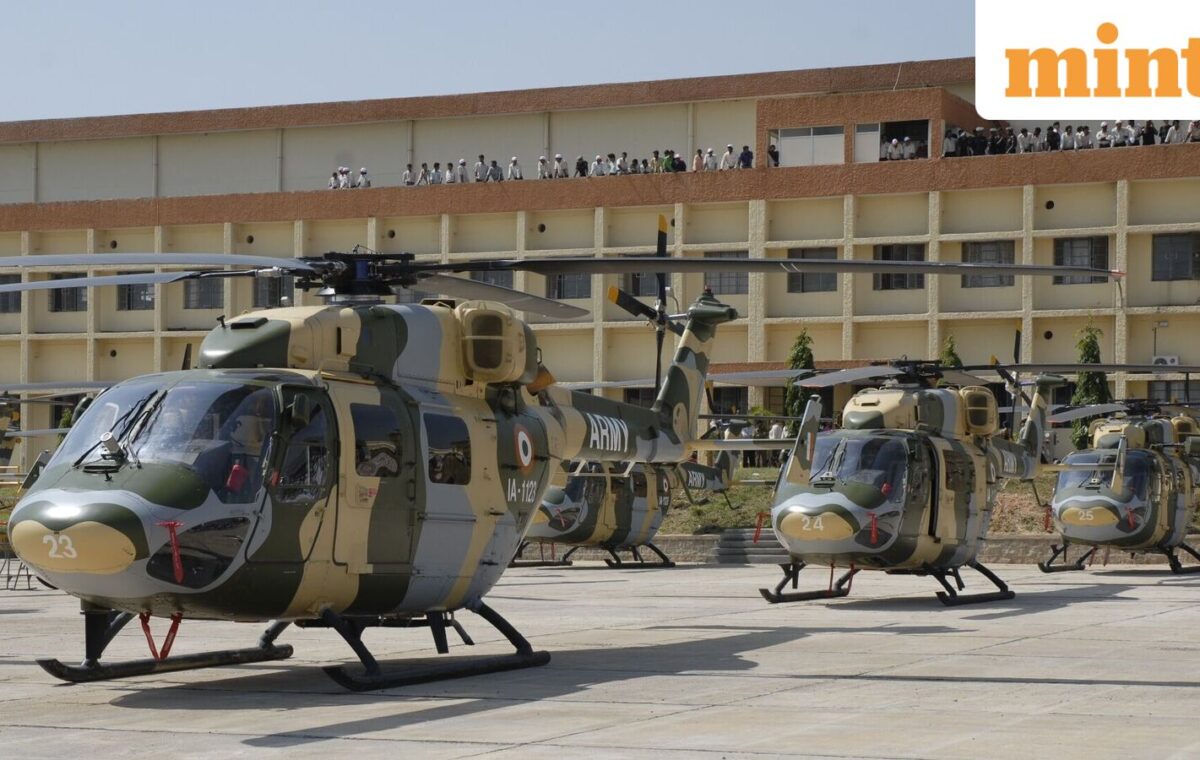
Hindustan Aeronautics Ltd’s improving revenue growth trajectory is driving investor confidence. In the June quarter (Q1FY27), standalone revenue grew 14% year-on-year to ₹5,515 crore, beating analysts’ expectations. The improvement reflects a pick-up in execution and was in line with the company’s FY27 revenue growth guidance of 10-12%, shared during its March-quarter earnings call last year. Much of the company's prospects now hinge on the slated deliveries of its much-awaited light combat aircraft, Tejas.
The Q1FY26 number compares with mere 2% growth in Q4FY26 and 7% in FY26. Despite a notable increase in raw material costs, earnings before interest, taxes, depreciation, and amortization (Ebitda) rose 19% year-on-year to ₹1,530 crore, as other costs declined. The stock had hit a 52-week high of ₹5,055 on Wednesday, but gave up some gains on Thursday at ₹4,990.
To sustain the Q1 revenue growth, the state-owned aerospace and defence company is pinning its hopes on the delivery of its Tejas MK1A and HTT-40, an indigenously developed training aircraft. Tejas, which had suffered a crash at the Dubai air show in November, is undergoing testing for certain refinements, and the first delivery is now likely in the latter half of the fiscal. HAL has orders to deliver 180 Tejas aircraft, worth about ₹1.1 trillion.
Besides the technical issues, HAL also faced initial delays in engine delivery from GE Aerospace, but 15-20 are expected to be delivered in FY27. In FY26, it received six engines.
“HAL has already built more than 20 airframes for the LCA Tejas Mk1A, which can be quickly completed upon receiving the engines,” noted Nomura Global Markets Research, projecting deliveries of 6, 16 and 20 aircraft in FY27, FY28 and FY29. HAL's current annual production capacity is 24 units, and it plans to raise it to 30.
The government is seeing significant traction with the government thrust on modernization and indigenization of India’s defence fleet. It has guided for orders worth ₹90,000 crore annually for FY27 and FY28, including ₹20,000 crore of orders for repair and overhaul (ROH). Among the major orders expected during FY27 are 140 advanced light helicopter and 40 Dornier aircraft.
Antique Stock Broking estimates an addressable pipeline of ₹4.5 trillion over the next four to five years. “We believe that HAL, with its long-term business outlook and strong execution capabilities, is well on track to report 17% revenue CAGR over FY26-29,” it added.
The momentum in orders reflects in HAL’s total order book position, which, at ₹2.54 trillion at the end of FY26, is 7.5 times the trailing 12 months’ sales, against three times at the end of FY24.
To meet the timelines for various large ticket orders and expanding ROH facilities, HAL has outlined capital expenditure plan of Rs14,000 crore, to be spent over the next five years.
However, HAL also sees significant variation in its gross margin because of the lumpy nature of deliveries. In Q1, the gross margin slid 280 basis points year-on-year to 65.3%, but it was better than the 54% reported in the previous quarter. Ebitda margin at 27.7% was notably short of the guided 30-31% for FY27, but this is seen improving with the Tejas deliveries.
HAL's stock has risen 45% from its 52-week low of ₹3,487.20 on 30 March, and is trading at 29.3x its 1-year forward earning per share, higher than the long-term average of about 26x, showed Bloomberg data.
Citi Research noted that Tejas LCA deliveries could trigger a re-rating by removing a key overhang and next two years’ order pipeline is being led by platforms where execution can be faster. Execution visibility is improving as GE engine supplies normalize, with HAL set to produce 24 aircraft annually. Overall, the pace of approvals remains crucial.
Ashish Agrawal has been associated with Mint for the last two years and writes for the ‘Mark to Market’ column. He has done his master’s in business administration from IIM Calcutta, specialising in finance and operations. His previous experience includes stints with The Economic Times and JSW Steel, among others. He has over 15 years of experience in stock market research, analysis and writing, and has covered sectors such as metals and mining, oil and gas, power (including renewables), capital goods (including electronics).<br><br>Ashish is passionate about infrastructure sectors, which, he believes, are the strands that lift the entire economy. He was invited for a visit to France, by the Government of France, in recognition of his coverage of issues related to nuclear power. Besides, Ashish has considerable understanding of the Indian and global economy and is the author of a book, “Indian Economy & Business: Overview of Recent Trends & Events”. As a part of the enterprise risk management team at JSW Steel, he had conceptualised, proposed and developed a Risk Index for the enterprise to quantify and monitor all the risk factors, and take mitigating action as needed.
Catch all the Business News , Market News , Breaking News Events and Latest News Updates on Live Mint. Download The Mint News App to get Daily Market Updates.