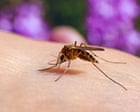
Dress like a zebra, wash your feet, keep off the beer: insect experts explain what works and what doesn’t – and why some of us get bitten more than others
It’s a good time to be a mosquito or other blood-sucking insect. In the UK and beyond, they are enjoying the summer heat, and there are lots of humans outdoors, some wearing very little, like an all-you-can-eat walking buffet. Some of the humans are drinking beer, which apparently makes them even more irresistible to mosquitoes. Many of us are warm and sweaty, which is all the better for the blood-suckers seeking us out.
Insect populations are changing because of the warming climate and there are organisations keeping an eye on invasive species, especially mosquitoes, which can be vectors for diseases such as dengue and malaria (globally, more than 600,000 people a year die from malaria). The UK “will have a threat from mosquito-borne diseases as time goes on,” says James Logan, professor of medical entomology at the London School of Hygiene and Tropical Medicine, and CEO of Dot, an “odour intelligence” company. “The biggest threats are arboviruses [viruses transmitted by arthropods, especially insects and ticks], such as dengue. We have mosquitoes throughout [mainland] Europe now that can transmit dengue. We also know that we do get those mosquitoes coming across to the UK, but they don’t seem to be breeding here successfully and surviving over the winter.” But, he warns, with milder winters and warmer summers, it is only a matter of time.
For now, mosquitoes – along with midges, ticks, horseflies and any number of blood-sucking insects – are a nuisance. Here’s how to survive the summer with them.
It will probably be female. With most blood-sucking flying beasties, such as mosquitoes and midges, the males flit around, feeding on flower nectar for energy. The females, though, need a blood meal (we refer to it as a “bite”, but she essentially drills into you and sucks your blood). “Blood contains a lot of protein, and they use that to produce eggs,” says Logan.
They are attracted to the carbon dioxide you breathe out, which they catch downwind. “It activates them and they begin to fly upwind,” says Jennifer Mordue, an entomologist and emeritus professor at the University of Aberdeen, of midges and the other flying blood-sucking insects. “If they lose it, they begin to cast sideways until they hit it again. It’s a conditioned response to find those odours, and then as soon as they are a bit closer, they will be picking up other odours from the source.”
Don’t think you can outwit them by holding your breath – you also release some carbon dioxide through your skin.
Many blood-feeding flies, such as horseflies, are attracted to big shapes, movement and heat. “We’re quite large objects walking around the countryside,” says Erica McAlister, principal curator for diptera and siphonaptera (flies and fleas) at the Natural History Museum in London. “If you think of what they usually go for – large vertebrates – they are attracted to dark large objects.”
Contrasting colour can also catch their attention. A white T-shirt against a pair of black shorts, for example, may pique their interest. “Light-coloured clothing is probably the better option,” says Logan. And, he adds, it means you are more likely to spot a mosquito landing on you.
Ticks – which are not insects, but arachnids, like spiders and scorpions – are also attracted to carbon dioxide, sweat and body smells, as well as heat and movement, but seem to be largely opportunistic, waiting for a human or other animal to come close enough for them to hop on.
Much of the research about this has been focused on mosquitoes, and it is mainly to do with the way you smell. “We all smell differently, and mosquitoes can pick up on that,” says Logan. “That tends to be what drives their behaviour,” he says, and it is what makes one person more attractive than another. Our smell can be affected by hygiene and diet, but a lot of it is genetic. “We know that identical twins will be bitten about the same amount as each other, but non-identical twins will be bitten different amounts,” says Logan.
It has been suggested that blood type can make a difference. “Some papers have shown that there may be something to do with blood type, or that mosquitoes can breed better when they feed on certain blood types,” says Logan. “But the evidence is scarce.”
Mordue studied midges and who they are attracted to. They are also lured by smell. “About 300 different chemicals come off our skin all the time, our own individual components. We discovered that there are a few compounds that are attractive to them, and some that are not.”
There is evidence to suggest that larger, taller people (therefore, usually, men) tend to be more of a target. “But, of course, you do get smaller people where the odour is more important,” says Logan. “Odour certainly is the strongest driver.”
Not really, says Mordue. “It has nothing to do with eating garlic or these things that you hear. There may be some evidence that your smell changes with menopause, but I don’t think that is very strong. So, really, you are what you are in terms of these compounds.” Logan has heard the myths – taking brewer’s yeast tablets, eating Marmite, drinking gin and tonic – but says: “None of that stuff works well.” There is some evidence that drinking beer can make you more attractive to mosquitoes. Logan says this may be to do with beer altering your smell – the compounds on your breath or skin – but, he adds: “It could just be that when you’re drinking alcohol, your body temperature tends to go up a bit. That might make you sweat more.”