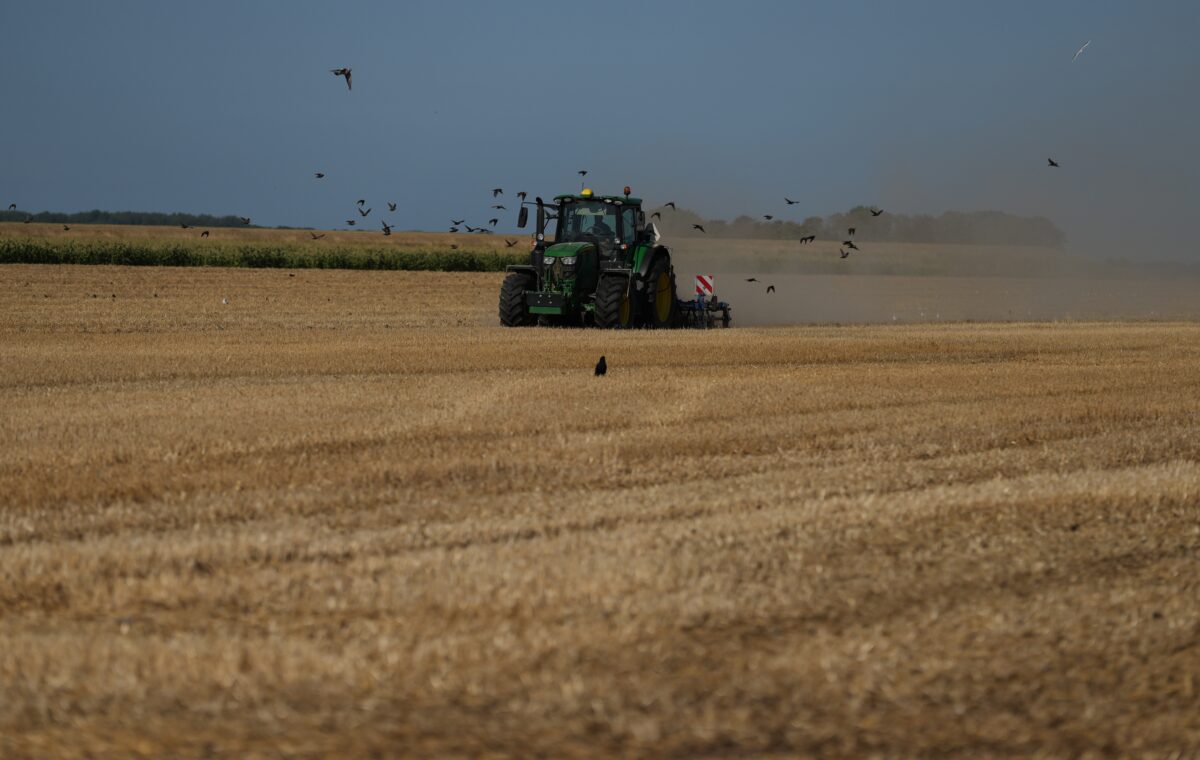
WOLPHAARTSDIJK, Netherlands (AP) — A cloud of dust billows behind Maarten Janse's tractor as he spreads a mixture of compost, straw and manure over a field to nourish the parched soil.
Janse's farm on the fertile land of the Netherlands' southwestern Zeeland Province is drying out despite his efforts to make it more drought resistant as accelerated human-caused global warming and a supersized El Nino batter fields across Europe.
The drought that is roasting much of Europe this summer is taking a heavy toll on crops across the continent, from potatoes in the Netherlands to corn in Bosnia and grapes in Italy. Even when farmers try to adapt, the extreme weather is hitting their crops and water supplies.
Triodos, a Dutch bank that has a focus on sustainability, published an analysis this week that estimated the heatwaves and drought could reduce gross domestic product across the European Union by 1% for 2026 or around 180 billion euros ($208 billion). Farmers are among the hardest hit, with their crops set to be badly affected by soaring temperatures and lack of water. In large parts of the Netherlands, farmers are no longer allowed to use water from streams and drainage channels to irrigate fields and orchards.
Another farmer in Zeeland, Hendrik Jan ten Cate, looks at a field full of withered potato plants that are almost all ready for harvest — a month early and with a significantly reduced crop. His potatoes are used to make French fries for companies including McDonald's, but they're likely going to be too small this year.
"People want long fries," he says as he holds one of the potatoes. "That's going to be tough this year."
Ten Cate is one of the lucky farmers because he is allowed to irrigate his crops. But, even so, he estimates his harvest this year will be down by about one-third compared to average years.
"It's not just the drought that is the problem," he says. "It is also the sun, the dry air and especially the hot days we have had this year. The potatoes just can't handle that combination very well."
In Bosnia, where agriculture contributes roughly 5% of annual GDP and 10% of all employment, grain farmer Slavisa Lukic stood in one of his corn fields as stalks blew limply in the breeze. His crops have been hit by repeated heat waves and drought conditions. He said this year's corn yield would be very poor, if he manages to harvest one at all.
Lukic remembers when he grew 6 to 7 tons per hectare on his farm. He expects this year's corn yield will be around 1.5 to 2 tons per hectare.
Pointing to the drought-stricken land in northeastern Bosnia, Lukic said clover fields that once grew abundantly have all but disappeared. "Now they literally do not exist," he said. "Nothing."
The drought is even hitting one of the Czech Republic's most famous products: beer.
Plzeňský Prazdroj, the country's largest beer producer, expects to incur losses this year due to a stunted hops yield.
Jakub Zaoral, the brewer's sustainability manager, said that changes in rainfall patterns – characterized by long periods of dryness with occasional heavy storms – mean that when rain does fall, it runs off the dry soil. That results in inconsistent yields and increasingly low groundwater levels.
"There's no choice but to simply accept the fact that one year will be great and the next won't be," he said. "If it were to happen three times in a row, that could very well become an existential problem for hop growers."