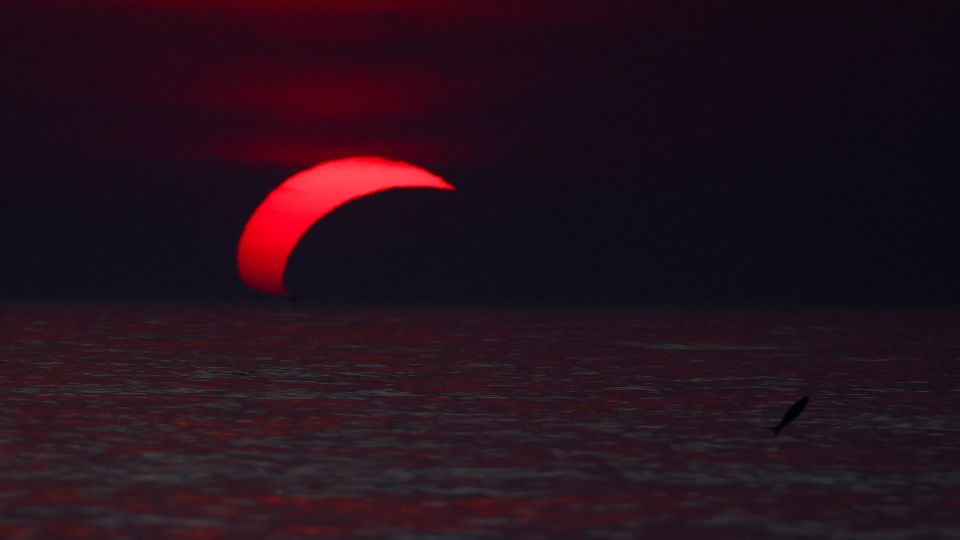
The grand stellar spectacle of the year — a total solar eclipse — dazzled the skies over parts of Europe on Wednesday.
A total solar eclipse occurs when the moon moves between the sun and Earth, casting a shadow on our planet that completely blocks the sun's light from some areas of the world, according to NASA.
Prime viewing locations in parts of Iceland, northern Spain and a small corner of northeastern Portugal were in the path of totality, or the areas of Earth where the skies grew momentarily dark as the sun completely disappeared from view — creating a rare sunset eclipse for some, especially observers in Spain.
Meanwhile, a partial eclipse, in which only some of the sun's light is blocked from view, passed over the northern US, Canada, much of Europe and northwestern Africa.
When viewing an eclipse, it's important to remember to wear certified eclipse glasses or use a handheld solar viewer to protect your vision any time the sun's light is on display before, during or after the eclipse, and follow these safety tips to protect your vision.
For those who live outside the eclipse's path, the European Space Agency shared a livestream of totality from Spain's Astrophysical Observatory of Javalambre in Teruel. NASA also hosted a live broadcast sharing views from across the path beginning at 1:15 p.m. ET.
The "diamond ring" effect appears as the moon moves across the sun during a total solar eclipse, as seen from El Arenal beach in Mallorca, Spain, on Wednesday. – Francisco Ubilla/Reuters
The excitement kicked off in a remote part of northern Russia where totality occurred midday local time. Sky-gazers in Greenland and Iceland experienced the longest duration of totality — about 2 minutes and 15 seconds — in the late afternoon and early evening.
But Spain and the northeastern tip of Portugal witnessed a rare spectacle as totality, which lasted just under 2 minutes, occurred right before sunset. In León, totality began at 8:28 p.m. local time and ended at 8:30 p.m.
Dr. Ryan French, solar astrophysicist at the Laboratory for Atmospheric and Space Physics in Boulder, Colorado, and coauthor of "Little Book of Eclipses," planned to stay a few hours north of Madrid where totality was expected to last for 1 minute and 45 seconds. He opted for a shorter eclipse experience with the likelihood of less cloud cover.
"For pretty much the entirety of Spain, by the time the sun sets sort of over the horizon, the total eclipse will have happened, but the sun will set in a partial eclipse, a beautiful sight seeing the sun set as a crescent sun," French said prior to the event.
And just as the eclipse excitement subsides, one of the best meteor showers of the year, the Perseids, will peak between Wednesday night and Thursday morning. NASA will host a live watch party with experts on YouTube beginning at 12 a.m. ET on Thursday.
Sky-gazers use solar eclipse viewing glasses during a partial solar eclipse on the beach in Nice, France, on Wednesday. – Valery Hache/AFP/Getty Images
For those living outside of the path of totality, a crescent-shaped partial eclipse, rather than a total eclipse, was the main event.
The amount of exposed sunlight depended on how close viewers live to the path of totality. For example, people in the US only saw a small part of the sun covered by the moon, while Europe and northwestern Africa experienced a more dramatic cloaking of much of the sun, according to NASA.