DapuStor's new 512TB monster wants to swallow your entire server rack
When you purchase through links on our site, we may earn an affiliate commission. Here’s how it works.
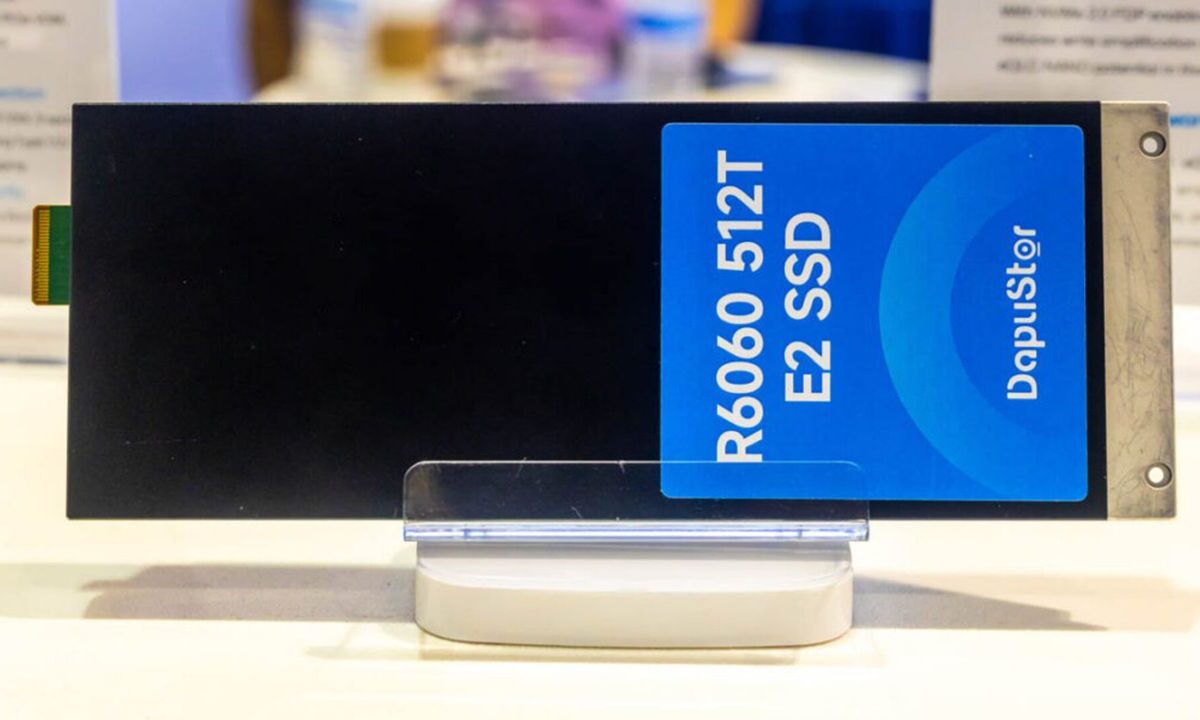
DapuStor has unveiled a massive 512TB NVMe SSD at the FMS 2026 storage trade show event, pushing enterprise storage capacity into half-petabyte territory for demanding data center applications.
The drive, officially named the R6060, belongs to the company's high-capacity family and uses its newer E2 form factor design for enterprise storage systems.
At 512TB, the R6060 holds exactly twice the storage capacity of E3.S or U.2 drives, which top out near 256TB.
The 512TB SSD belongs to DapuStor’s high-capacity NVMe family and measures approximately 200 × 76 × 9.5 mm, giving it substantial capacity within a relatively compact enterprise storage form factor for NAND placements, allowing manufacturers to pack substantially more flash memory inside each device.
The drive pairs DapuStor's in-house DP800 controller with PCIe 5.0 connectivity and the newer NVMe 2.0 protocol standard used industry-wide.
DapuStor uses QLC NAND because modern workloads increasingly require huge storage capacity rather than maximum performance from every individual drive.
Artificial intelligence workloads require large repositories for training datasets, while inference systems can also generate substantial demand for high-capacity cache storage.
Sign up to the TechRadar Pro newsletter to get all the top news, opinion, features and guidance your business needs to succeed!
Video, audio, and other rapidly expanding datasets are creating similar demands, making high-capacity drives increasingly useful for data centers managing enormous volumes of information.
A server equipped with 36 E2 drive bays could theoretically accommodate 16PB of raw storage using these 512TB drives.
That density could reduce the number of servers, processors, memory modules, and networking components required for certain storage-heavy deployments.
The approach is particularly relevant to systems designed around 1PB and beyond, where physical infrastructure can become substantial.
The E2 approach can add more storage capacity to a single-CPU or dual-CPU server, potentially reducing overall system requirements.