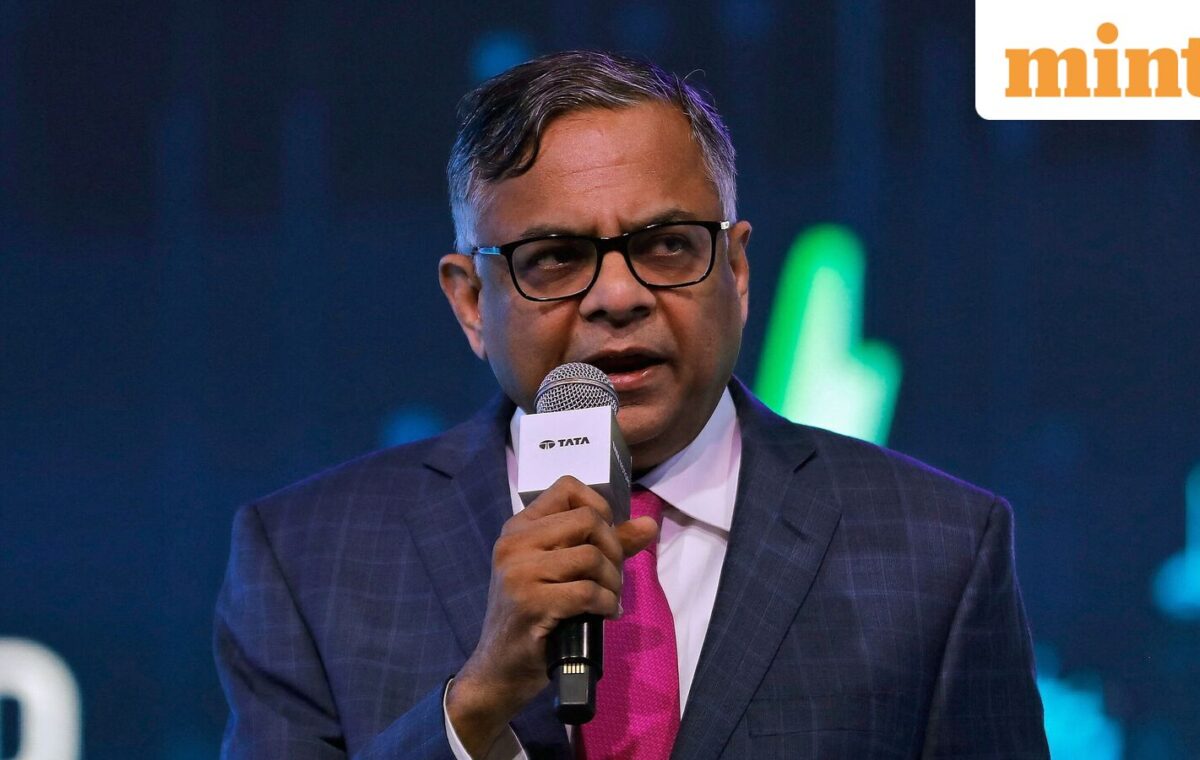
Natarajan Chandrasekaran’s term as chair of Tata Sons has been a tale of two halves, with the Tata Group delivering a robust performance during his first term, and external challenges and the underperformance of private businesses catching up with India’s largest conglomerate in the second.
During his first five-year term ended February 2022, Tata Group marquee companies such as Tata Consultancy Services (TCS) and Tata Steel delivered strong financial returns, successfully tiding over the covid-19 pandemic.
TCS continued to deliver record profits each year, maintaining its pole position in India’s technology services sector. Tata Steel delivered its highest-ever profit in FY22, overtaking even TCS, the group’s biggest cash generator. Tata Motors scripted a historic turnaround, rising from being a fringe player to finding a podium place on India’s car sales charts in subsequent years.
Even within private businesses, the Tata Group made early inroads into e-commerce, with Tata Digital launching its ambitious super-app Tata Neu towards the end of Chandra’s first term.
However, a string of challenges hit the group during Chandrasekaran's second term slated to end in February 2027. TCS reported its first-ever revenue decline since listing in 2004 and was forced to let go of over 12,000 employees over the past year, as artificial intelligence threatens to upend the IT business.
Tata Motors continued its upward journey, successfully splitting its business into specialized passenger and commercial vehicle units. But its subsidiary Jaguar Land Rover faced multiple setbacks, including a cyberattack that suspended its production lines, a botched relaunch of the Jaguar brand, and declining sales in key markets. Tata Steel, too, faced persistent losses in Europe, offsetting the company’s performance in India.
These issues were on top of external challenges such as wars, tariffs, and supply chain disruptions, including semiconductor shortages and China’s export restrictions on rare-earth magnets.
“Chandra has done well as the chairman, giving balanced performance across the group and its constituencies. This is especially so in the first term,” said Kavil Ramachandran, professor of entrepreneurship (practice) at the Indian School of Business, Hyderabad. His second term was, however, mixed with external geopolitical and technological challenges, adding to his woes on the business front, he said.
“In short, I would rate him as a very successful leader, who could perhaps have handled some situations better. Some of the internal management challenges in group companies such as Air India could have been handled better,” he said.
The market capitalization of the group’s listed companies shows this more clearly. Between March 2017 and March 2022, the valuation of its listed companies surged three-fold to ₹23.2 trillion, growing at twice the pace of benchmark Sensex. But in the subsequent four years, it moved barely 4% to ₹24 trillion, far slower than the 23% growth in Sensex over this period.
On the private side of the business, losses mounted, nearly doubling year-on-year to ₹27,854 crore during the year ended 31 March 2026. The four new businesses that Tata Sons entered into under Chandrasekaran—Air India, Tata Digital, Tata Electronics, and Agratas—accounted for the lion’s share of the losses as they remain in their growth stage, requiring significant capital investment.
Air India’s losses more than doubled to ₹22,238 crore as the carrier had one of its worst-ever years, with a deadly air crash and a surge in fuel costs due to the war in Iran. Tata Digital was the next big loss accumulator, as neither its super-app nor its e-commerce bets, such as BigBasket and 1mg, saw significant consumer traction.
In fact, the losses at the private businesses were a key hurdle that kept the Tata Sons board from unanimously granting Chandrasekaran a third term in February this year. Noel Tata, the chair of Tata Trusts, which owns 65.9% of Tata Sons, had cited the continued losses in the new businesses and the lack of a roadmap for these businesses at the 24 February board meeting.
A key milestone under Chandrasekaran’s watch was the group going debt-free: from the ₹20,839 crore in bank borrowings at the end of March 2017, it now has zero borrowings.
The group cut its standalone debt primarily to avoid being listed under a Reserve Bank of India (RBI) guideline, as loans from financial institutions are among the metrics the regulator assessed in the past when classifying upper-layer non-bank lenders such as Tata Sons. For now, Tata Sons’ application to surrender its licence as a core investment company remains pending with the Reserve Bank of India.