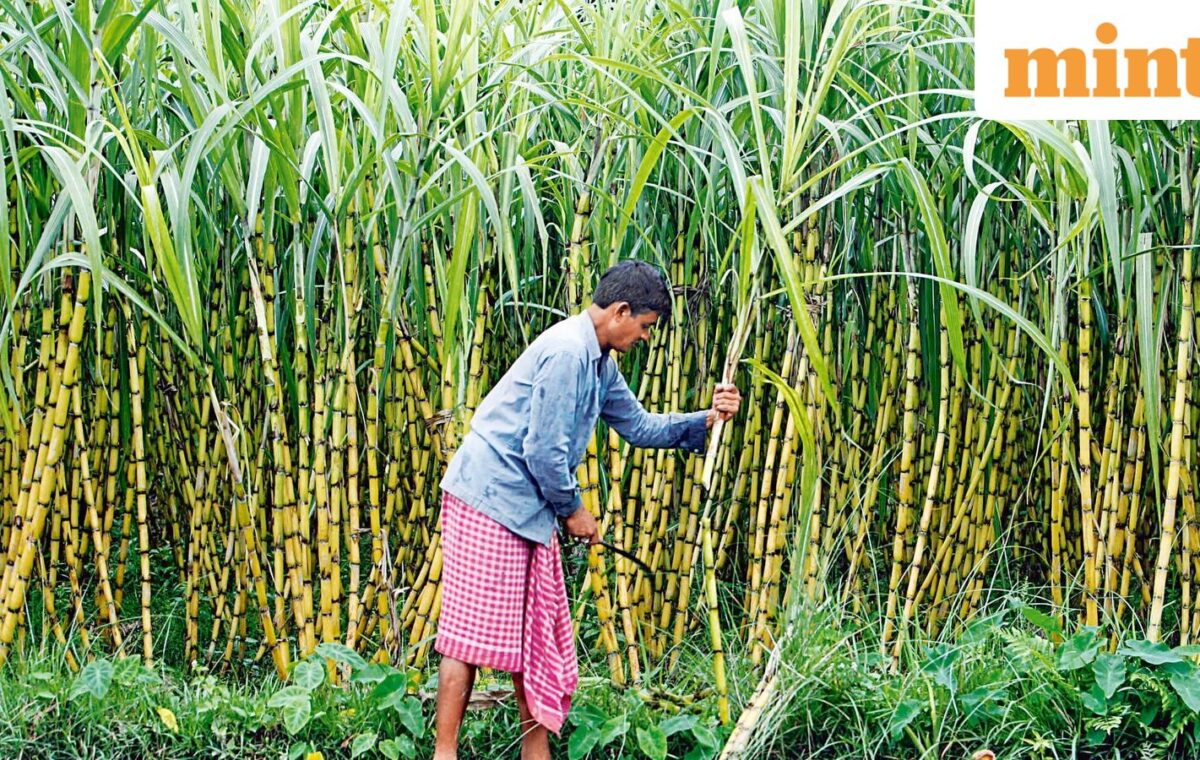
The sugar industry has proposed to the Centre that the 2026-27 sugar season commence nearly 15 days earlier than the normal schedule.
The demand to advance the sugarcane crushing season, which normally begins on 1 October, aims to increase volume in the domestic market in the run-up to the festival season, which in turn will help ease supply and prices. Mint explains:
The Indian Sugar & Bio-energy Manufacturers Association (ISMA) and National Federation of Cooperative Sugar Factories Ltd (NFCSF) have proposed commencing the 2026-27 sugar season nearly 10-15 days earlier than the normal schedule, subject to prevailing agro-climatic conditions.
India’s sugarcane crushing season traditionally begins on 1 October. However, last year, crushing was delayed in several major producing states due to prolonged monsoon and post-monsoon rains. For example, the Maharashtra government set 1 November as the official start date, citing waterlogging and delayed harvesting due to heavy rains, while mills in Uttar Pradesh began operations on 4 November.
The early commencement of crushing is expected to bring fresh sugar to the market sooner, particularly ahead of the festive season, helping ease supply concerns and support price stability without imposing an undue burden on consumers.
Sugar prices have already risen amid concerns over limited supplies, increasing 6.5% over the past month to ₹50.7 per kg as of 11 August, according to consumer ministry data.
While the move is intended to serve the broader public interest, it could have significant operational and financial implications for sugar mills. An early start to crushing could lead to lower sugar recovery and cane yields, potentially affecting mills’ operational efficiency and profitability, according to the ISMA.
There are around 550 sugar mills in the country, including mills in the private, public and cooperative sectors. Sugarcane crushed before it reaches full maturity may contain lower sucrose levels, reducing the quantity of sugar recovered from each tonne of cane. Early harvesting could also affect cane yields if agro-climatic conditions are not favourable.
The ISMA and NFCSF have requested that the government consider appropriate support measures to partially offset the losses associated with the early commencement of crushing, including compensation for recovery losses.
Sugarcane acreage stood at 5.83 million hectares as of 7 August, down 31,000 hectares from 5.86 million hectares during the corresponding period last year, according to government data. In 2025, the total acreage stood at 5.88 million hectares during the kharif season.
The major decrease in area has been reported in Uttarakhand, Maharashtra, Punjab, Madhya Pradesh, Bihar, Gujarat, Odisha, and Tamil Nadu. Higher area coverage has been reported in Uttar Pradesh, Haryana, Assam, Telangana, Chhattisgarh and Arunachal Pradesh.
The marginal fall in sugarcane area may have implications for sugar output and cane availability for mills, although final production will also depend on yields, weather conditions, and the recovery rate during crushing.
The government has assured that adequate quantities of sugar are available in the country to meet domestic consumption requirements. The country's domestic sugar consumption is estimated at around 28-28.5 million tonnes annually.
According to estimates, institutional consumption such as food and beverage companies, hotels, restaurants and catering (HoReCa) and processed foods accounts for 60-65% of total demand, with the remaining share coming from households.
India is one of the world's largest sugar producers. According to the ISMA, sugar production in the 2025-26 sugar season is likely to touch 28 million tonnes.