Mahindra & Mahindra Ltd and external investors have put more than ₹2,200 crore into building Mahindra Last Mile Mobility (MLMM), helping it rapidly scale electric three-wheeler sales. The result: a unicorn whose revenue has more than doubled in two years and whose valuation has risen nearly fivefold since 2024.
The last-mile mobility business, carved out of Mahindra & Mahindra’s consolidated operations in 2023, is now valued at more than ₹10,000 crore, or $1 billion. The milestone comes as the Mahindra Group prepares to list the business in the second half of 2027.
A review of MLMM’s filings with the ministry of corporate affairs (MCA) since 2023 shows that parent Mahindra & Mahindra has invested about ₹900 crore in the business through equity infusions, while external investors including the India-Japan Fund (IJF), International Finance Corp. (IFC) and, most recently, Lightrock have invested a combined ₹1,322 crore.
The latest ₹322 crore funding round, announced on 30 July, led by Lightrock and joined by existing investors IFC and IJF, was struck at the valuation that took MLMM into unicorn territory.
Sameer Abhyankar, partner and head of India at Lightrock, told Mint that the company's rapid scaling has presented an attractive opportunity for investors. “MLMM is one of the leading operators boosted by the tailwind of three-wheeler electrification, backed by Mahindra's brand, distribution, financing, and scale.”
“The company has been built from the ground up by a high-quality management team into a significant player in electric three-wheelers, underpinned by a focused strategy and outstanding execution, a track record Lightrock sees as core to the investment case,” Abhyankar told Mint.
Krishna Kumar, partner and fund head – India-Japan Fund, NIIF, said the fund sees last-mile mobility as an important part of India’s transition towards cleaner transportation, commercial three-wheelers particularly so as they are well suited to electrification given their high utilisation and the economic benefits that electric vehicles can offer.
“We have backed a strong operating business with an established market position, a differentiated product portfolio and significant headroom for growth,” Kumar said.
“MLMM’s progress since our first investment in January 2024 reinforces our approach of identifying high-quality companies and partnering with them through their growth journey. Our recent follow-on investment further reflects our conviction in the business, its leadership position and the long-term opportunity in last-mile mobility,” he added
MLMM’s filings show the scale-up behind the valuation jump.
Revenue more than doubled from ₹2,367 crore in FY24 to ₹4,798 crore in fiscal year 2026 (FY26) as sales of electric three-wheelers and four-wheelers across cargo and passenger segments expanded. The company also sells internal-combustion-engine vehicles. Its major rivals include Bajaj Auto, TVS, Piaggio and Euler Motors, among others.
Net profit rose nearly sevenfold, from ₹26 crore in FY24 to ₹185 crore in FY26. The company said it sold 136,855 vehicles in FY26, up 26% from the previous year, with more than 100,000 of those sales coming from electric vehicles (EVs).
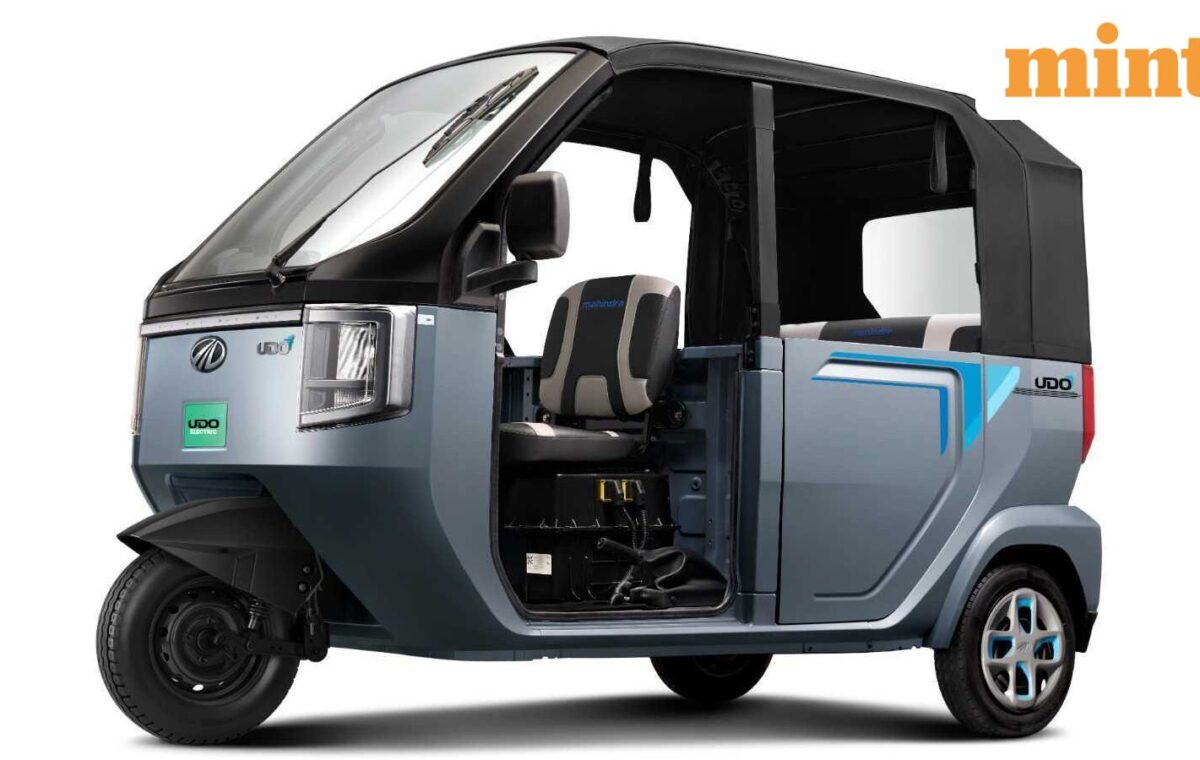
Profitability, however, moderated in FY26. Revenue rose from ₹3,783 crore in FY25 to ₹4,798 crore in FY26, while net profit fell from ₹246 crore to ₹185 crore. The decline came in a year when the company stepped up product activity, including the launch of UDO, which it described as a category-defining product in the L5M EV segment, as well as refreshes of Zor Grand Range+ and eAlfa Hard Top.
“During the year, your company launched UDO, a category-defining product in the L5M EV segment, offering best-in-class design, range and performance. Alongside, the Company introduced multiple product refreshes, including Zor Grand Range+ and eAlfa Hard Top, further strengthening its portfolio and value proposition to customers,” MLMM said in its board report for FY26, filed on 27 July.
Mahindra & Mahindra established MLMM in May 2023 to expand its presence in the rapidly growing electric three-wheeler market, carving the business out of its consolidated operations. Electric three-wheelers, including cargo three-wheelers, e-rickshaws and e-autos, accounted for 64% of the segment at the end of June, according to the Federation of Automobile Dealers Association.