Get the Popular Science daily newsletter💡
Breakthroughs, discoveries, and DIY tips sent six days a week.
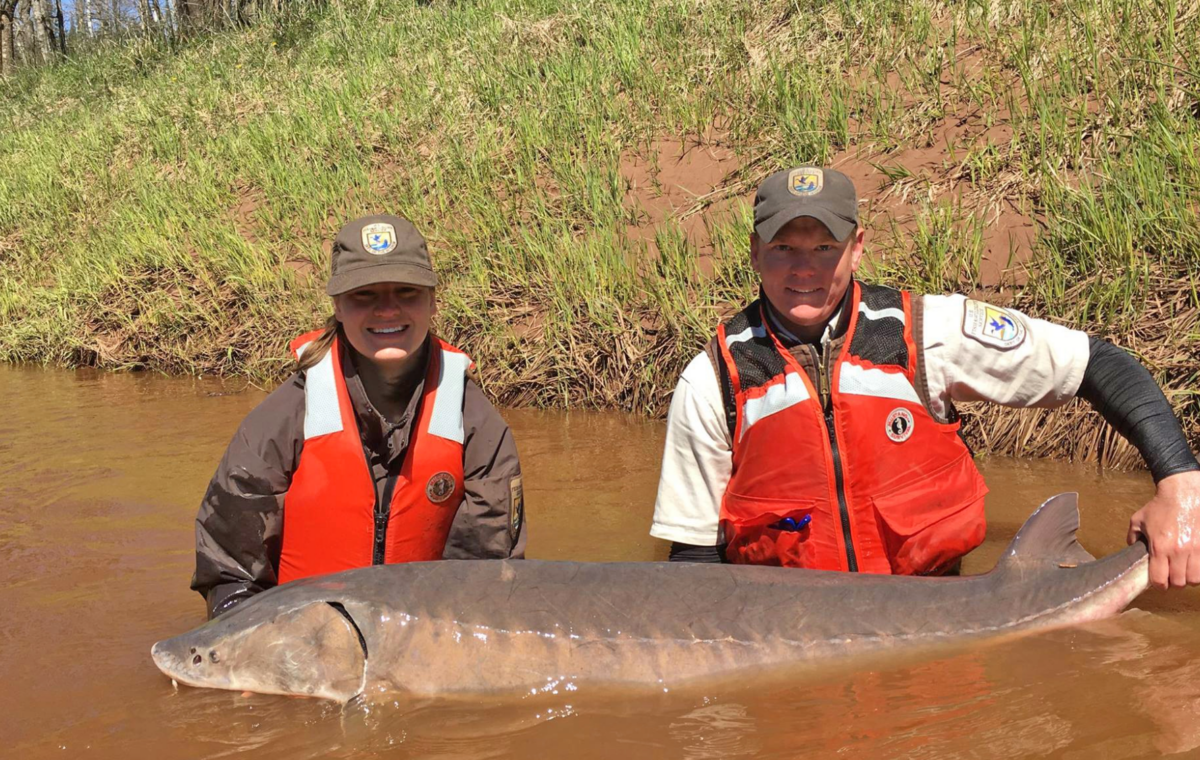
The six-foot long, 100-pound, and thunderously loud lake sturgeon (Acipenser fulvescens) skulking around the Great Lakes may live upwards of 200 to 300 years. A new study published in the Journal of Fish Biology from the Michigan Department of Natural Resources and Michigan State University puts them among North America’s oldest freshwater fish and brings their lifespan up to one of the poster fish for longevity, the Greenland shark (Somniosus microcephalus).
“Scientists have long recognized that lake sturgeon are among North America’s longest-lived freshwater fish,” Scott Colborne, assistant professor in Michigan State University’s Department of Fisheries and Wildlife, tells MSU Today. “But the new study suggests they may live far longer than previously appreciated. These fish are a living connection to history.”
For context, here a few of the historical events that some lake sturgeon swimming today may have been alive for:
Scientists typically estimate a lake sturgeon’s age by counting growth rings in fin spines. However, since these rings are increasingly difficult to interpret in older fish, researchers thought they may be underestimating the age of the oldest individuals.
To test this, Colborne and his team dove into one of the largest long-term datasets ever assembled for lake sturgeon. They analyzed the growth records from tagged sturgeon that had been measured repeatedly over several years, and developed a much more accurate picture of how slowly these ancient fish continue to grow over the course of their lives. They also applied the same mathematical models that estimate Greenland shark’s lifespan.
The data shows that many live for 200 years, with some getting close to 300.
Beyond adding another animal to the long-life club, these findings have important conservation implications. Since lake sturgeon mature slowly and reproduce infrequently, it can take decades to replace their population numbers. Better estimates of how long they live can help scientists more accurately understand their survival, population recovery, and how long-term harvest and habitat restoration efforts are working.
According to the team, it also shows the value of long-term conservation. University researchers, tribal nations, and state partners have spent decades protecting, tagging, and monitoring lake sturgeon across the Great Lakes.
While discussing the research with a tribal community member, Colborne learned that some Indigenous communities had long believed that lake sturgeon could live as long as 400 years.
“That was one of those goosebump moments,” Colborne said. “Here we were using modern analytical approaches, and they were pointing us toward something that Indigenous communities had long understood—that these fish live incredibly long lives.”
Additional work is needed to better understand the biology behind their longevity and also may prompt scientists to revisit how they estimate the ages of long-lived fish.
“Because of their life history, sturgeon are very resilient and adaptable animals,” Colborn said. “If we give them the opportunity to survive, they’ll figure it out. There’s a reason these fish have been around for millions of years.”
2026 Popular Science Home of the Future Awards