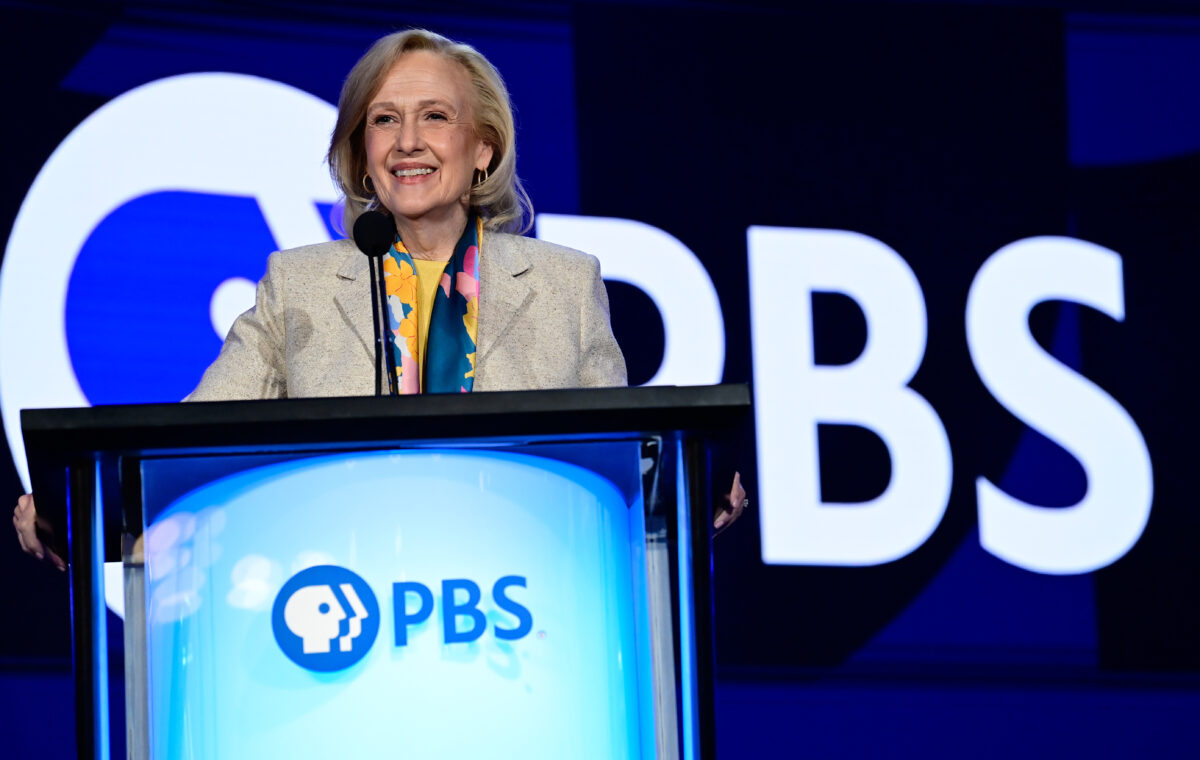
Paula Kerger is navigating arguably the most challenging period of her 20-year tenure at the helm of the Public Broadcasting Service (PBS), which has more than 330 member stations. Last spring, President Donald Trump signed an executive order calling for all federal funding to PBS and NPR to be blocked, accusing the organizations of bias. Soon after, the Department of Education notified the Corporation for Public Broadcasting (CPB) that it was terminating the 2020-2025 Ready To Learn grant for educational content, affecting PBS as well as dozens of public television and radio stations. PBS and NPR sued, and in March this year a federal judge ruled that the executive order barring the federal funding violated the First Amendment.
But the organization must still grapple with a funding shortfall created by a Congressional vote to rescind around $1.1 billion in advance appropriated federal funding for PBS and NPR, and an entirely new landscape for public media. The CPB, which was created in 1967 as a nonpartisan nonprofit to direct federal appropriations to public television and radio stations, announced in January that it would officially dissolve. PBS has since reduced its budget by 21% and cut 15% of positions, or around 100 jobs.
It’s not the first time PBS has faced such a threat, Kerger says, pointing to Newt Gingrich's “Contract with America” platform in 1994. But his idea was a “three-year glide path to zero,” she says. By contrast, the latest move gave stations just three months to find alternative funding, since they were already expecting the appropriated funds for 2026 and 2027, she says.
Since the rescission, Kerger has been touring the U.S. and speaking with affected communities. “The light bulb went off,” she says of the public’s reaction. “It's like, ‘Oh, Viewers Like You. That means us.’” Since the July 2025 rescission, PBS has seen more than a million new memberships. Philanthropy and commercial partnerships are helping. And Kerger hopes to get “some level of government funding back,” particularly to support rural communities and infrastructure, she says.
Kerger says she is most concerned about the future of content for children. “The kids' media landscape right now is really scary. A lot of kids are on YouTube, and there is some good stuff on YouTube, but kids get caught in the algorithm and they end up in places they shouldn't. Not all of it is by educators—our stuff all is, and it's rigorously tested,” she says. PBS is also working on games and content for “the significant number of kids that are not in formal pre-K, and whose family may not have access to as much technology or broadband.”
TIME spoke with Kerger on July 15 about the aftermath of the funding pullback, what people get wrong about PBS, and what gives her hope about the future for the organization.
This conversation has been condensed and edited for clarity.
You've talked before about how some people don't understand what PBS is. What do people get wrong about PBS?
Media in most countries started out as government-based, and then commercial media came second, and we were the other way around here. So commercial media was actually a growing industry, and it was the first woman FCC commissioner—a woman by the name of Frieda Hennock—who was looking at what she was anticipating as something that was going to have an enormous impact on society, but that was all rooted in commercialism in the marketplace. She worried there would be limitations, that there would be things that would be in the public interest that [the] commercial marketplace wasn't going to take up, and so she lobbied to have spectrum put aside for both TV and radio, and that's how we began.
Flash forward to Lyndon Johnson. He was particularly taken with what the BBC was able to do in terms of bringing great culture and history to the public, and he thought that our country should have that. He recognized that this loose confederation of individual stations that were mostly doing local or educational stuff wasn't exactly it, and that with some support you could create something that was more akin to the BBC, and that's when he signed the Public Broadcasting Act. Part of that was to create a network [that] could pull all these individual stations together. The second part of it was to ensure that there was federal funding available for communities that would perhaps be challenged to have their own stations. And so our funding always looked like that up until we lost the money last year. The largest percentage of most of the money went to stations, not to PBS and NPR. I think that was a confusion with some members of Congress. I'm not sure they knew exactly what they were voting on.
Those that were in smaller communities would get a larger proportion of their budget from the federal government. In Alaska, there actually is no other media except public radio and public television stations. Almost half of their budget comes from the federal government. So, it sort of played out exactly as LBJ anticipated. Our stations are all locally owned, locally operated, locally governed. I don't tell anyone what to do, but everyone pays dues to PBS. We take that money, we raise some other money, leverage some additional money. We work with producers. We pull together a full schedule that we distribute. The whole broadcast infrastructure is all managed by PBS. The digital infrastructure that was built— apps, PBS.org that a lot of stations plug into—all built by PBS. Stations’ positions on cable and on places like YouTube TV, negotiated by PBS. The work that we do in schools, which is all distributed via broadband—free, all done by PBS. Stations then contribute their content, so that it is still very much bottom up, but the glue that pulls it all together is PBS.
Can you talk me through where things stand today with the funding pullback?
So last year was quite a year, and we're still navigating through quite a few things. It started out with the FCC saying, "We think you're running commercials.” We actually are not. What we are running is sponsorship credits. We actually had worked with the FCC to define what is appropriate for public media, and we've worked closely with every Administration. Then we had the executive order that was going to make it illegal for any federal money to come to PBS and NPR. We won that suit. And the government [missed] the deadline to appeal, so it stands.
And then, of course there was the rescission. The executive order took out a program that we have managed for 30 years, which has funded our kids' content: Ready To Learn. For many years, the Department of Education would fund programming out of PBS that was all built around what the Education Department's priorities were, whether that's literacy or math skills or executive function or, in the last round—which had been re-upped under the first Trump Administration—workforce preparedness. Now, you can decide what that means for preschool, but we interpreted it as giving kids a really good start on the basics, before they entered school, as a way of just helping to make sure that we were jump-starting them in their school career that would lead to a professional career. After the executive order, that money was gone.
Then in June we lost the House vote, and this money had been advance appropriated for 2026 and 2027…I worked with the Public Media Company and within a very short period of time, we were able to raise bridge funds. That helped stabilize smaller stations that I think, some of them, would have gone dark very quickly.