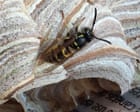
Eilish Rothney’s first instinct was to get rid of the wasps entering her converted shipping container in Norfolk. Now she enjoys their constant hum
When wasps began streaming through a rusted gap in her office door one June morning, Eilish Rothney’s first instinct was the same most people would have: get rid of them. The reserve manager for the Trinity Broads, part of the Norfolk Wildlife Trust, had discovered a wasp colony taking up residence in her office, a converted shipping container.
“They just built the nest inside my door,” she says. “My first thought was: ‘Oh no, I have to get rid of that now.’ But then I realised: ‘Wait, why? Why do I have to do that?’”
Two months on, Rothney is in a co-working arrangement with the nest, which is now more than a metre tall and swallows an entire bookshelf of ring binders. It has papered the inside of her office in what she calls “lovely layers of colours”, with thousands of chewed wood pulp cells stacked like the world’s strangest filing system.
Rather than evict her new colleagues, Rothney adapted. She opened the window to give the wasps a clear flight path. “I just stroll past like I’m a browsing cow, calmly going about my day,” she says. “The wasps were fine with me being there. The longer I was there, the more I felt relaxed being alongside them.”
The queen lays eggs continuously, while worker wasps forage and bring food back to feed the larvae. That, in turn, exudes a sugary liquid that the adult workers drink. Rothney describes a low purring sound rising off the nest, which she believes comes from thousands of wings beating to keep the colony cool. “It’s almost like the colony in itself is a living organism,” she says.
She says she isn’t worried about being stung – “it wouldn’t be a whole lot worse than mosquito bites” – and her advice for anyone less enthusiastic than her is: “Insects learn that certain individuals won’t harm them. Just keep calm, they will sense that and won’t feel threatened.”
Rothney traces her convictions about wildlife back to an ecology field trip at university, and to what she describes as “a kind of poetry and beauty in understanding the intricate relationships between everything”. She says she has become increasingly frustrated by how easily the label “pest” becomes a green light for extermination. “It’s fair enough if people don’t like wasps,” she says, “but we need to move away from things just being killed out of convenience. We cause a lot of damage with that approach.”
She is quick to defend the wasps which interfere with picnics every August, too. By late summer, the larvae stop producing their sugary secretion, leaving the adult workers suddenly cut off from their main food source, she says. “The poor things are starving. It’s not a battle between them and me. They’re desperate. Let’s provide them with that sugar and maybe draw them away from someone’s real ale in the evening.
“All I want is for people to be more tolerant of wasps, and of nature generally. I’m proud to be working where I am, and it’s our 100th anniversary this year – so maybe the wasps are celebrating too!”
As the weather turns this autumn, Rothney says, the queen will stop laying, the males and worker wasps will die off, and next year’s queens will leave to hibernate alone. By winter, the nest will be empty.
“It’ll be sad when they leave. I do feel motherly towards them,” she says. “It’ll be odd when they’re gone, because even the noise itself is amazing.”
And when the nest is empty? “I’m going to try to take it apart very carefully when they leave so I can see what it looks like inside.”
Until then, the shelves belong to the wasps.
It’s invertebrate of the year again! From 3-12 August, every day we will profile one of the thousands of amazing invertebrates that our readers have nominated. And then, when you’ve heard about all of them, we’ll open the voting so you can choose your favourites. Don’t hesitate to get in touch with thoughts and ideas: email us at environment.desk@theguardian.com with Invertebrate in the subject line.