Startup wields subterranean lightning strikes to conjure the gas
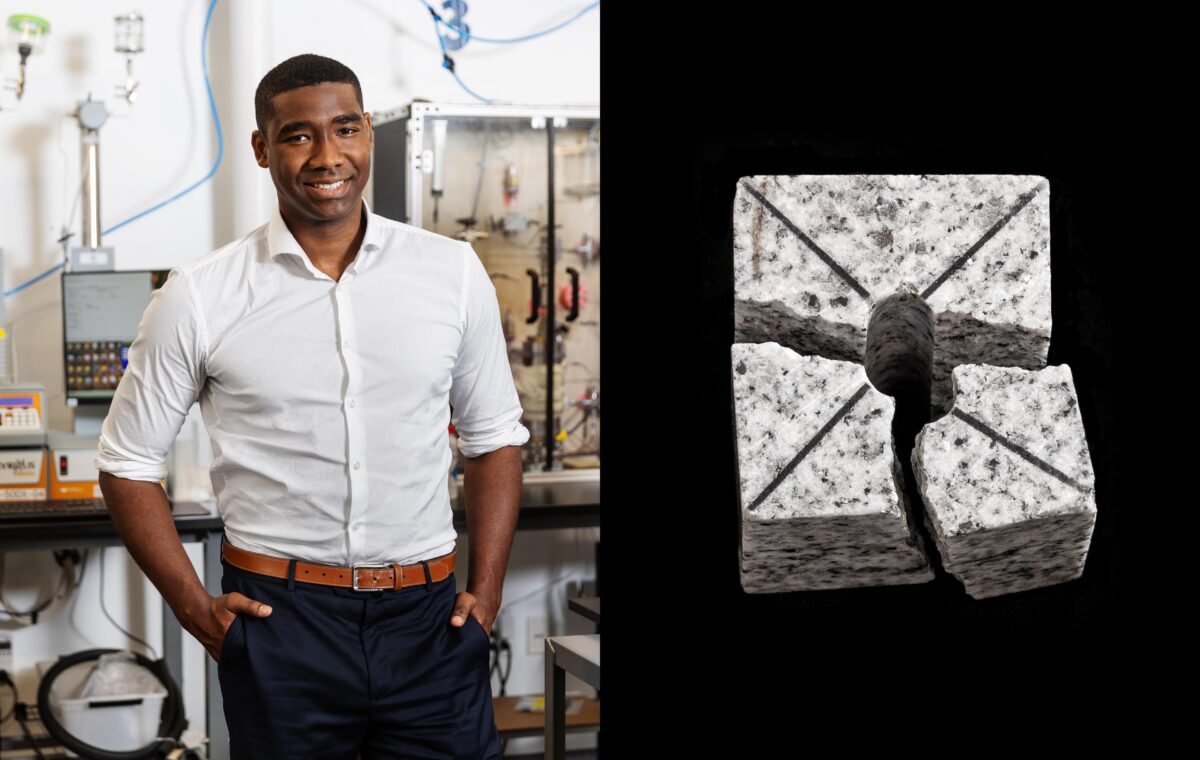
Paris Smalls, founder of Eden GeoPower, breaks subterranean rocks with electricity. His precision fracturing technique could be used to stimulate hydrogen production.
In a tranquil Boston suburb, on the far edge of a horse farm, where pasture gives way to woods, a crane lowers an enormous electrode into a borehole. The electrode, a half-meter-long cylinder with copper-tipped arms to ensure good contact with the borehole walls, descends—deeper, deeper—through layers of spongy sandstone to the hard, marbled roots of an ancient mountain range hundreds of meters below ground. Here the rock is tight; there are few cracks for water or gases to flow. But that’s about to change.
A stone’s throw away, a second electrode—a twin of the first—has been fixed in another borehole at the same depth. From above ground, a pair of high-voltage generators cabled to the two electrodes fires a series of pulses.
Tsss!…Tsss!…Tsss!…Tsss!…Tsss!….
Each discharge, heard faintly at the surface, is like a miniature, subterranean lightning strike. The rock between the electrodes heats. Pressure builds. Then, suddenly, the rock splits into a spiderweb of fractures.
On a horse farm outside of Boston, a worker sets up the well where Eden’s electrode will be lowered with a winch.Bob O’Connor
Eden GeoPower, the Massachusetts-based startup performing this peculiar field test, calls the technology electrical reservoir stimulation. The company’s tagline: “We break rocks with electricity.”
Eden’s researchers hope their rock-breaking technique will someday aid mineral mining, tap geothermal heat, or create geologic storage areas for carbon. But there’s an even more intriguing use that could create a whole new category of energy production: generating hydrogen underground.
The dream of a hydrogen-powered economy dates back to the 1970s, when petroleum shortages and rising concerns about pollution from fossil fuels sparked visions of cars, ships, planes, and industrial machines running on hydrogen instead of carbon. Hydrogen is often touted as a clean fuel because when it’s burned or consumed in fuel cells, it emits only water and heat. However, it currently takes more energy to make than it yields, and the cheapest and most common way is by reacting steam with methane, a potent greenhouse gas.
To break hard, subterranean rock, Eden lowers large electrodes into the ground and sends high-voltage electric pulses between them. The method creates a fracture network that’s more permeable than would be possible using traditional hydraulic fracturing. The strategy could be used to access iron-rich rock for hydrogen stimulation.
It’s possible to make zero-carbon hydrogen by splitting water with electrolyzers powered by renewable energy. But in most cases, the process is too expensive to be economical—a reality that burst the hydrogen-hype bubble in the early 2020s. Global demand for hydrogen in 2024 reached approximately 100 million tonnes, containing energy equal to only about 3 percent of the world’s annual energy consumption. Most of it is used as chemical feedstock for petroleum refining and for making fertilizers and plastics.
The frustrations of manufacturing clean hydrogen have convinced many entrepreneurs and scientists to instead seek the element underground. For the past half-decade, dozens of companies around the world have been hunting for buried stores of hydrogen, called natural or geologic hydrogen. But with a commercial-scale operation yet to be proved, Eden and a handful of other startups and research groups are chasing the more audacious scheme of producing geologic hydrogen artificially.
This approach, known as stimulated geologic hydrogen or engineered hydrogen, turns subterranean rock formations into giant hydrogen factories. It typically involves injecting water into iron-rich rock, which oxidizes the iron and releases hydrogen as a by-product. Fracturing the rock, as Eden is doing, creates a network of conduits for the water to reach iron-bearing minerals.
The concept of stimulated hydrogen is so new that few have had a chance to test it. Proponents say that if it works—which is a big “if”—it could provide almost unlimited energy for the indefinite future. There’s one way to find out: Start breaking rocks.