Find this story in your account’s ‘Saved for Later’ section.
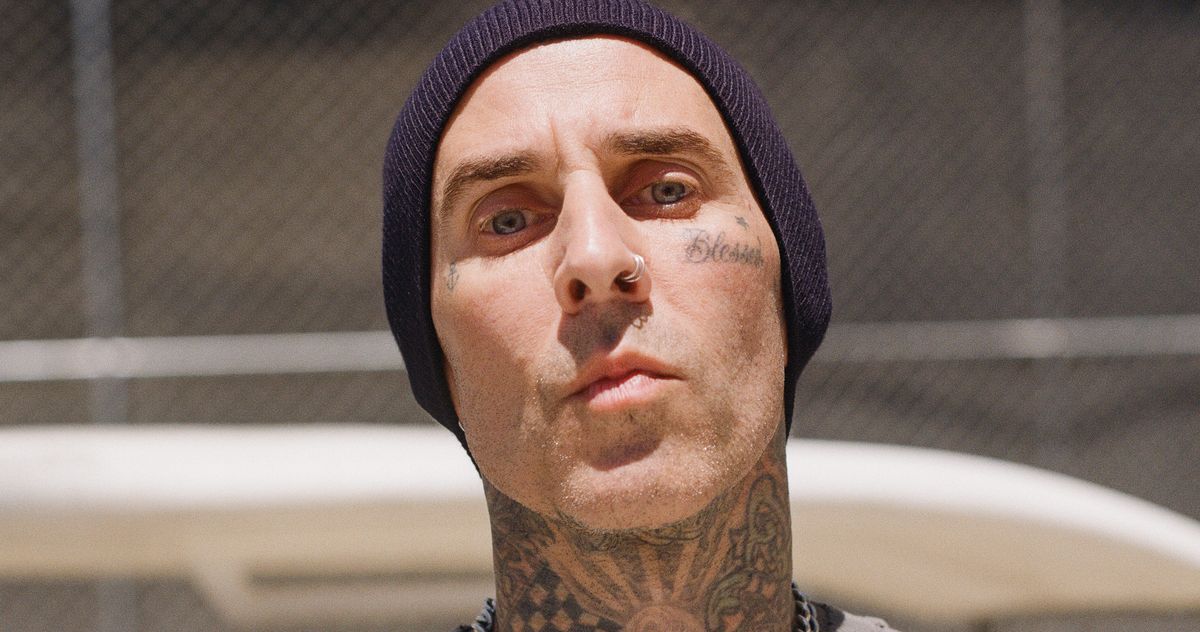
The drummer, as the new Travis Barker documentary, Louder Than Fear, posits, is the center of a band’s universe. By that logic, Barker is Blink-182’s beautifully tattooed ball of hydrogen. We have the 50-year-old to thank for some of the most Warped Tourian songs in the punk-pop canon, but now Barker is giving us the chance to understand the fuller scope of his life story. Filmed over nine years from 2017 to 2026, Louder Than Fear goes deep into the musician’s Southern California upbringing and why he picked up his first pair of sticks — never underestimate the power of Animal from The Muppets — and the perfectionist style of play that continues to guide him throughout his career.
Yes, of course it’s fun to see Barker, Tom DeLonge, and Mark Hoppus get themselves into some dumb shit in the archival Blink-182 footage, but the crux of the documentary is about the most life-altering moment in Barker’s life. In 2008, as a functioning addict, he was a passenger in an airplane crash that claimed the lives of two of his closest friends. Barker, who broke all of his ribs, fractured his back, and had burns on over half of his body, had a premonition about the plane crashing; he described the aftermath as if he was in Final Destination and considered suicide while he was still in the hospital. Little by little, Barker recovered, and he’s since been enshrined as one of the finest drummers working today. He also takes great pride in producing records and serving as a session musician across all genres. But the brush with death forced him to ask: “How do I become a better human and healthier human?”
Barker is now sober and a long-distance runner and, with the encouragement of his wife, Kourtney Kardashian, overcame his fear of flying. “I would love to be remembered as a great father, husband, brother, son, survivor, drummer, and musician,” he recently told me when we met in New York, growing serious when discussing his craft. “I would probably die if I didn’t do it. It’s not only how I’ve survived my whole life, but I also feel completely off if I don’t play drums and make music every day. I can’t explain it. It’s like a normal person not getting a meal or their supplements. Music is my supplement. The two hours onstage? That’s do or die.” Louder Than Fear, which will be released on Hulu on August 13, can even function as Barker’s fairy-tale story. “I knew who I was going to become,” he says, “and I couldn’t let the bad things that happened in the past destroy me.”
This documentary was filmed over nine years. Can you tell me what motivated you to open up your life to a film and the boundaries you set for it?After my memoir, someone had mentioned: “Would you want to do a documentary?” Next thing you know, I’m on a boat — the Queen Mary II from New York to London — and they’re filming me. I’ve had a couple of near-death experiences and felt it would be cool to share my story and maybe inspire someone that needs it like I did when I was a kid. I didn’t really think anything was attainable back then. I felt guilty even for dreaming or saying anything I wished for because I was told it was impossible. So for anyone who’s trapped and feels like they can’t achieve anything or maybe nothing’s accessible, I want them to know their dreams aren’t too far off.
When did you realize your goals could be attainable?A few days ago, someone asked me: “Did the kids you grew up with kind of get that you were on another level? Or you were playing a lot to prove yourself?” Now that I think about the question, I’m like, Everyone were such haters. No one was going to be like, “Yeah, you’re good.” Everyone was like, “You’re not going to make it. But I’m not going to make it and none of us are going to make it.” That was the attitude. My dad was working 60 hours a week at a steel mill. After my mom passed away when I was 13, the day before high school, her one wish was for me to pursue music and to never stop playing drums. So that was like, I was not going to fucking lose. I’m doing it for my mom and I know she’s with me on my journey.
Even though I spent a short time with her, I knew there was no way I accomplished what I accomplished or how everything fell into place without her. My only goals were to find a way to have enough money to eat, have somewhere to sleep, and play the drums. I wasn’t wishing for much. So it’s crazy to ever think I would be successful. It was just: Can I be alive, play drums, and survive?
Tom and Mark said in the documentary that when you joined Blink-182, you opened up a valve for the band. What do you think they were missing that only you were able to provide?I needed them and they needed me. It’s a pretty honest observation. I’ll also say, you’re only as good as your drummer. It’s obviously weird for me to even talk about myself like this or try to pinpoint exactly what it was, but I’d have to say it was the three of us writing together and pushing a couple of different rhythms or different tempos we were playing around with. Mark and Tom were always like, “Do that crazy shit you do. Just do something crazy.” And to me, doing something crazy meant playing a weird Latin groove, or Stewart Copeland chops, over a punk-rock riff. I had this creative freedom to make a genre of music sound a little bit different. It’s pretty simple and makes a song sound more complicated than it is. There weren’t many guitar solos in our band, so there was a lot of room for me to go off when Mark and Tom told me to. And then sometimes I’d be like, “I have an idea. This song should be like this instead of that.” That was helpful. I was a foundation and kept everything intact while they had fun, went crazy, and did their banter and everything. My job was to hold it down. That’s what I tried my best to do — hold it together so they could explore.
There was nothing that was off the table stylistically. It was always so fun and interesting to play with them. If you ever follow UFC or boxing, they say, “Style makes fights.” It’s the same thing when you mix band members or styles of musicians. I love boxing. I hated thinking of something that I wanted to do behind the drum kit and not having the skill, stamina, or endurance to follow through with it. Some drummers go out there and it’s very much like a job — a nine-to-five. But it’s like oxygen for me. There’s times when I’ll just throw everything out the window and go for broke because I’m having such a good time.
I can’t live without it. There’s times where I’ll start a set and relate to a fighter in the first round and think I’m going to be tired. But then the second round hits and I’m like, No, I’m going to be fine. The second song then becomes the third song and the 13th song. And then I remember, Your kit is going to be elevated on a parallel. Stay calm. That’s what I trained for. I’m having the time of my life. I’m ready to die out there.
Last year, there was strangely a period of time when drummers were either getting fired or leaving their bands, all of whom were older drummers in legacy, long-tenured groups. You’re a bit younger than Josh Freese and Matt Cameron, but I’d still value your perspective about that entire cycle and if you learned anything from it.I wonder if, just stylistically, they made sense in different bands. Sometimes you make the wrong decision and your skill level versus style is different. You could have someone on paper that seems like they’re really good for a project but then doesn’t fit right. In my heart, I don’t think Matt Cameron left Pearl Jam because he couldn’t keep doing it. He’s such a great drummer. There’s no faking any of those things. It’s all about taste.
I’ll give you a recent example that relates to this: I produced, helped write, and played drums on an Alkaline Trio album. My job was to be their dream drummer. It wasn’t about my own mission statement or what I wanted to do. I see so many musicians who go and record a song, and they try to show off their skill level or everything they know. It’s not about that. It’s about making this song great and what the song calls for. I love being in situations like the one I was just in with Alkaline Trio, where I’m there to meet every goal as a drummer that they would wish for. There’s times where they’re like, “We want you to Travis Barker out on the fucking drums right here.” And I’m like, “Okay, you green-lit that. I’ll follow my dreams.” But I would never default to that. If anything, I’m more reserved in a lot of playing situations. I think it might be overplaying, but if they want me to do that, I’ll do that. That can be an issue, the overplaying thing — you need to make sure you have the eye on the assignment. With that in mind, I feel like maybe all of that stuff could have been avoided a year ago.
How have you adapted the physicality of your playing as you’ve aged, to ensure you can continue playing this instrument as long as possible? I want to play it the way I do now for the rest of my life. I haven’t taken any preventative measures. Well, no. I sit a little bit higher on the kit now. Everyone has said for years, “Travis sits really high so everyone can see him.” Not true. My drums are just flat. Most drummers like to have a bit more weight to them, but mine are flat. Some of my favorite drummers, like Mikkey Dee and Mike Borden, played flat drums. It’s not the most comfortable thing, but it’s always how I loved my drums to be.
I have a friend who used to be a touring drummer and all he does now is try to help drummers maintain their longevity. He’ll coach them and be like, “Sit up straight. Stop doing that weird thing with your foot. I don’t know if you’ve ever noticed and you’re doing it all the time.” He’s so specific, but those are the things that drummers don’t think about. Hell, I never thought about some of it. One day he came over and told me I had to have better posture. I remember I had seen a video of me from years ago and I’m like, “Oh, no, no, no. I can’t ever sit like that again.” Now I’m trying to always sit up tall. I feel like my set goes better, too, and I’m hurting less if I’m not slouching and I’m more aware. But sometimes everything goes out the fucking window and I’m just going for it. That will always be important to me.
I did a reported piece on the state of drummers after everything settled down, and one observation several drummers made was: The number of people who are able to handle A-level touring is dwindling, and the people who can are getting older. Do you feel like a drummer crisis is in our near future?I think there’s so many good drummers right now. It’s the age of the internet where everyone has a YouTube page where you can learn from. It’s no longer “I need to go see this drum instructor.” You can find a video of drummers playing with other drummers. For example, I saw a video the other day of Steve Jordan, who’s now with the Rolling Stones, playing a groove. All he’s doing is playing it and not adding any fills. It was something to the effect of, Do you know how fucking hard that is? To not, as a drummer, want to do stuff when you don’t need to — but that’s when you have to lock in.