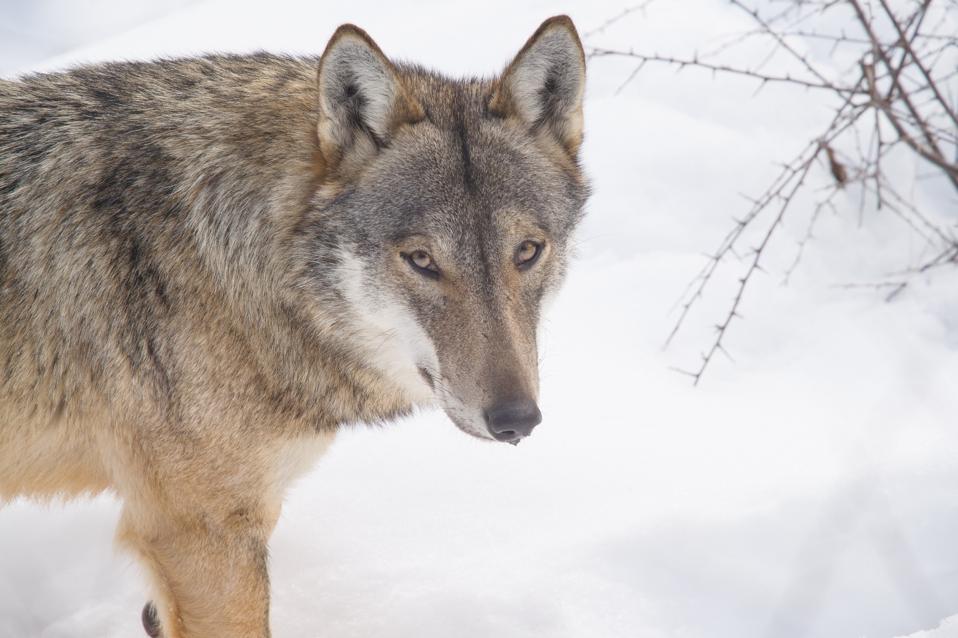
At my home in the hills of Umbria in central Italy, the wolves usually begin howling after dark. There is a pack in the hills behind my house, and when they call out, another pack often answers from farther away. I have never seen a wolf in all the time I have lived here, but my neighbors have. They own a farm down the road, and more and more often, they have watched wolves circle in as the sun rises, testing the flock, only to be chased off by the Maremma Sheepdogs that protect it. My neighbors told me that once, a single dog managed to hold off an entire pack.
What I've realized is that it was never about seeing one. It is about knowing something wild moves through the same hills, just beyond sight. On long walks at dusk, I sometimes pause when I hear movement in trees too dense to see through. If a wolf is there, it has almost certainly seen me first. I may never catch sight of it, but the possibility makes me stop and listen.
Across Europe, small outfitters now run trips built around that same sense of possibility, tracking packs through Italian forests, following prints through the snow in Sweden and placing photographers in remote hides overnight in Finland. Some trips cost thousands. A sighting remains the prize and, when it happens, people talk about it for years.
For hundreds of years, people in Europe saw the wolf as a villain, appearing in old stories and chasing Little Red Riding Hood through the forest. But in Italy, the wolf had a different image. The she-wolf who cared for Romulus and Remus is still a symbol of Rome. The real wolf is even more fascinating than these legends, especially now that it is coming back to areas where it has not lived for generations.
Luperca, the she-wolf who according to Roman mythology nursed Romulus and Remus, founders of Rome
A 2025 study in PLOS Sustainability and Transformation found that over 21,500 wolves lived in Europe by 2022, which is a 58% increase over ten years. Germany's 2024-25 count recorded 219 wolf packs, up from just one in 2000-01. ISPRA's first nationwide estimate put Italy's wolf population at 3,307 in 2020-21, with about 946 in the Alps. A later estimate for 2023-24 raised the Alpine number to 1,124. Wolves started returning to France from Italy in the early 1990s, and a 2026 study estimated an average of 1,013 wolves in France for the winter of 2023-24. This is one of the most remarkable predator recoveries in modern Europe, happening in areas like farms, villages, and ski resorts where people once thought large carnivores were gone for good.
It's important to clarify that headline number since they could be much higher. Cecilia Di Bernardi, the study's lead author and a researcher at the Swedish University of Agricultural Sciences, told me in an interview, "Some countries have very detailed monitoring: Denmark, Finland, France, Germany, the Italian Alps and Scandinavia track close to every individual wolf genetically. Some of the largest populations, such as those in Bulgaria and Romania, are less intensively monitored. So, the 21,500 figure is an expert-based estimate drawing on the most accurate source available in each country."
An Iberian wolf above a village in Peneda-Gerês National Park, Portugal
Wolves in these regions were not brought back by people. Instead, they made their own way back, moving from surviving groups and crossing borders, highways, and even some of the most populated areas in the world. "It's really a combination of socio-ecological drivers, but legal protection has been the turning point," Di Bernardi said. "Wolves have been listed under the Bern Convention and the EU Habitats Directive since the 1970s to 1990s, and that consistent, wide-range protection across borders is what allowed the species to recover at all." The return of wild ungulate populations, more forests, fewer people living in rural areas, and generally positive public opinion also played a role. "Importantly, these conditions set the baseline for recovery across all four large carnivores, but wolves, as ecological generalists, had a faster and further recovery than the others."
Even scientists who study wolves closely admit they were surprised by how quickly the population grew. "We were so focused on trying to avoid extinction of the few wolves left in Italy that we did not pay much attention to the health of wolf numbers in eastern countries, where numbers were relatively healthy. The speed of the increase surprised us. The current numbers are still small from a biological point of view, especially when considering that the range is huge," says Luigi Boitani, Chairman of the Large Carnivore Initiative for Europe, who has worked on wolf conservation in Europe since the 1970s.
The scale of that return is also documented in Wolf, an award-winning documentary by Dutch wildlife filmmaker Cees van Kempen. Van Kempen tells me he spent more than 1,000 days filming in European forests and drew on interviews with more than a dozen scientists and wolf experts to trace the species' return from Poland through Germany to the Netherlands. The film combines rare footage of wild wolves with research into how the animals have spread across some of Europe's most densely populated landscapes.
Cees says, "Of course, it is wonderful that the wolf has returned to the Netherlands after 150 years. This is a reward for the nature conservation policies of the past decades, which have allowed the ecosystem to recover so that the wolf feels at home again in our forests."
A gray wolf, at the De Hoge Veluwe National Park, Netherlands
The central Apennines offer one of Italy's most established wolf-watching experiences. Days begin before sunrise, with tracking through beech forests, open mountain terrain and valleys used by deer, wild boar and the endangered Marsican brown bear.
The European Nature Trust (TENT) was started in 2000 by British conservationist Paul Lister, who also owns the Alladale Wilderness Reserve in the Scottish Highlands. This charity supports rewilding, education, and community projects across Europe, such as efforts to help wolves and bears live alongside people in Abruzzo. TENT offers a four-night Winter Wolf Adventure, with two trips planned for 2027. Each trip costs about $3,250 per person and is limited to ten guests. Conservationists from Io Non Ho Paura Del Lupo lead the tours and show guests how they help wolves and local communities coexist. In 2027, the trips will be hosted by Adam Weymouth, author of Lone Wolf, a book about the return of wolves in Europe.