Two days before my 39th birthday, I sat in a small boat making its way up a deep river lined with rooty mangrove trees. Though I had never been to this place, it felt hauntingly familiar, like an unlived memory. This was the River Gambia, and it was taking me to the village of Juffure.
It was February 2001. Three years earlier, President Bill Clinton had appointed my father, George W. Haley, U.S. ambassador to the Republic of Gambia. Like an act of poetic atonement, America sent the great-great-great-great-grandson of a slave back, as a diplomat, to the country whence his ancestor had been kidnapped. From my first breath of Gambian air, every step felt like an introduction to my whole self. But the most extraordinary moment was when I walked into Juffure, as my uncle, Alex Haley, had done 33 years earlier on his journey to writing Roots: The Saga of an American Family, and discovered our beginning.
As soon as the boat reached shore, I gazed into some three dozen eyes that looked like mine, many belonging to my cousins, unmet and however many times removed, and imagined how Uncle Alex felt when he first set foot there. I thanked him silently for his sacrifice and perseverance.
How does a single book at once condemn and captivate a nation? Fifty years ago this August, Roots did just that. In 1976, the bicentennial of the United States of America, Alexander Murray Palmer Haley saw the story he had carried since childhood, then researched and written over 12 years, sit atop the New York Times best-seller list for 46 weeks, spending 22 at No. 1. A U.S. Coast Guard veteran and freelance writer had dispelled any notion of it having been born the land of the free that its anthem professed, and the entire country, it seemed, was now on notice.
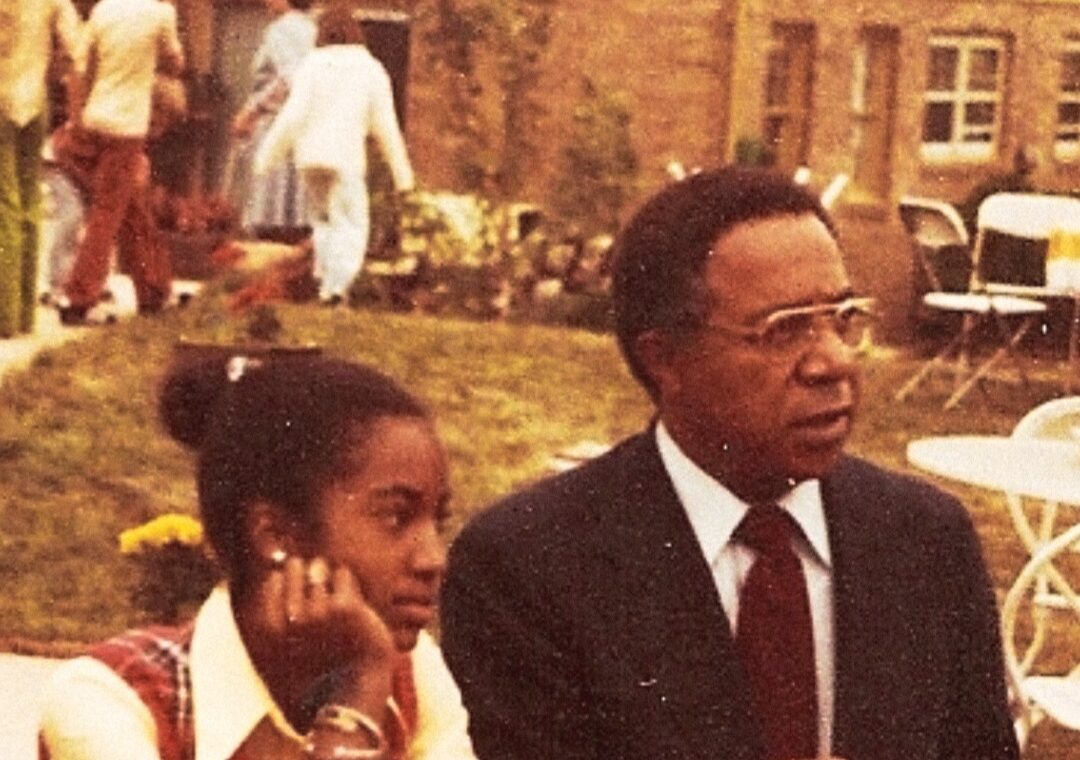
Alex Haley was my father’s older brother, and a significant presence in my life. He called me his “beloved niece” and “Little Bertha,” the second a loving attribution to his mother. He flew in for ballet performances and piano recitals, sent flowers for a good report card, and bought me my first car. He delivered the commencement speech at my high school graduation, and sat front and center at my college and law-school graduations. I adored him.
And now, all of those conversations around the Thanksgiving table had finally come to fruition. At 14, I innocently felt that his accomplishment was mine too. I had been raised on this story that was now the world’s to know. This was my family. And this is my love letter to him.
The author, center, on a trip to Juffure in the Gambia
Roots sold 1.5 million copies in its first seven months and eventually 8 million, collecting a National Book Award, a special Pulitzer Prize, and an NAACP Spingarn Medal. It was translated into more than 35 languages and adapted into a ratings-smashing TV miniseries. You would be hard-pressed to find anyone born in America before 1980 who does not remember a copy of Roots on the bookshelf or the miniseries playing on the TV. In his Feb. 2, 1977, monologue for the Tonight Show episode on which Uncle Alex appeared, Johnny Carson remarked, “If there’s anyone watching who does not know about Roots, you must have either been out of the country or on Mars someplace.”
But none of this had been Uncle Alex’s wildest dream. All he had set out to do was to find out for himself who the African was. Uncle Alex and his brothers spent most summers on their maternal grandparents’ front porch. There, they would sit rapt, listening to the stories their grandmother Cynthia and her sister friends told late into the night. One such story told of a man brought to America on a boat from Africa that had landed in “’Naplis.” The African’s name was “Kinte.”
The African had been sold to a plantation in Spotsylvania County, Virginia, where he married Bell, the plantation cook. The two had a daughter named Kizzy, which in his native tongue meant “stay put.” So much more the devastating irony when she was sold to a plantation in North Carolina at 16. There, her enslaver fathered her child, George, who became known as Chicken George because of his skills working gamecock fights.
The stories became livelier at this point, and more rich with detail, as these were characters the women had known personally—Chicken George was Cynthia’s grandfather—and they stayed with Uncle Alex. Haunted him, really. Who was this Kinte? Where had he come from? There was no 23andMe then, but there were reams of microfiche at the Library of Congress and ample records in basements of the Churches of Latter-day Saints. There was also, and first, Cousin Georgia.
When my uncle would land in Kansas City, Kans., where my family lived, it was like a rock star on a sold-out tour. We knew he had come to sit at the knee of his grandmother’s cousin, Georgia Anderson, decades after he’d watched her rocking chair keep time on a porch. Now in her 80s, she was the last living repository of the stories of the African, including some of the words of his native tongue: she knew that kamby bolongo meant river, and kora was a stringed instrument like a banjo.
Her recounting, alongside his research, enabled Uncle Alex to learn that these cherished words were of the Mandinka language, spoken primarily in the Republic of Gambia. He made multiple trips on his meager budget, traipsing around a country the size of Connecticut. Had he too much audacity in believing he could reverse the Middle Passage?
Perhaps he was feeling that way when he stepped into Juffure in April 1967, and the griot recited a history that included a 17-year-old Kunta Kinte, who had left the village almost exactly 200 years earlier to gather wood to make a drum for his younger brother and never returned. Uncle Alex carried the other end of that story: where that firstborn son of Binta and Omoro Kinte had ended up on a British slave ship named the Lord Ligonier that set sail from the Gambia River on July 5, 1767, and arrived in Annapolis, Md., on Sept. 29, 1767. One hundred and forty Africans had been smuggled onto that ship. Ninety-eight survived the journey.
Uncle Alex’s arrival in Juffure was a feat of ancestral home revealed and personal mystery solved. James Earl Jones made that moment his own in the Roots miniseries. In his portrayal of Alex Haley there in Juffure, Jones exclaims with bass-toned exuberance: “You old African! I found you, Kunta Kinte!” I always smile at this scene. Knowing Uncle Alex, I imagine that his reaction would have been no less dramatically felt, but more understated. I see him sitting there, knee to knee with the griot. Upon hearing the name Kinte and then calculating the data, I envision him folding in on himself, a gut punch quietly and gratefully received; a recognition of origin, a recompense for every African American back home, a proof of life: before.