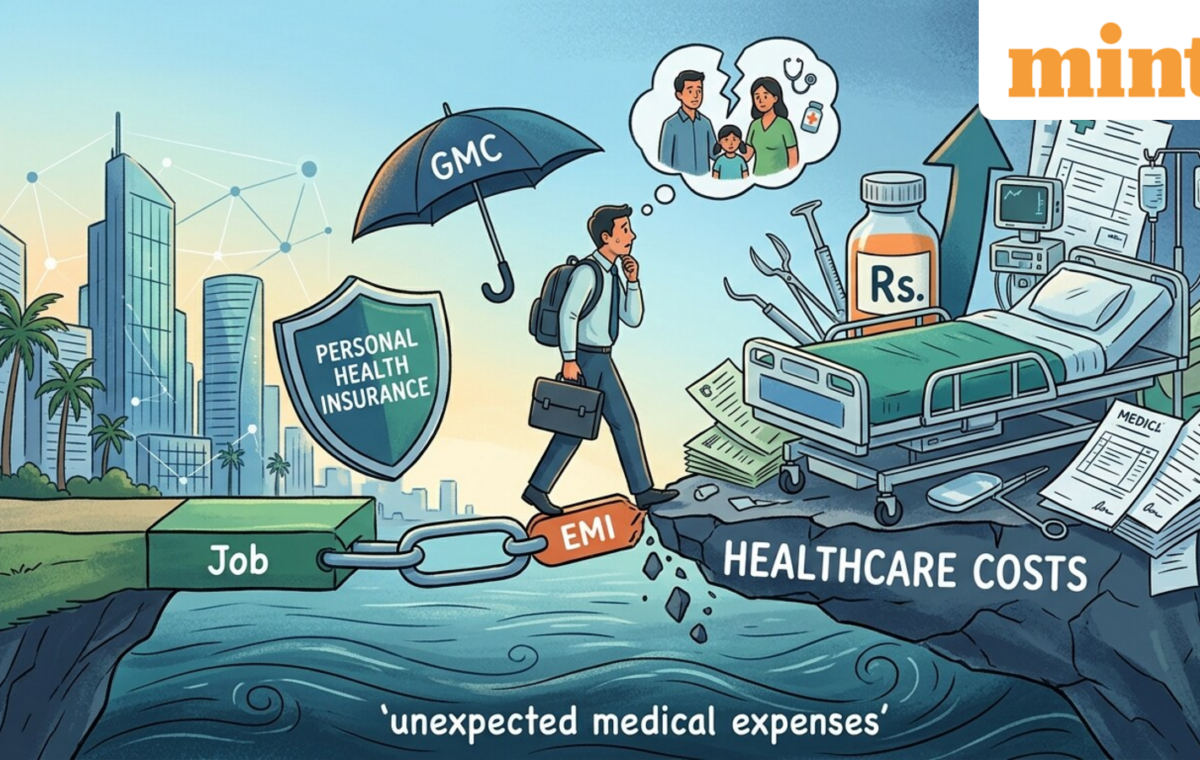
Rising healthcare costs have emerged as the biggest financial concern for corporate employees in India, overtaking worries around job security, equated monthly instalments (EMIs) and other financial pressures, according to Tata AIG General Insurance’s Corporate Health Protection Pulse 2026.
The survey found that 94% of respondents said unexpected medical expenses cause them financial stress. Healthcare costs, hospitalisation, lifestyle diseases, family health coverage and inadequate emergency savings emerged as the top concerns among employees.
The findings also highlight a broader financial vulnerability among salaried workers. Nearly seven in 10 respondents said they could financially sustain themselves for six months or less if they lost their jobs. Only 12% said they could manage their finances for more than a year without employment.
The survey covered more than 748 corporate employees aged 28-55 across Mumbai, Delhi, Bengaluru, Hyderabad, Chennai, Ahmedabad, Pune and Kolkata. All respondents were covered by their employer’s Group Medical Cover (GMC).
Despite having employer-provided health insurance, many employees remain concerned about whether their coverage would be sufficient during a medical emergency. Nearly 75% of respondents agreed that their employer-provided GMC alone may not be adequate in the event of emergency hospitalisation.
At the same time, 84% said having additional health insurance beyond their employer-provided cover is important. However, 45% said they did not have any personal health insurance apart from their GMC.
Awareness about existing employer coverage also remains limited. Only 41% of respondents said they were fully aware of all the features and benefits available under their GMC.
“While Group Medical Cover remains an important pillar of employee wellbeing, the findings show that many individuals are still uncertain about the extent of their coverage and whether it would be adequate during a medical emergency or a job transition,” said Dr Santosh Puri, Head of Retail – Health Underwriting at Tata AIG General Insurance.
The survey also points to a potential vulnerability when employees switch jobs. While 88% of respondents considered uninterrupted health insurance coverage during a job change important, only 40% were aware of solutions that could help maintain medical cover during such a transition.
Healthcare expenses were also identified as the biggest financial concern during a job transition, ahead of loss of income and EMI obligations.
Family protection emerged as the strongest reason for employees considering additional health insurance. Respondents ranked a higher sum insured, coverage for family members and continuity of coverage during job transitions among the most important features while evaluating a top-up plan.
Tata AIG said lack of awareness and a “will buy later” attitude were among the key barriers preventing employees from purchasing additional health insurance, particularly among those aged 28-34.
The findings suggest that having employer-provided health insurance does not necessarily mean employees have adequate financial protection. Understanding the limits of GMC, assessing family healthcare needs and ensuring continuity of coverage during employment changes could become increasingly important as medical expenses rise.
Kirti Jha is a Senior Content Producer at Mint, where she writes on mutual funds, taxation, personal finance and macroeconomic developments. Her reporting focuses on helping readers understand complex financial developments through data-driven, research-backed stories that explain how policy changes, market trends and regulatory decisions affect investors and households. <br><br> Before joining Mint, Kirti worked at ET Money, where she specialised in mutual fund research and investment analysis. She tracked portfolio disclosures, fund manager strategies, sectoral allocation shifts and investment trends, distilling large datasets into investor-focused insights. Her work combined quantitative analysis with consumer-centric storytelling, enabling readers to better understand fund positioning, portfolio changes and long-term investment opportunities.<br><br> Kirti holds a Bachelor's degree in Economics from Indraprastha College for Women, University of Delhi, and a Master's in Finance from the Jindal School of Banking & Finance at O.P. Jindal Global University. Her academic training emphasised analytical thinking, quantitative research and financial decision-making, providing a strong foundation in understanding capital markets, financial systems and economic policy. With a combined experience in investment research and financial journalism, she is committed to producing accurate, accessible and insightful journalism that empowers readers to make well-informed financial decisions.
Catch all the Instant Personal Loan, Business Loan, Business News, Money news, Breaking News Events and Latest News Updates on Live Mint. Download The Mint News App to get Daily Market Updates.