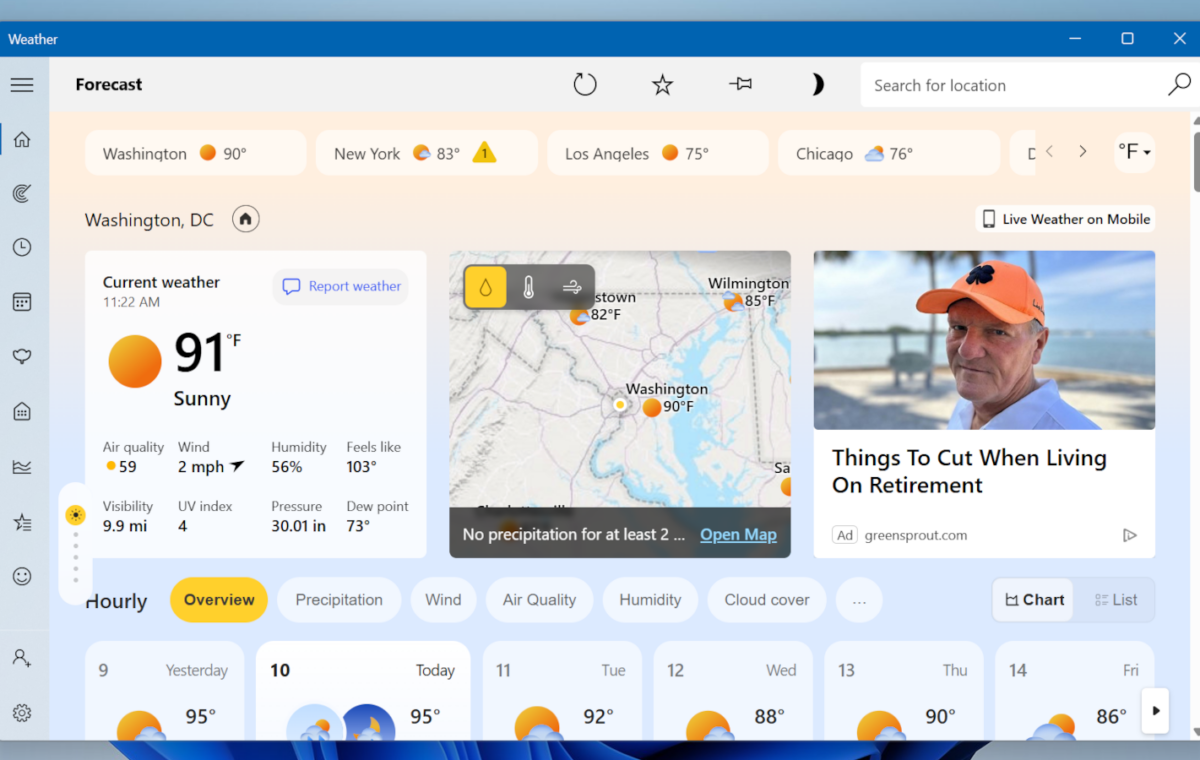
It’s long been known that Windows 11 requires unusually large amounts of memory to function, and it’s been one of the most consistent criticisms of the operating system. The built-in Weather app serves as a prime example of just how much of a memory hog Windows 11 has become.
The Weather app is conceptually simple, displaying weather data provided by MSN and its various sources. Pulling data and mocking it up in a visually pleasing way for users isn’t rocket science, and there’s no reason why an app like Weather should involve any complex programming. Yet, Windows 11’s Weather app uses five times as much RAM as the macOS Weather app, according to an analysis by Windows Latest.
After launching the app and not doing anything else—no scrolling or clicking—the Windows 11 Weather app consumed over 1.2 GB of RAM. Part of that is no doubt due to the displaying of advertisements and sponsored content. Compare that to the ad-free macOS Weather app. It’s no secret that Apple wants to make money, yet even Apple doesn’t shove nuisances like that into its app, preserving its performance.
But ads aren’t all to blame. As mentioned, the Windows 11 Weather app takes up a lot of RAM. Numerous individual processes are needed to run it, according to Task Manager. From a technical perspective, the Windows 11 Weather app apparently runs like a browser, and the numerous processes in Task Manager are apparently Chromium processes.
This is how much RAM the macOS Weather app uses, according to the Activity Monitor.
The macOS app, on the other hand, runs as a single process in Activity Monitor. It takes up just 123 MB on our own Mac, while Windows Latest reports usage of 246 MB. The Windows 11 Weather app therefore uses at least five times as much RAM as the macOS app does.
Further reading: Windows 11 tweaks to optimize RAM usage
This article originally appeared on our sister publication PC-WELT and was translated and localized from German.