This ultra-light solar filter film is one of the most versatile and best-quality ways to image the sun.
When you purchase through links on our site, we may earn an affiliate commission. Here’s how it works.
Baader AstroSolar Filter Film OD 5.0 is best thought of not as a single product, but as a family of specialist solar filter materials and ready-made filters for safely imaging the sun. Its greatest appeal is flexibility: a single A3 or A4 sheet can be turned into custom front-mounted filters for camera lenses, binoculars, small telescopes and spotting scopes. Optically, it’s superb, with crisp sunspots, a sharp solar limb and a neutral white disk that gives photographers plenty of freedom in editing. However, it’s also delicate and easy to damage.
Not as rugged as polymer or glass filters
Why you can trust Live Science
Our expert reviewers spend hours testing and comparing products and services so you can choose the best ones for you. Find out more about how we test.
Baader AstroSolar Filter Film OD 5.0 is one of those "secret" astronomy products that looks almost too simple to be special. In its most familiar form, it’s a thin, silvery A3 or A4 sheet of metalized film that can be cut and mounted in cardboard, plastic or commercial filter cells. Surely it’s better to have a pre-made filter for your camera? Go to any solar eclipse, and you’ll get your answer: experienced eclipse photographers, solar observers and anyone wanting to safely point a camera or binoculars at the sun very often rely on Baader AstroSolar Filter Film OD 5.0.
Its popularity does not come from its ruggedness nor its out-of-the-box convenience. Whether bought as a loose sheet for making filters or as ready-made Baader solar filters for binoculars, camera lenses and telescopes, it enables super-sharp captures of sunspots on the sun, allowing much faster shutter speeds than some rival solar filter materials.
Although a brighter Baader AstroSolar Filter Film OD 3.8 Photo Film is also available (which is not designed for visual use), this review focuses on the Baader AstroSolar Filter Film OD 5.0, both as a practical DIY filter material and as the core of ready-made solar filters.
The defining feature of Baader AstroSolar Filter Film is how little there is to it. The film is extremely thin — around 0.01 mm — and feels much more fragile than tougher solar polymer materials. That can be disconcerting the first time you handle it. It wrinkles easily, but should never be pulled tight. However, initial fears are misplaced because a good homemade solar filter does not require the film to be flat. In fact, it should be mounted slightly slack, because wrinkles and ripples in the filter material actually improve the image.
The real design advantage is that AstroSolar Film is hugely versatile and can be cut to suit almost anything. A single sheet can be used to make a front filter for a telephoto lens or two, as well as for a couple pairs of binoculars. Any filter must always go over the front of the optics, never behind them. For binoculars, make a filter for one objective lens for safe one-eyed viewing and securely cap the other.
Product type: AstroSolar Safety Film OD 5.0 solar filter filmMaterial: Metalized filmThickness: Around 0.01 mmLight reduction: OD 5.0 blocks 99.999% of visible sunlightSolar color: Neutral whiteFormats: Loose sheets and pre-made filters
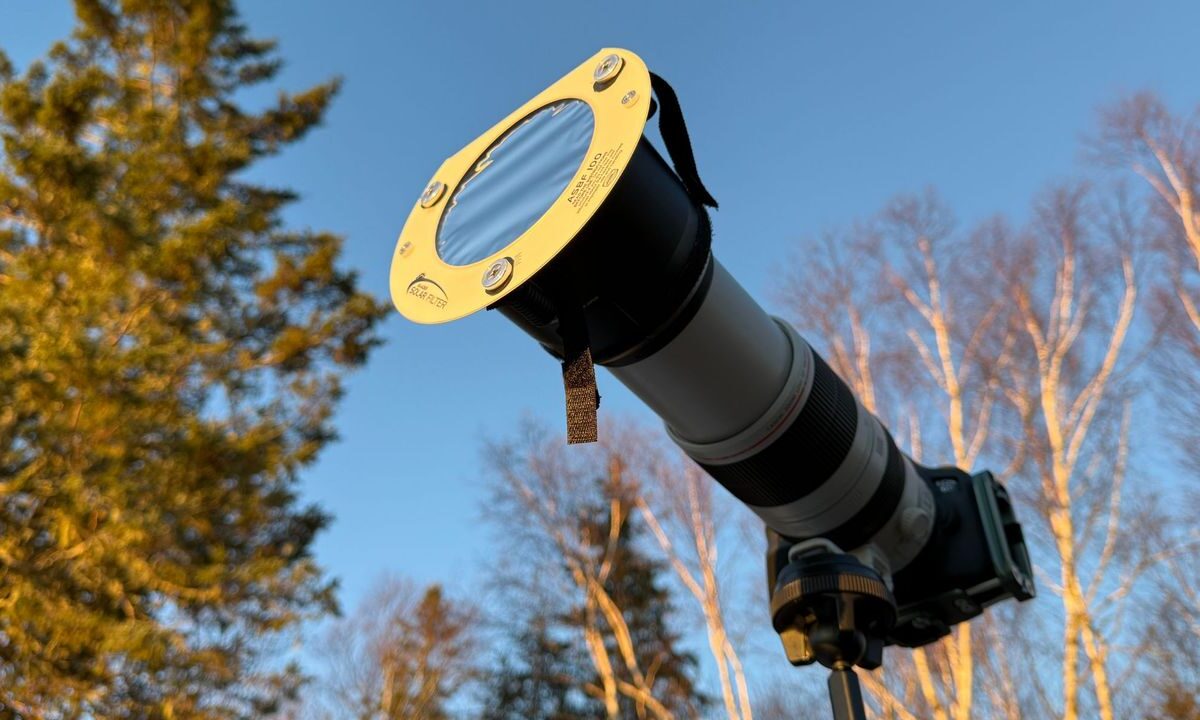
The film is sold as a loose sheet of material for DIY use in four sizes: ECO (140×155 mm/5.5×6 in), A4 (20×29 mm/8×12 in), 100x50mm/40×20 in, and Giant (117×117 mm/46×46 in). Also sold are the ASTF: AstroSolar Telescope Filter OD 5.0 (80-280mm), ASSF: AstroSolar Spotting Scope Filter OD 5.0 (50-150mm) and ASBF: AstroSolar Binocular Filter OD 5.0 (50-100mm). All come in multiple sizes.
They are, of course, neater and more durable than homemade cardboard versions, but the optical principle is exactly the same. Besides, the loose sheet version is more attractive if you have several lenses or binoculars to cover, or if you want to make a filter that precisely fits a specific lens hood.
Get the world’s most fascinating discoveries delivered straight to your inbox.
Although its versatility makes it unusual, making DIY solar filters won’t be for everyone. However, the main reason to choose Baader AstroSolar Filter Film is for its image quality. When used correctly, it produces a sharp, high-contrast, white-light view of the sun. Sunspots appear cleanly defined, the solar limb looks crisp and the image has a neutral white tone, rather than the deep orange produced by some polymer filters.