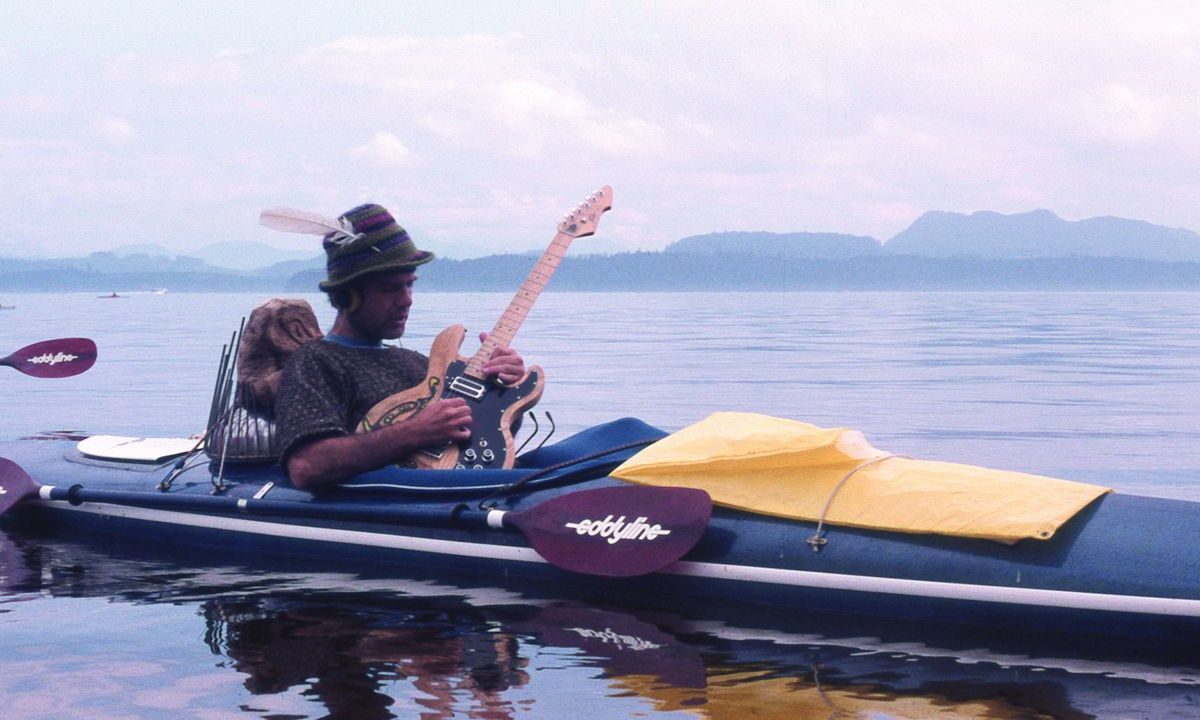
Staff writer Sascha Pare spoke with musical composer and sound artist Jim Nollman about his new album, "Orcas' Greatest Hits," created with killer-whale bandmates.
When you purchase through links on our site, we may earn an affiliate commission. Here’s how it works.
Throughout his career as a composer, Jim Nollman has worked with unorthodox partners to create music. Instead of collaborating solely with human musicians, the artist has expanded his cast to include animal bandmates, and they've been making melodies together for more than 50 years.
Nollman's new album, "Orcas' Greatest Hits," will be released Aug. 14 by the music label Smithsonian Folkways Recordings. As the title suggests, the album is a collection of songs centered around orca (Orcinus orca) vocalizations.
Nollman now lives in Friday Harbor, Washington, but he recorded these sounds off the coast of British Columbia between 1985 and 2002, using underwater microphones called hydrophones. The vocalizations weren't random calls that Nollman overheard; rather, he prompted the orcas to "sing" by broadcasting his and fellow musicians' music into the water via underwater speakers. The artists kept the volume at a reasonable level to protect the orcas and performed after dark to avoid motorboat sounds.
However, orcas weren't Nollman's first animal bandmates. Fresh out of Tufts University in the 1970s, he made music with various animals, including turkeys, wolves and dolphins. To learn more, we spoke with Nollman about his career, including several years he spent consulting with the U.S. Navy, and the extraordinary interactions he's had with whales and other creatures.
Jim Nollman is a Washington state-based musician, sound artist and author interested in interspecies communication. He has released several music albums, including "Playing Music with Animals" in 1982 (Folkways Records), "What the Dolphin Said" in 1997 (Beluga Records) and "Music for Swimming and Flying" in 2021 (Other Minds Records).
Sascha Pare: How did you first start making music with animals?
Jim Nollman: In my latter year at university, I got involved in the theater, doing all the music for all their plays. I soon got into John Cage [an American composer known for his innovative approaches to sound] — first in Boston, and then in the San Francisco Bay Area when I moved there. I got to know some of the avant-garde music people, especially in Berkeley, because there was a big movement there [centered around California's KPFA Radio].
I'd been in Mexico, playing flute, and the turkeys next door would always gobble on a certain high note and at a certain volume. I said [to an editor at KPFA], "Why don't you send me to a turkey farm? I'd like to do a Thanksgiving Day piece." He gave me a sound man and a Nagra tape recorder. I remember vividly, because having a Nagra after just getting out of college was a big deal for me. I was into technology. [Editor's note: Nagra is a Swiss brand of portable audio recorders.]
The turkey farm had 300 turkeys, and I immediately learned from the owner that it's really only the males that gobble. He kept the males and the females separate, so he put me into the fenced-in area where the males were. I started singing, and I could control them. The turkeys closest to me would start, and the gobble would go out to the edge of the 300 birds. And then it would come back, and then they would all stop. I was singing "Froggie Went A-Courtin'," which is an old American folk song [originally from Scotland] about animals. I sang 30 or 40 verses of this song and controlled the turkeys.
Jim Nollman's new album, "Orcas' Greatest Hits," will be released Aug. 14.
I was around 24 years old, and I had a hit. I knew I wanted to be a musician, but I had some major flaws to be a performer, because I didn't like being the center of attention. I'm kind of an introvert. That's a loser if you're trying to be a singer-songwriter. I loved writing tunes and playing them, but not in front of a big audience. This [recording tunes in nature with animals] was a way to get into music.
After the turkeys, I wondered if I should try making music with animals again. I tried it with kangaroo rats [Dipodomys deserti], which build these burrows like Trinidad steel drums. Kangaroo rats only come out at night, and they thump to each other in their burrow systems, which are tuned — it seemed to me, anyway, that each place in the burrow had a different tone — and they communicate with one another.
Then, I went to a wolf preserve. I realized that the wolves did two or three howl sessions in the morning around dawn and two or three at night. The wolves wouldn't play with me if I was out of their key. If I played a flat note, they would stop and basically tell me, "We don't mind if you're playing in our pack, but you've got to do it right." That was a big lesson for me, and that's how I got into it.