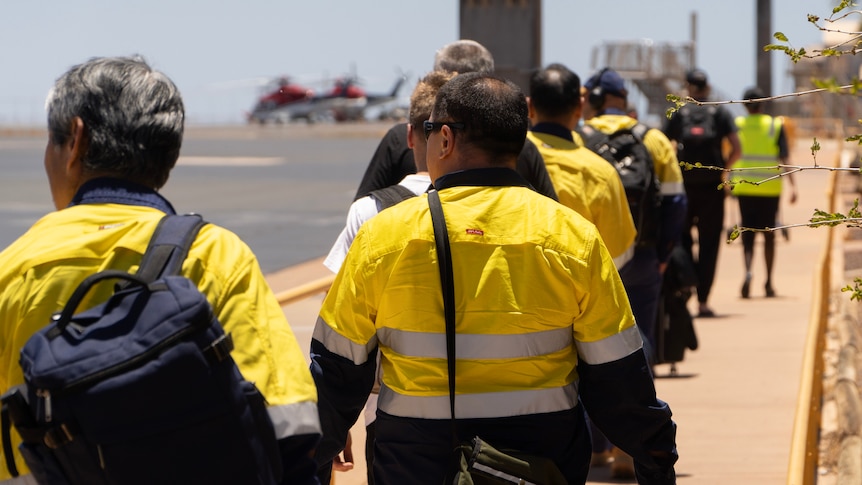
Fly-in, fly-out workers arrive at Kalgoorlie-Boulder Airport. (ABC Goldfields: Jarrod Lucas)
A lobby group representing some of Australia's most historic mining regions has been pushing for the census to better capture data around fly-in fly-out workers.
The Australian Mining Cities Alliance comprises six local governments, including councils from Kalgoorlie-Boulder, Mount Isa and Broken Hill.
The Australian Bureau of Statistics is expected to begin releasing the data gathered on census night next year.
As households across Australia begin filling out their forms for the 2026 Census, mining communities fear the count will fail to capture the nation's growing fly-in fly-out (FIFO) workforce.
The historic mining city of Kalgoorlie-Boulder, about 600 kilometres east of Perth, is experiencing one of the biggest booms in its history.
An aerial view of Kalgoorlie's Super Pit gold mine. (ABC Goldfields: Ivo Da Silva)
The rise in FIFO work practices has been so dramatic that Kalgoorlie-Boulder Airport is now among the busiest in regional WA, with more than half a million passenger movements.
Mayor Glenn Wilson has made regular use of the airport travelling to Canberra to lobby for changes to the census while casting doubt on the accuracy of previous data.
"What we've continually done through lobbying of the ABS [Australian Bureau of Statistics] is to make sure our ghost populations are included," he said.
"We have got a baseline population, and then with the mining activities, those populations increase and put added strain on our infrastructure and our services."
He chairs the Australian Mining Cities Alliance, which counts the City of Broken Hill, City of Karratha, Mount Isa City Council, Isaac Regional Council and the Shire of East Pilbara among its members.
Glenn Wilson is concerned "ghost populations" are not being included in the data. (ABC Goldfields: Jarrod Lucas)
When the first national census was held in 1911, the population of Kalgoorlie and Boulder, then separate towns, was estimated at a combined 19,605.
That grew to 29,306 as of the 2021 Census, with 20 per cent of the population employed in gold mining.