This article contains spoilers for the House of the Dragon Season 3 finale.
House of the Dragon is not making a habit out of quiet finales. Viewers who grumbled over the anticlimax of Season 2 must have been pleased with Sunday’s Season 3 finale, which one-upped the previous episode’s Sunfyre resurrection and brûléeing of many soldiers loyal to Rhaenyra with a Battle of Tumbleton that torched the city; left thousands of casualties Black, Green, and civilian; and ended both Ormund Hightower’s (James Norton) kingmaking ambitions and his life. Major character deaths weren’t even limited to the battlefield: RIP Helaena, for one, too good for Westeros and for her family. I’ll miss Phia Saban’s quietly resolute performance.
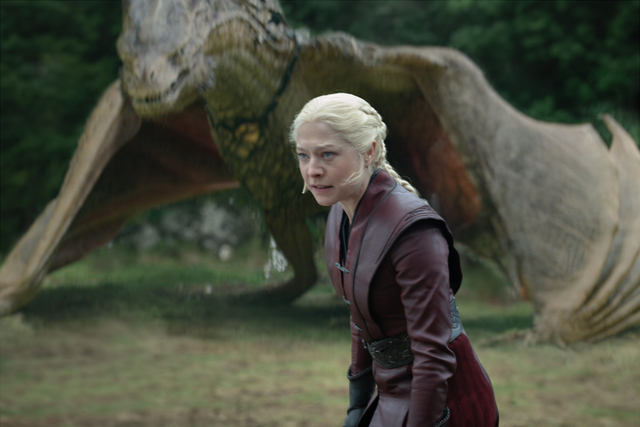
You wouldn’t be wrong to place the blame for the battle’s carnage as well as Helaena’s spiky suicide on Rhaenyra (Emma D’Arcy). It’s she who, after some handwringing, orders Daemon (Matt Smith) to lay siege to Tumbleton and “root out every Hightower and kill them to the last man.” She also has a captive, pregnant, hunger-striking Helaena violently force-fed. Anti-Rhaenyra sentiment is festering, even within the Red Keep. Until this season, she has been Dragon’s default hero, bravely defending her right to succeed her father against a Green faction whose loyalty to Aegon II (Tom Glynn-Carney) basically comes down to misogyny, despite wrenching personal losses. But now that she sits the Iron Throne, the show is making us—like the starving peasants she has yet to materially help—question whether she is truly the great leader she’s convinced she can be. I don’t know that she is, or that anyone could be in similar circumstances. She’s still the hero of this story, though, even if she turns out to be a tragic one.
The finale opens with Rhaenyra waking to the news that Aegon is alive, and that his return—with a still-quite-lethal Sunfyre, no less—after she declared him dead makes him some kind of messiah. Understandably, she panics, cursing the memory of Viserys (Paddy Considine) for putting her in such a terrible situation. “His prophecy has tested me again and again, and I have met its every challenge!” she complains to Daemon. He takes the opportunity to remind her of her Targaryen supremacy. So, how should she wield it? “The only quality the realm understands is strength,” Daemon says. It’s enough to get him dispatched to Tumbleton.
Baela (Bethany Antonia) urges Rhaenyra to have Lord Corlys (Steve Toussaint) rescued from the Hightowers’ clutches while Black forces are in town. He is, after all, the Hand of the Queen, and he’s sacrificed mightily for her cause. Also: “It was your fault” the Sea Snake was captured in the first place, Baela says. When Rhaenyra seems less than enthusiastic about helping him, Baela really goes off on her. “If a person is useful to you, you wield them,” she accuses. “But if not, you abandon them.” This may be true. A few scenes later, Rhaenyra abruptly banishes her paramour Mysaria (Sonoya Mizuno)—through a minion, no less. (Mysaria does get a nice severance package.) But doesn’t a responsible sovereign have to be ready to throw her friends and family under the bus in service of what she believes to be the greater good of the kingdom? I mean, wasn’t that the takeaway of six seasons of Matt Smith’s other show, The Crown? Of course, as with Elizabeth’s real-life refusal to let her sister marry a divorced man, the question of whether it’s actually prudent for the monarchy to deprioritize saving Corlys is a different matter.
It isn’t just Baela who rips into Rhaenyra in her own home. Helaena’s force-feeding comes after a heated encounter with the Queen. “You cannot think I would harm you,” says Rhaenyra, who must still see herself as a merciful person. (That she has thugs shoving gruel down Helaena’s throat seconds later suggests an alarming lack of self-awareness.) Helaena’s retort: “Do you think life is nothing more than not being dead? Our father would hate you for this.” She’s right. But Rhaenyra is also correct when she points out to her half-sister that Viserys’ dithering over succession is what put them in this predicament in the first place. Then again, there’s truth to Helaena’s scathing final blow: “All the things you care about are ugly. This place is ugly. You, yourself, are ugly.”
Helaena is Dragon’s Cassandra; her supernatural prescience and big-picture perspective make her perhaps the wisest character this side of Game of Thrones’ Bran the Broken. (This makes the embroidered portrait of Rhaenyra on a bloody Iron Throne that is, in effect, her suicide note, particularly foreboding.) If you take “the things you care about” and “this place” to mean power and King’s Landing—or Westeros at large—she’s reiterating a core theme of A Song of Ice and Fire. Like anyone vying for a throne, Rhaenyra is playing a brutal, yes, game. Would it be a more just or humane game, though, if she forfeited? Would it have a better long-term outcome?
Rhaenyra doesn’t think so. And unlike Aegon or Aemond (Ewan Mitchell), whose kingly ambitions don’t seem grounded in anything more than entitlement and will to power, she is actually taking Westeros’ future into consideration when she clings to her birthright. Not only does she ascend the Iron Throne with the intention of helping the small folk, but she also sincerely believes in the Song of Ice and Fire prophecy—a prophecy that Thrones viewers know will, whether self-fulfilling or not, both lead to great destruction and, ultimately, prove instrumental in saving humanity from extinction via White Walker. This is why we see her, in the finale, demand to be anointed by the High Septon (Gary Raymond) and order Alyn (Abubakar Salim) to kill him when he refuses. She isn’t betraying the Seven, exactly, because her fealty is to the prophecy and to her Valyrian ancestors. She believes she’s answering a higher calling.
Tragedy lies in the gulf between beliefs or intentions and reality. In the Battle of Tumbleton, it’s Daemon rejecting Gwayne (Freddie Fox) and Daeron’s (Benjamin Evan Ainsworth) plea for peace, taking offense at Corlys’ further attempts at diplomacy, exhorting his army to avoid excessive casualties because “the Queen’s moral standing must remain absolute”—and then presiding over a grisly mass slaughter against an enemy that makes terrified children cannon fodder. Because he is carrying out her order to decimate the Hightowers, in defiance of Corlys’ plan for victory without bloodshed, Rhaenyra is just as responsible for these atrocities as Daemon. A tragic hero has the most noble aims but, due to some intrinsic character flaw or external factor (a sexist society, say, or misplaced faith) ends up doing the wrong thing for the right reasons. Rhaenyra seems to be heading in this unfortunate direction, but she’s no villain. We’ll find out in the show’s last act whether her heroism proves to be triumphant or tragic.