When you buy through links on our articles, Future and its syndication partners may earn a commission.
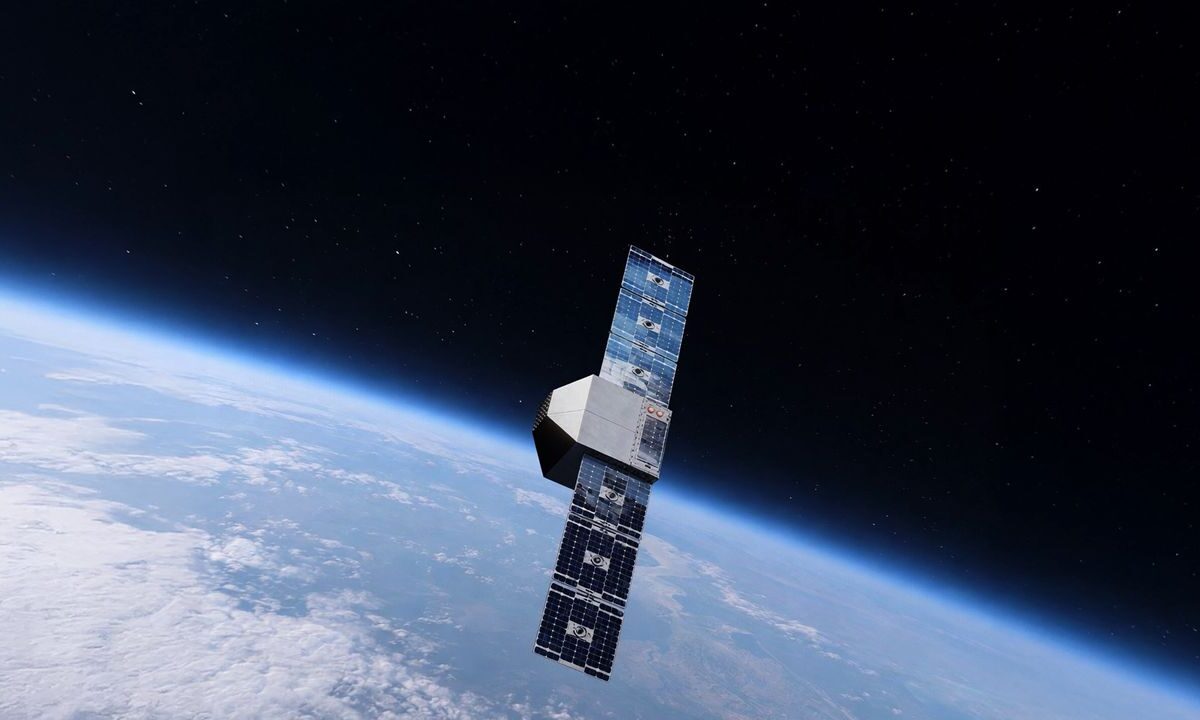
Artist's illustration of a satellite operating in very low Earth orbit. Kreios Space is partnering with Kongsberg NanoAvionics to develop such a satellite mission. | Credit: Kreios Space/Kongsberg NanoAvionics
A new way to move around Earth's outer atmosphere could soon get a field test.
The Spanish company Kreios Space plans to launch into orbit the world's first satellite that uses scooped-up air to push it forward, the company announced on Tuesday (Aug. 4).
The technology Kreios Space has been developing is called air-breathing electric propulsion (ABEP). It relies on air sourced from Earth's atmosphere, which is then heated up, ionized and expelled to generate thrust.
Diagram showing the different types of orbit around Earth. | Credit: ESA
This method will allow satellites in very low Earth orbit (VLEO) — the region from roughly 60 miles to 250 miles (100 to 400 kilometers) above our planet — to counteract atmospheric drag without the aid of liquid fuel.
"Kreios is building the satellites that make sustained operations in very low Earth orbit possible," Kreios Space CEO Adrián Senar said in the Aug. 4 announcement.
"By enabling satellites to fly lower, longer and more efficiently, we are enabling higher-resolution Earth observation, much better satellite communications, more responsive and accurate missions and a more sustainable orbital infrastructure," he continued.
Kreios Space chose Lithuanian-based Kongsberg NanoAvionics to provide the satellite bus that will carry the ABEP system into orbit for the test run.
"Kreios is tackling one of the most demanding operating environments in space, and this mission joins a very short list of European VLEO initiatives," Kongsberg NanoAvionics CEO Atle Wøllo said in the same statement.
"Our engineering team has worked closely with Kreios to configure the MP42 satellite bus to the mission's specific requirements and support the integration of Kreios' technology," he added.
Kreios Space did not give a target launch date for the mission in Tuesday's statement, saying that the company will launch it "at a time when interest in and development of VLEO technologies has accelerated." But the company's website identifies 2027 as a notional target for its first space mission.
Satellites in low Earth orbit (LEO) — altitudes of roughly 100 miles to 1,200 miles (160 to 2,000 km) — generally don't need constant propulsion. Usually, a small boost from traditional thrusters here and there is enough to keep a LEO satellite on the right track. To power the thrusters, these satellites usually have some form of fuel built in.
VLEO works differently. It's low enough that there's still some atmosphere present, which generates drag on spacecraft. If you want a satellite to move around VLEO, it'll need to employ propulsion most or all of the time to counteract that drag. Any fuel that the satellite brings with it therefore won't last long.