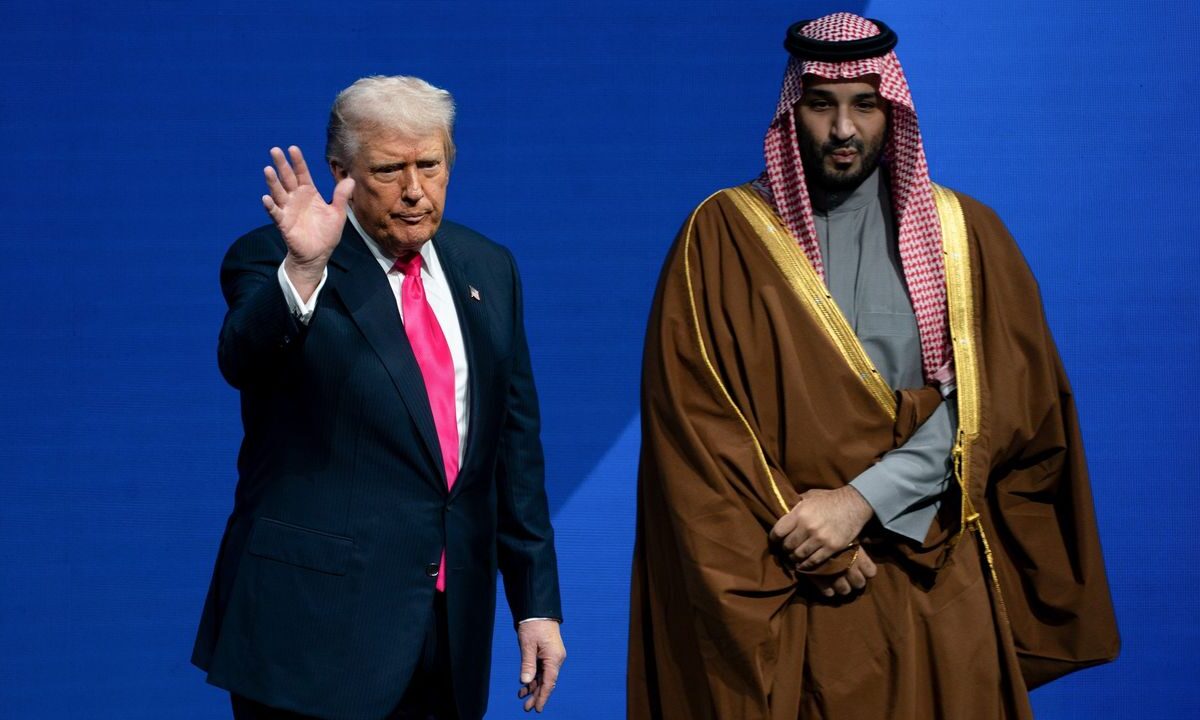
Washington’s stipulations seem to have put the agreement in jeopardy, creating additional tensions in the region
Well, is it on or is it off? No one’s quite sure, said Al Jazeera (Doha). Two weeks ago, the United States and Saudi Arabia signed a multibillion-dollar deal allowing US companies to build and operate nuclear power plants on Saudi soil over the next 30 years.
But a day later, President Trump added a new condition, via social media: Saudi Arabia must fall in line with the UAE and other Arab nations that have signed the Abraham Accords, and recognise the state of Israel.
And that may prove a deal breaker, said David Frum in The Atlantic. Riyadh had been working towards this landmark pact for almost two decades. Thanks to the savvy of its de facto leader Crown Prince Mohammed bin Salman (MbS), who ensured the private equity firm of Trump’s son-in-law, Jared Kushner, would get its share of the billion-dollar nuclear licensing deals at stake, he almost got it over the line.
Escape your echo chamber. Get the facts behind the news, plus analysis from multiple perspectives.
From our morning news briefing to a weekly Good News Newsletter, get the best of The Week delivered directly to your inbox.
From our morning news briefing to a weekly Good News Newsletter, get the best of The Week delivered directly to your inbox.
But now it must surely be in doubt, said Mohamad Elmasry on Middle East Eye. Riyadh has vowed it won’t normalise relations until Israel guarantees Palestinian statehood. And MbS has reportedly told US officials that hostility towards Israel is so great among Saudis in the wake of Israel’s devastating war in Gaza, that to sign a normalisation treaty would probably get him assassinated.
It’s obvious why the Saudis still badly want this nuclear deal, said Joseph Cirincione on MS Now (New York). It’s not, as they claim, to diversify their energy profile: that makes no sense for a nation sitting on an ocean of oil and blessed with the ideal wind and solar conditions for generating renewable energy – a far cheaper option.
No, the real reason is to gain atomic weapons to protect itself against its main foe: Iran. MbS has made no secret of his desire to build a bomb, and the deal would be a concrete step in that direction. Despite Trump’s claims to the contrary, it appears to permit nuclear enrichment on Saudi soil, thus enabling Riyadh to follow the likes of India, Israel and Pakistan in covertly enriching uranium to weapons-grade levels.
Who knows what’ll happen if this “reckless” deal goes ahead, said Mitchell Plitnick on Mondoweiss (New York). The “gold standard” nuclear-power pact that the US signed with the United Arab Emirates in 2009 required the UAE to forego the ability to enrich uranium, and obliged it to submit to International Atomic Energy Agency inspections: this Saudi deal has no such restrictions.
Which is why it would inevitably trigger a Middle East arms race, said Azriel Bermant in Foreign Policy. If the deal proceeds, Iran would openly seek its own nuclear deterrent, something it has so far officially forsworn. “It beggars belief that the US went to war against Iran to prevent it from acquiring a nuclear weapon yet now acts in a way that is an open invitation for Tehran to weaponise.” And in a way that would also pour “proliferation kerosene” on Turkey and Egypt’s “smouldering nuclear ambitions”, said Matthew Kroenig and Henry Sokolski in The Wall Street Journal. Trump’s deal invites disaster.
Actually, the US is doing the right thing, said the Washington Examiner. The hard truth is that the “era of non-proliferation is coming to an end”: Pakistan and North Korea are both testing nuclear weapons. Given that sobering reality, better the US offer “a guiding hand” to the Saudis and oversee their nuclear agenda than let China or Russia fill the void.
Good or bad, the deal matters a lot to the US president, said Sharon Squassoni in The Bulletin of the Atomic Scientists (Chicago), so rumours of its death “are premature”. After all, it’s not some “spur-of-the-moment fantasy” cooked up by Trump. The same deal was also being considered under Joe Biden, and then too enrichment was a quid pro quo for recognising Israel.
The Saudis won’t do so, of course, given recent history, but they won’t have to. Although Congress can disapprove the deal once it’s submitted, the present Congress – due to adjourn on 18 December – is much less likely to do so than any freshly elected one. So the Saudis can “call Trump’s bluff by simply sitting back” and waiting for him to succumb to the pressure of the December deadline.