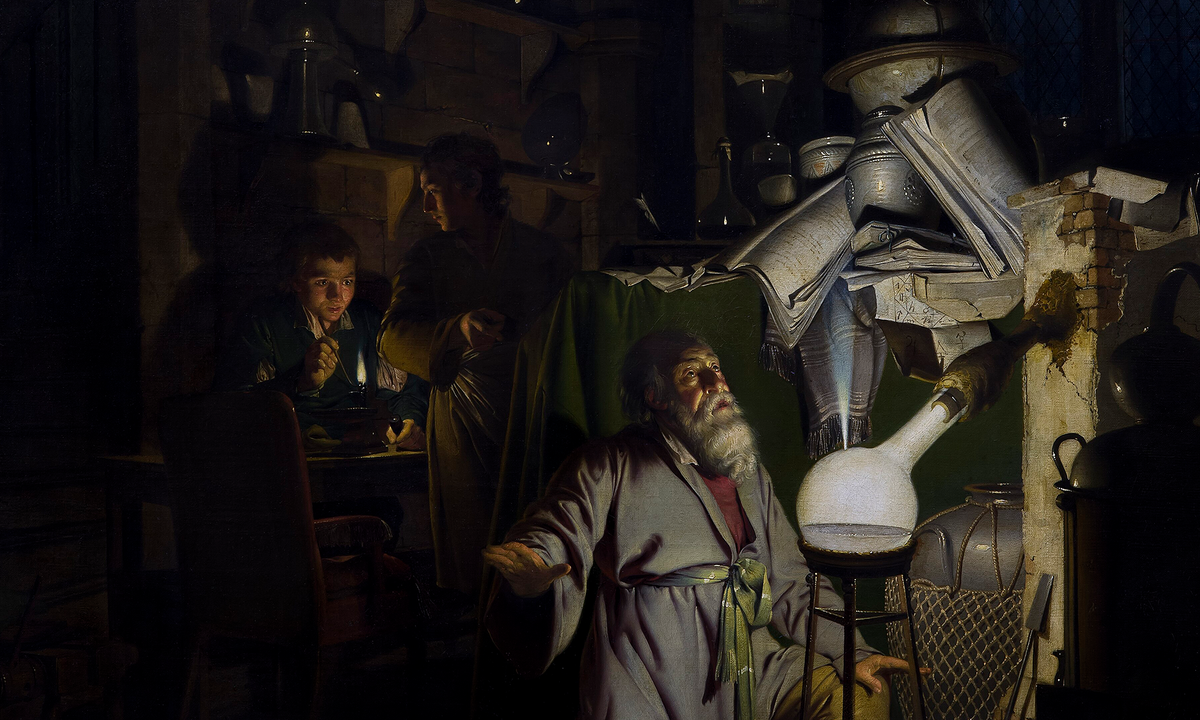
Editor Hannah Osborne spoke with science writer Kit Chapman about his book "The Age of Alchemy." In it, he explores how, long before modern science existed, people were finding extraordinary ways to solve problems and understand the world around them.
When you purchase through links on our site, we may earn an affiliate commission. Here’s how it works.
Long before chemistry was a formal science, humans were experimenting with substances to solve problems, cure illnesses and make money. In his book "The Age of Alchemy: How Early Innovators Shaped Modern Chemistry" (Profile Books, 2026), author Kit Chapman, a science journalist and honorary researcher at Falmouth University in the U.K., traces how this ancient, protoscientific tradition shaped the world.
From our ancestors' early use of fire to some accidental — and disastrous — pyrotechnics in the 14th-century French court of Charles VI, Chapman reveals how early innovations across the world paved the way for modern science.
Live Science spoke with Chapman about his book, which has been short-listed for the 2026 Royal Society Trivedi Science Book Prize.
Kit Chapman is an award-winning science journalist and adventurer who has travelled to more than 100 countries in his quest to explore ancient innovations and discoveries. His first book, "Superheavy", was a finalist for the AAAS SB&F prize, his second, "Racing Green", was named the RAC Motorsport Book of the Year 2023, and his latest, "The Age of Alchemy", has been shortlisted for the Royal Society Trivedi Science Book Prize. Kit holds a masters degree in pharmacy from the University of Bradford, and a PhD in the history of science from the University of Sunderland. A former editor at Chemistry World, Kit is currently an honorary researcher at Falmouth University, UK.
Hannah Osborne: The book is full of brilliant historical anecdotes that bring all of these alchemy breakthroughs into context. What was your favorite one and why?
Kit Chapman: I mean, you can't go wrong with a man trying to turn his own urine into gold, I think. Hennig Brand [who accidentally discovered phosphorus in the 17th century] was one of my early touchstones. I've known about this story for a while. I've always thought, "How can I get this into a book? What's the link?" Obviously alchemy provides this fantastic base. He bankrupted two wives to try and fund his 1,500-gallon [5,700 liters] urine habit — and then he gets something [phosphorous], against the odds.
This is the first element we can actually put a name to. This is the first person we can say actually discovered a chemical element, and it's an alchemist in the purest sense of the word. Then, of course, he tries to keep it secret. He sells it, eventually, to a friend, and his urine goes on tour around Europe, showing the kings and queens this glowing pee, before suddenly, [chemist and philosopher] Robert Boyle actually works out exactly what's going on.
That, to me, sort of encompassed everything I was hoping for in the book. There's a fantastic story there that's about human connection. There's the unraveling of mythology, and theology and belief, and starting to look at science. But there's also real practical stuff going on there. He didn't know what he was doing. He just didn't know why he was doing it, and that I found fascinating.
HO: You make the point that these people weren't thinking, "Oh, I'm going to do chemistry." How important is that for understanding how these early innovations shaped modern knowledge of how things work?
KC: I think that's essential. We often look at science as something separate from the real world, and one of the things that I really wanted to do with this book was to illustrate that science is going on in every profession. It's going on in every home, continuously; it's going on in our bodies continuously. It's everywhere.
Science is a way to understand what's going on in the world. It is not a separate thing from culture, from belief, from trade, from globalization, from discovery, from just getting on with life. I wanted to bring in the potters, the weavers, the bakers, the urine salesmen — which was an entire thing that I didn't really know I had to go down. I found it fascinating.
And, of course, [there are] artisans. When we start looking at the first actual chemistry that's being done, it is people trying to create beautiful works of art, perfumes, things like that. It moves away from survival and into this ecstatic beauty, and that, to me, encompasses what I love about the history of science. It's bringing all of these threads together and making discoveries not necessarily where we think we're going to find them.
HO: You mentioned the beauty of it all, and the perfume. One of the chapters I really enjoyed was the first chemist who was a female perfume maker in ancient Assyria.