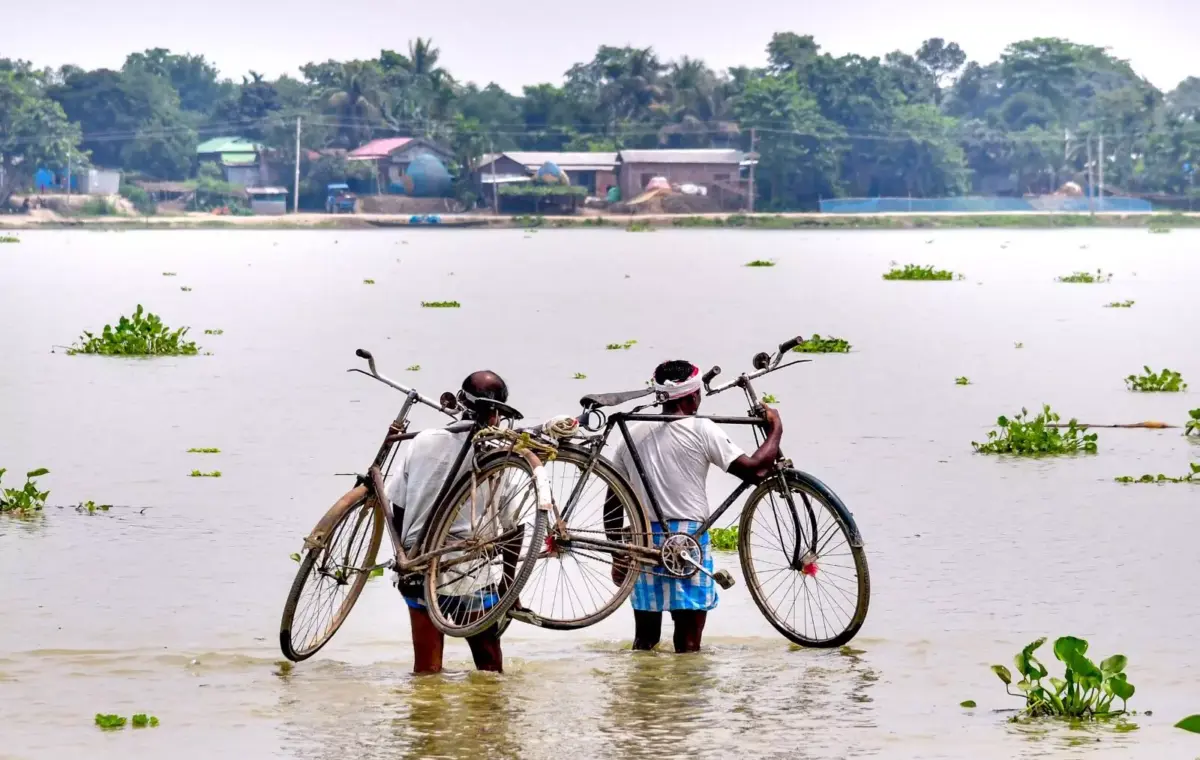

Agartala/Guwahati, Aug 2: Despite battling devastating floods through much of July, Assam has received 28% below-normal monsoon rainfall so far this season, according to the India Meteorological Department (IMD).
The rainfall shortfall comes even as Assam witnessed one of its worst flood spells this season, underscoring the uneven distribution of monsoon rainfall across the state.
The IMD’s latest rainfall data showed that five of the eight Northeastern states recorded below-normal rainfall during June and July despite weather-related disasters across the region.
Officials attributed the erratic rainfall to weak rain-bearing systems over the Bay of Bengal, the absence of active monsoon troughs and the influence of El Niño.
Among the five states with deficient rainfall, Meghalaya recorded the highest shortfall at 58% during June and July, followed by Arunachal Pradesh (41%), Manipur (40%), Assam (28%) and Mizoram (24%). Sikkim, Tripura and Nagaland recorded normal rainfall during the two-month period.
The rainfall deficit was even more pronounced in June, when Assam recorded a 37% shortfall. Nagaland registered a 56% deficiency, followed by Arunachal Pradesh (44%), Mizoram (37%) and Tripura (36%).
Meghalaya and Manipur were categorised under the IMD’s “Large Deficient” rainfall category, recording deficits of 74% and 71%, respectively.
The broader East and Northeast Meteorological Sub-Division, which comprises the eight Northeastern states along with West Bengal, Bihar and Jharkhand, recorded an overall rainfall deficiency of more than 30% during June and July, the first half of the four-month southwest monsoon season.
The southwest monsoon reached substantial parts of the Northeast on June 7, two days later than its normal onset, and covered the entire region by June 10, according to IMD officials in Guwahati and Agartala.
Looking ahead, the IMD has forecast below-normal rainfall across the country during the second half of the southwest monsoon season (August-September).
However, it said East and Northeast India are likely to receive normal to above-normal rainfall in many areas during the period, offering some relief to the region.
Meteorologists said the erratic rainfall pattern has been influenced by El Niño conditions, weak Bay of Bengal weather systems and the absence of active monsoon troughs.
A stronger El Niño is expected to develop during the second half of 2026, potentially bringing hotter and drier conditions across large parts of Asia, although experts remain optimistic that the Northeast could receive adequate rainfall during the remaining peak monsoon months.
The southwest monsoon, which accounts for nearly 70% of India’s annual rainfall, is critical for the agrarian economy of the Northeast, where a large proportion of the population depends on rain-fed agriculture.
Adequate rainfall during the remaining months of the season will be crucial for Kharif cultivation as well as replenishing rivers, reservoirs and groundwater resources across the region.
IANS