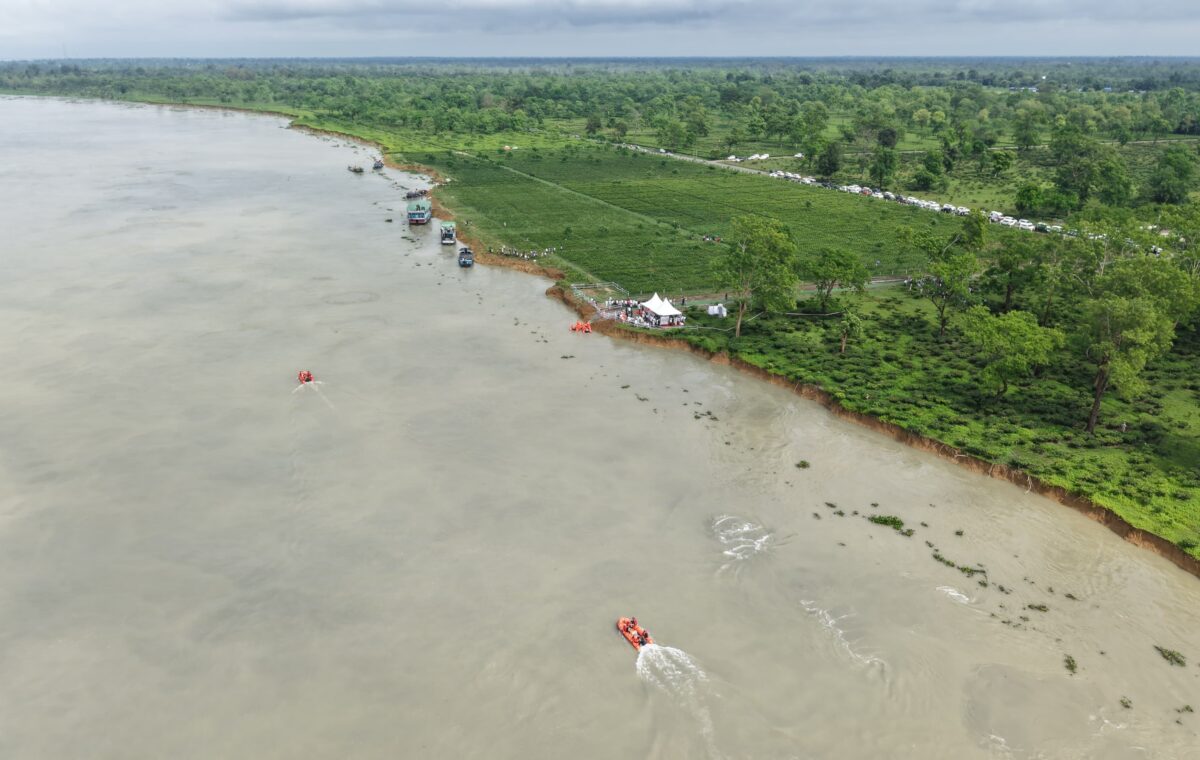
Guwahati, Aug 2: At a time when Upper Assam is grappling with the aftermath of one of the most devastating flood seasons in recent years, Chief Minister Himanta Biswa Sarma, on Sunday, made Dibrugarh his first stop to assess the damage and review the persistent riverbank erosion threatening vast stretches of the district.
Although Dibrugarh was spared the worst of the recent floods that ravaged districts such as Sivasagar and Charaideo, relentless erosion along the Brahmaputra and its tributaries continues to consume land, damage infrastructure and threaten livelihoods.
Reviewing the situation in Chabua constituency, Sarma, on the first of his four-day visit to Upper Assam, said he assessed erosion-prone stretches in Balijan, Pukhurijan, Dinjan and Rahmoria, where protective works are underway.
“I reviewed the riverbank erosion situation in the Chabua constituency, especially in Balijan, Pukhurijan, Dinjan and Rahmoria. The Water Resources Department has carried out work in some areas, but unless the work is completed in its entirety, there will continue to be losses in one place or another,” he said.
Emphasising the need for a long-term strategy, the Chief Minister said the state government would engage experts from the Indian Institute of Technology (IIT) to devise sustainable solutions for erosion control and protection of vulnerable river stretches.
“I will also conduct a meeting along with IIT experts and professors in Guwahati to develop a long-term solution to Brahmaputra erosion and protection of vulnerable stretches and will take necessary steps,” he said.
Sarma further revealed that the Water Resources Department has proposed a scheme to address erosion-related issues in Assam.
“The department has also proposed a Rs 90-crore scheme for Assam erosion. I will look after the means to draw the budget from. We will take measures to ensure that what happened this time doesn’t repeat again,” he said.
The Chief Minister noted that the full extent of damage caused by the recent floods in Upper Assam would become clear only after a detailed assessment in the coming days.
“The entire assessment for the damage, loss and devastation caused by the recent Upper Assam floods will only come out after a few days. The floods had not gripped the entire Upper Assam; we need to particularly look at Sivasagar and Charaideo. Although there have been losses in Jorhat, Golaghat, Dibrugarh and Tinsukia, they are not on the scale witnessed in the other two districts,” he said.
Highlighting the complexities of managing erosion along the Brahmaputra, Sarma described the river as both dangerous and unpredictable.
“The Brahmaputra River is dangerous and devastating. Protection at one site causes the meandering current to hit a new place. This is a huge problem for us and we have to keep fighting with it,” he said.
Following the erosion review in Dibrugarh, the Chief Minister is scheduled to visit flood-affected districts of Upper Assam to assess relief and rehabilitation efforts on the ground.