The great citizens of a country are not those who bend the knee before authority but rather those who, against authority if need be, are adamant as to the honour and freedom of that country. – Albert Camus
The prolific British historian, AJP Taylor, wrote major works on modern Germany, modern Britain, and the two World Wars, as well as a life of the media magnate, Lord Beaverbrook. However, he himself considered the best of his books to be The Trouble Makers, a study of British dissenters who opposed their country’s expansionist and imperialist foreign policies. In the academic world of Oxford of his time, Taylor was a bit of a troublemaker himself, which may explain this choice. Nonetheless, the book remains compellingly readable, not least because of its cast of characters.
Among Taylor’s troublemakers was the nineteenth-century Liberal politician, John Bright. Bright – whom the historian, Asa Briggs, called “the most important figure in mid-Victorian radicalism” – was a brilliant orator, some of whose speeches in the House of Commons took apart his country’s campaigns abroad, such as the war in Crimea in the 1850s. His criticisms of government policy angered Conservatives, who charged him with betraying the interests of the nation.
To these accusations, Bright combatively responded: “How indeed can I, any more than any of you be un-English and anti-national? Was I not born upon the same soil? Do I not come of the same English stock? Are not my family committed irrevocably to the fortunes of this country? Is not whatever property I may have depending as much as yours is depending upon the good government of our common fatherland? Then say to one of his countrymen, because he happens to hold a different opinion on questions of great public policy, that therefore he is un-English, anti-national?”
I first read these words 30 years ago. They immediately struck a chord, for that damning epithet, anti-national, was used ubiquitously in the India of my youth. And by our then prime minister, no less. Elected in 1971 on a popular mandate, Indira Gandhi turned increasingly authoritarian, stifling dissent, capturing public institutions, and making the Congress Party a family firm. When a popular movement led by the veteran freedom-fighter, Jayaprakash Narayan, questioned her ways, she claimed its leaders (including JP) were in the pay of foreign powers and put them all in prison.
Mrs Gandhi’s singular contribution to Indian political discourse was the idea of the “foreign hand”. The nationality of this hand was hard to establish, although one presumes it was coloured white.
A week after the declaration of Emergency, the prime minister gave an interview to The Times of India. “The aim of the Opposition parties was obvious,” she remarked; it was “to paralyse the government and indeed all national activity and thus walk to power over the ‘body’ of the nation. The situation had come to such a pass that a few more steps would have led to disintegration, which would have exposed us to foreign danger.”
1975 :: PM Indira Gandhi Blames Foreign Hand , Emergency Declared pic.twitter.com/MTE9aTST8b
More recently, Prime Minister Narendra Modi – who resembles and perhaps even exceeds Indira Gandhi in his authoritarian ways – has also attacked his critics as malignant anti-nationals. Modi’s acolytes charge opponents of his policies as being in the pay of India’s difficult neighbour, Pakistan, or even as acting on behalf of the American businessman, George Soros. Those opposed to the majoritarianism and authoritarianism of the ruling regime are accused of being members of a “tukde-tukde gang”, allegedly working to break up the nation at the behest of foreign powers. Other epithets used to damn critics include “urban Naxals” and “Macaulay putras”.
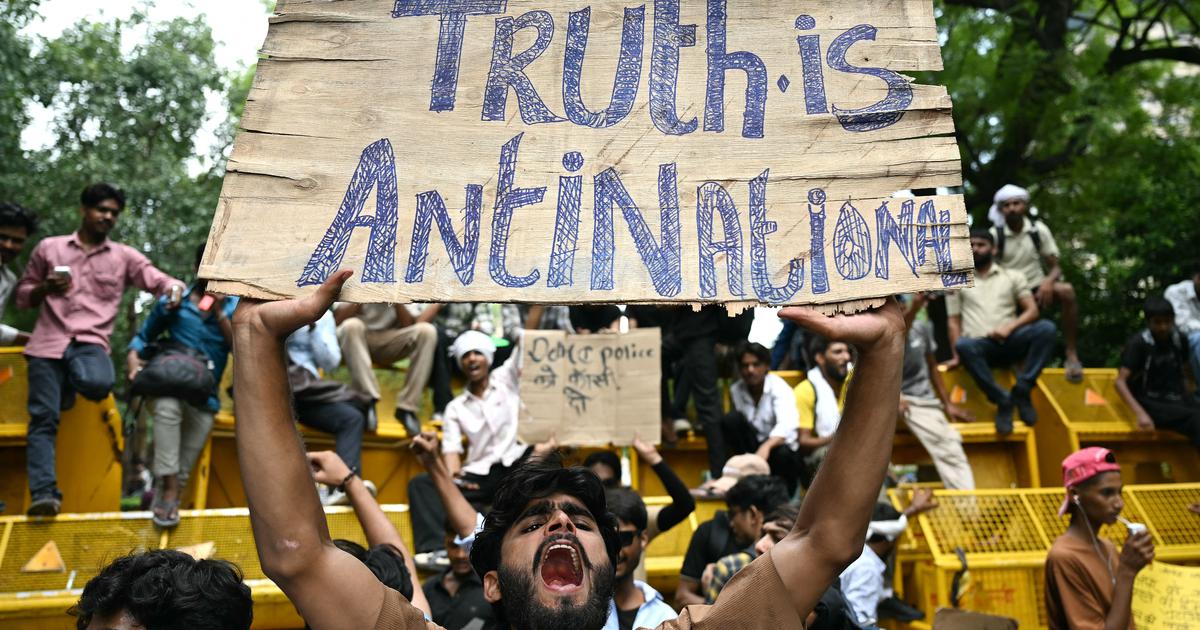
A recent illustration of this paranoid mindset is the attacks by the sangh parivar on the students’ protest. The protesters were, non-violently and at some personal cost, drawing attention to the corruption of the state education sector. Yet it was claimed (typically without any evidence) that participants had a criminal background, or were funded by unidentified powers allegedly determined to break up India.
One Rashtriya Swayamsevak Sangh ideologue urged the government to “come out with clear and credible evidence at the earliest about potential foreign funding for the protest”. An article in the RSS’s house magazine, The Organiser, claimed that “the well-fed, smartphone-wielding agitators operate more like a professionally managed campaign than spontaneous anger.”
The pizzas and burgers that students were apparently eating, the article continued, showed that “foreign accounts were subsidizing the protest kitchens”, that the agitation was being supported “from countries across the globe”. Indeed, there were “suspected links to global players like George Soros and ‘Deep State’ networks”.
Anti-India nexus of CJP: Anjali Bharadwaj & Shabana Azmi, funded by Ford, Soros & deep state spotted at Delhi protestvia @eOrganiser https://t.co/jVGczJuxtX
The hyper-nationalists of the sangh parivar tend to divide Indians into two classes. One is either a deshbhakt, a devoted servant of the nation, or else a deshdrohi, a traitor to the nation. Supporters of the regime in power fall into the former category; those who dissent, even if they do so only occasionally and mildly, are placed in the latter category.
In the context of the student protests, the malignant hollowness of the term, “deshdrohi”, is all too apparent. In a recent essay in Himal SouthAsian, Neha Dixit quotes a young participant, a female student from Uttar Pradesh, as saying that while she had grown up hearing that “people who speak against the Indian government are ‘anti-national”’, the examination leaks and their cover-up by the party in power had shown her that it was not the protesters “but the Indian government itself that is anti-national”.