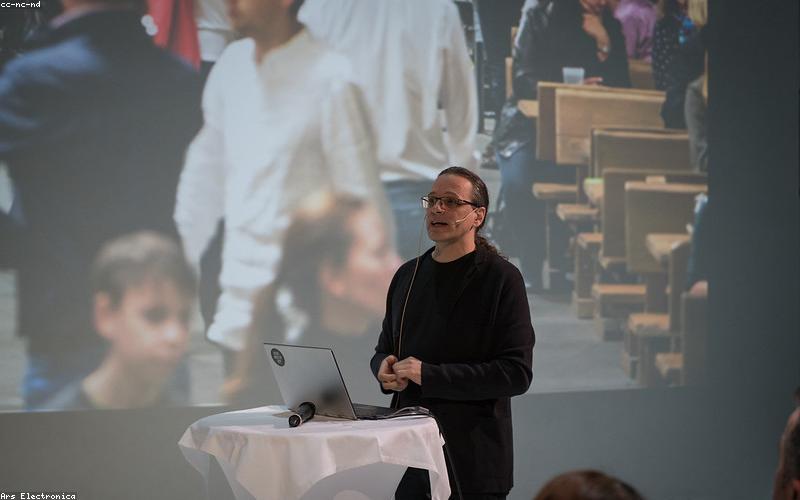
Andrew Yee performing at the premiere of Trans Requiem at NYC’s Trinity Church on September 18, 2025.
In the moments before the September premiere of composer-cellist Andrew Yee’s Trans Requiem (a recording of which was just released on New Amsterdam Records), the sanctuary of New York City’s Trinity Church was resonant with tuning instruments—interspersed with a beeping metal detector. That sound felt, to me, like a reminder both of relative safety and potential danger.
Earlier, when I arrived at the church, I had felt relieved to see no protesters. But then I felt silly. Surely, I thought, a classical concert would be niche enough to go under the radar. Still, I reminded myself, this was a large gathering centering trans experience in a place of worship. With each beep, I couldn’t help but imagine the worst: What if someone had a weapon?
I wish I could say that, with the first chords of Trans Requiem, these anxieties dissipated. But that wouldn’t be entirely true. Trans Requiem doesn’t distract from current realities. It mourns them in real time.
A requiem is traditionally a musical setting of the Catholic funeral mass. However, Yee considers Trans Requiem to be “more of a secular-style mass, even though the location is in a church.” Nevertheless, she said, “if people want to accept this mass in a religious manner, they’re welcome.”
Considering the fraught relationship that the trans community often has with Christian institutions, it is especially moving that Trinity Wall Street commissioned Trans Requiem. Before the September concert, Trinity vicar Michael Bird said that he has many times been asked why an Episcopal church would put on such a piece, to which he always replied, “How could we not?”
Yee’s Requiem is scored for string orchestra, choir, and two vocal soloists, in this case, soprano Breanna Sinclairé and tenor Katherine Goforth—both trans women, “one with a high voice and one with a lower voice,” said Yee.
At the September performance, two cello sections sat on either side of the stage, an arrangement that produced a dark, bass-heavy sound in contrast to the silvery voices in the choir. Yee led from one of the cello sections, providing back-up for conductor Melissa Attebury.
Yee, who is the founding cellist of the Attacca Quartet, turned to composition relatively recently. Two years ago, the Queer Urban Orchestra premiered Yee’s Briefly Gorgeous for chamber orchestra, based on the novel by Ocean Vuong. More recently, Or, The Whale, a co-composition with Caroline Shaw based on Herman Melville’s Moby-Dick, was released on Platoon. At around 40 minutes, Trans Requiem is Yee’s most ambitious work to date.
It is especially ambitious considering that, by writing a requiem, Yee situates herself in terms of a canon that includes Wolfgang Amadeus Mozart, Giuseppe Verdi, Johannes Brahms, Gabriel Fauré, and Benjamin Britten.
In terms of other requiems, Yee feels most connected to Brahms’s A German Requiem, which Brahms once said could have easily been titled “a human requiem” because of its universality. But Brahms’s Requiem was also deeply personal, written after the death of his mother and of his mentor Robert Schumann. Handpicking from the Lutheran Bible, Brahms created a text in vernacular German that remained spiritual but didn’t mention an afterlife, instead providing solace for the living.
“I don’t want to compare my piece to his,” said Yee, “but in the same way that Brahms wrote A German Requiem, this is A Trans Requiem. This is my experience.” Trans Requiem is also “a human requiem” in that it shows the humanity of a group that is being increasingly dehumanized.
However, while composing, Yee tried not to listen to other requiems, as she didn’t want their earworms influencing her unconsciously. “I’m just not going to write a ‘Dies Irae’ better than Verdi’s,” she said.
Though Trans Requiem doesn’t include a “Dies Irae,” it does include a “Requiem,” “Kyrie,” “Lux Aeterna,” “Libera Me,” and “In Paradisum.” These Latin texts are interspersed with English ones, mostly written by Yee herself, except for “Death Before Detransition,” which sets a poem by J. Jennifer Espinoza.
“Death Before Detransition” starts, spitting and spinning, in the lower strings. It is as if the underworld has opened up. You might not realize, at first, that the choir is singing in English: “You will have to pry /my gender from my cold /dead hands /and even then /all you will hold / is an idea I carved / into the side of the world / with fire.” It’s a rare moment in Trans Requiem when grief turns, briefly, to anger.