Published: 13:02 BST, 7 August 2026 | Updated: 13:02 BST, 7 August 2026
The idea of an AI designing brand–new viruses might sound like the plot of the latest science fiction blockbuster.
But it has become a reality, after scientists from Stanford University used AI to create 16 fully functional pathogens.
The breakthrough has been dubbed a 'significant turning point' in science, with many scientists pointing out that it could unlock a new era for treating disease.
Speaking to the Daily Mail, Dr Simon Clarke, Associate Professor in Cellular Microbiology at the University of Reading, warned that the technology could potentially be used to create dangerous bioweapons.
'The study poses no direct threat to human health because it only involves viruses that only target bacteria, though creating novel synthetic life forms which don’t exist in nature, raises broader ethical concerns,' he explained.
'While this technology has not been used to generate human pathogens, the study confirms AI can design viable, non–natural viruses.
'This underlying capability means the technology could potentially be used to create dangerous pathogens with potential to be a bioweapon, though safeguards within the AI model, which are in place in this study, can help mitigate the risk.'
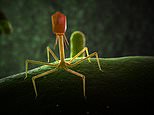
scientists from Stanford University used AI to create 16 fully functional pathogens (stock image)
In their study, researchers at Stanford University used AI to create a genome for a virus that infects bacteria, known as a bacteriophage.
The AI suggested thousands of genomes, and the researchers created 302 in the lab before exposing them to bacteria.
Overall, 16 of the viruses suggested by the AI were able to kill E.coli.
According to the researchers, the breakthrough suggests AI can design new viruses with the potential to 'massively improve human health'.
However, in the wrong hands, such technology could prove catastrophic, according to Dr Clarke.
When asked whether AI could create a virus that sparks a new pandemic, he told the Daily Mail: 'AI can only design genetic code, it cannot physically create or release a virus on its own.