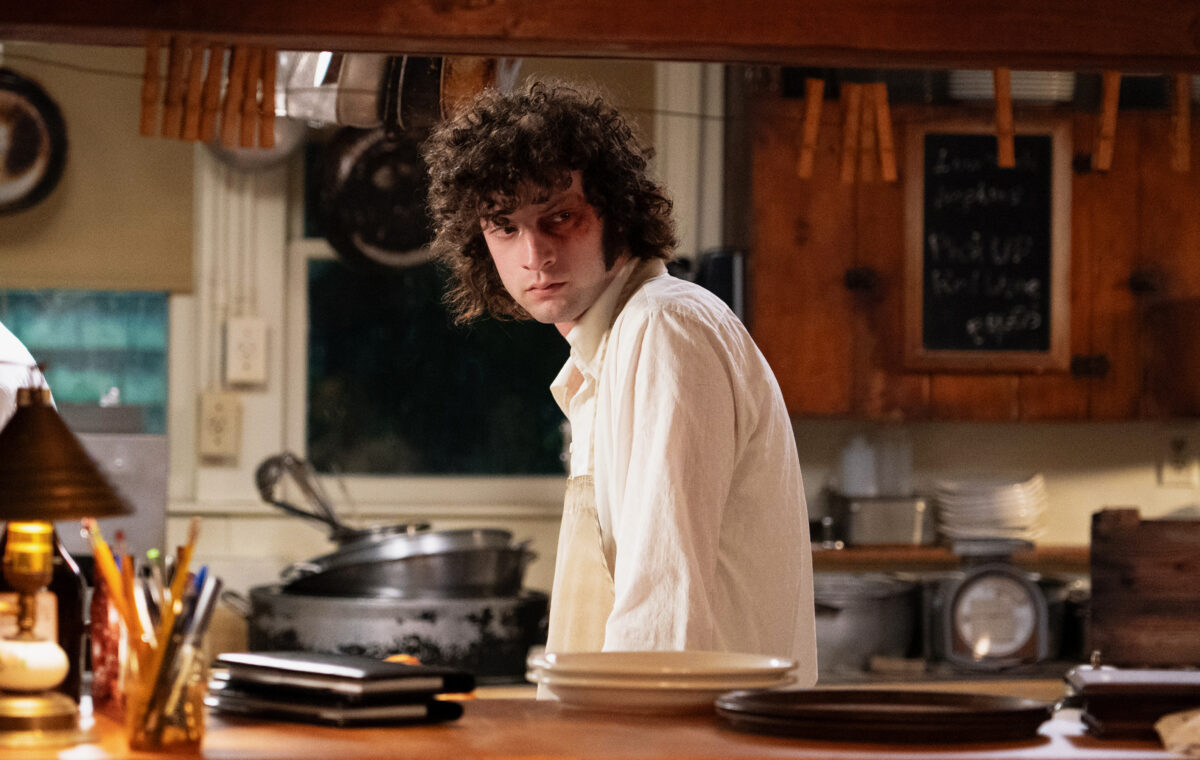
Before Anthony Bourdain was a famed chef with eight Emmys for his travel series Anthony Bourdain: Parts Unknown, he started out as a dishwasher in Cape Cod’s hippie enclave Provincetown in the mid-1970s. Tony, out in theaters Aug. 7, explores this period in Bourdain’s life, imagining how that kitchen job whet his palate for working in the restaurant industry.
In the movie, Dominic Sessa portrays Anthony Bourdain, a student at Vassar College who follows his crush Nancy Putkoski to Provincetown, where she works in the summer at a pizza shop. She doesn’t exactly feel the same at first, and so one night, a heartbroken Bourdain drowns his sorrows at a casual seafood restaurant and gets into a fight there, ending up too drunk to go home. The restaurant’s chef (Antonio Banderas)—known simply as “Chef” in the film—brings him back to his house. The chef lets him stay for the summer because he has nowhere to go and puts him to work as a dishwasher in his restaurant.
The staff is full of miscreants, who are snorting lines of cocaine left and right. But the chef becomes a mentor, showing Bourdain the particulars of running a Provincetown kitchen: how to shuck oysters and make homemade salt out of seawater. Bourdain arrives looking for love and ends up finding it in food and kitchen culture—a passion that would shape the rest of his life.
The real Bourdain died by suicide in 2018 at the age of 61. Tony, taking place over one summer, does not delve into questions about his death. “We wanted to remind people why they loved him in the first place, focus on the beginning of his life where he figured out how to share his superpower with the world of curiosity, empathy and connecting people through food,” says Lou Howe, one of the Tony screenwriters.
Here’s the real dish from Bourdain’s time in Provincetown, where he decided to become a chef.
When Bourdain went to Provincetown for the first time, he wasn’t craving lobster rolls, but the company of one particular woman. As he wrote in his 2000 memoir Kitchen Confidential, he was 18 and “unhappily in love” when he went there to find his high school crush and future wife Nancy.
They were both students at Vassar, and they shared a house with roommates, where he says there was a lot of cocaine, pot, acid and sunbathing nude—in other words, as he put it, “healthy teenage activities.”
Nancy worked at Spiritus Pizza, and while Bourdain didn’t actually move in with a chef, as the movie depicts, he did sleep in the crawl space over a walk-in refrigerator at Spiritus Pizza at one point.
One of the roommates hooked Bourdain up with a dishwashing gig at the Flagship, best known for serving up fried seafood to summer tourists.
“He was forced to get this job. He didn't have any money in Provincetown,” says Todd Bartels, one of the Tony screenwriters.
The rag-tag kitchen crew included an ex-con and part-time methadone dealer who worked the salad station. They nicknamed Bourdain “Mal,” short for “mal carne,” which is what they called bad meat. Bourdain was doing all of the grunt work at the Flagship, scrubbing pots and pans, scraping plates, peeling potatoes, and cleaning shrimp.
Bourdain was attracted to a certain kind of swagger that the kitchen crew boasted. In one dramatic example in Kitchen Confidential, he wrote that when he watched a chef at the Flagship rear-end a bride celebrating her wedding at the restaurant, “I knew then, dear reader, for the first time: I wanted to be a chef.”
Chefs at the restaurant were hailed for “total number of waitresses screwed, cocktails consumed without visible effect.” He gushed about the chefs, not only for their ability to churn out so many dinners in a sweltering kitchen, but also because they were “sexual athletes” who lived a life of “adventure, looting, pillaging, and rock-and-rolling through life with a carefree disregard for all conventional morality.”
In Tony, Sessa as Bourdain is obnoxious, talking himself up and lying to everyone he meets, even pretending that he’s writing a book about the restaurant to impress Nancy. The real Bourdain was definitely known as an arrogant kid in Provincetown. Per Kitchen Confidential, back then he was “angry” and “undisciplined,” writing, “I treated the world like my ashtray.”
“He was very brutally honest in critiquing his younger self, so that gave us some free rein to paint this wayward young man in all his warts,” says Howe.