Published : Aug 07, 2026 14:01 IST – 15 MINS READ
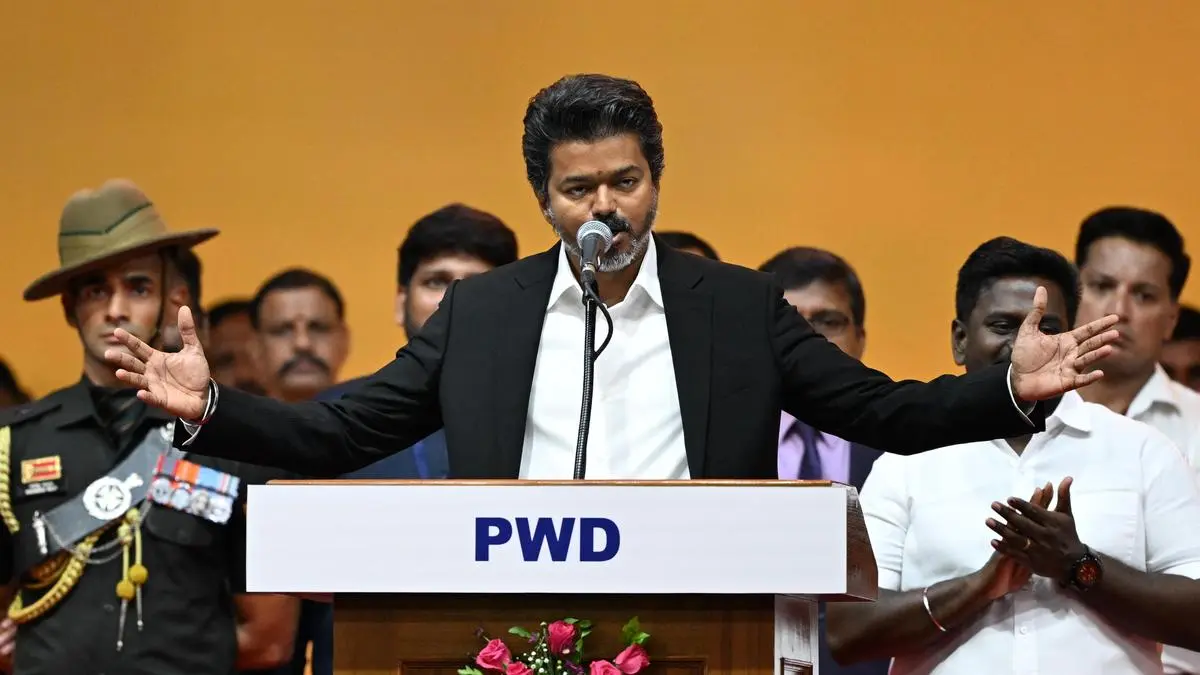
Tamil Nadu Chief Minister C. Joseph Vijay after the swearing-in ceremony at Jawaharlal Nehru Indoor Stadium in Chennai on May 10. WhatsApp feeds are flooded with stories of how contractors in the State are now executing government tenders without handing over a single rupee in kickbacks.
| Photo Credit: B. Jothi Ramalingam
If we trace the arc of Indian politics over the last couple of decades, there is a playbook that emerges. What voters want, particularly the urban middle class, it appears, is a kind of cinematic catharsis. A righteous crusader who finally cleans up the system. We saw its modern genesis with the AAP, born from a televised street movement that promised to replace politics as usual with absolute moral purity. We watched it deployed on a national scale by the incumbent BJP, with candidate Narendra Modi even promising to credit the recovered “loot” to individual bank accounts of citizens. And today, this script has reached its most viral apex in Tamil Nadu.
The Tamilaga Vettri Kazhagam (TVK), after its unexpected victory in the recent Assembly election, has quickly moved from promising a future to building the perception of now. If one spends any time in the corners of Tamil social media, almost everyone, it would seem, has a personal anecdote on how the entrenched commission culture in the public works, highways, and registration departments of Tamil Nadu has been decimated. WhatsApp feeds are flooded with stories on how contractors are now executing government tenders without handing over a single rupee in kickbacks. The Chief Minister himself has told people to refuse to pay a bribe. And take his name while doing so! The overarching narrative is as ubiquitous as it is intoxicating: the dark era of politicians skimming off the top of public contracts and services has been wiped clean, replaced overnight by an ethically upright administration.
And given the fact that the TVK rode to power on the provocative potential of Instagram reels, this performative virtue display has become mainstream. There is a daily deluge of viral content engineered by enthusiastic cadres and amplified by the public. There are the ubiquitous shaky-camera videos of low-level bureaucrats being publicly berated by self-styled TVK vigilantes for allegedly demanding a 500-rupee bribe for a patta transfer or some other basic function. There are press briefings where newly minted Ministers spend more time boasting about their refusal to use official convoys than they do outlining their policy vision or explaining departmental budgetary choices.
What is clear, regardless of whether what is being said is true, is that the political discourse has been completely hijacked by a kind of personal virtue cult. When a representative’s primary qualification is a loudly broadcast refusal to partake in the traditional spoils of power, governance itself is transformed into a daily reality television show of moral hygiene. The electorate, exhausted by decades of systemic graft, consumes this not as administrative strategy but as a form of spiritual redemption.
AAP leader Arvind Kejriwal in a December 2013 photograph. He had appeared to be a righteous crusader who would clean up the system when he emerged as an anti-corruption leader in the agitation that spelt doom for the Congress regime.
| Photo Credit:
Raveendran/AFP
Beneath the intoxicating theatre of viral reels as governance lies a dangerous trap. By reducing the sprawling, complex machinery of administering a relatively prosperous State of 80 million people to a simple purity test, we run the risk of becoming prudish without a purpose. This anti-corruption framing assumes that the primary problem of governance is a moral one, that if we simply replace “bad, greedy men” with “good, honest men”, the State will magically transform into a great one.
When “anti-corruption” is elevated from a tool of institutional accountability to a winning campaign promise, it poisons politics. The surest way to keep corruption burning as an unresolved problem is for people to vote on it as the sole issue, operating under the delusion that we are choosing a good person over an evil one. Such clear-cut moral distinctions belong to movie scripts and simply do not exist in reality. It also betrays a foundational assumption of liberal democracy: the radical premise that nobody is fundamentally better or more inherently virtuous than anybody else.
The entire premise of democratic institutions was built specifically to manage human fallibility among equals, not to elevate messiahs. Reasonable adults know that. Or so we would assume. We also know deep in our hearts that you and I are just as susceptible to corruption as every politician who has ever been elected to office. All you need to do is remember how many people you know have paid a bribe to get ahead in some line, and how many times you have. More importantly, an election is a fundamentally inadequate instrument for judging an individual’s moral character, even if that character is somehow superior. A ballot box is designed to aggregate preferences on policy direction, not to canonise saints.
When a politician who contests elections on such an anti-corruption platform actually wins, we end up with a problem far worse than the one we were trying to solve. An agenda built entirely on this illusion of moral hygiene cannot survive the rigorous friction of actual policy debates. In such a scenario, the incumbent is forced into a corner: they must continuously manufacture the presence of a corrupt villain to justify their continued existence. Elections, then, cease to be arguments about state capacity and instead degenerate into a performative theatre of criminalising the opponent. When this happens, democratic norms collapse under a two-pronged assault.
First, the rule of law is actively weaponised; the state apparatus is deployed to target, raid, and neuter the opposition using any means necessary, all under the high-minded guise of cleaning the system. Second, once the opposition is successfully jailed or politically liquidated, the democratic guard rails disappear entirely.
The incumbent is left with an unchecked monopoly on state power, eventually turning the weapon of anti-corruption outwards against dissidents, journalists, or any ordinary citizen who dares to dissent. The crusade that promised to liberate citizens from the corrupt politician ends up delivering them into the hands of an unaccountable autocrat.
As the BJP’s prime ministerial candidate ahead of the 2014 general election, Narendra Modi even promised to credit recovered “loot” to individual bank accounts. Here, arriving for a BJP conference in New Delhi in December 2013.
| Photo Credit:
Prakash Singh/AFP
History offers a grim, repetitive confirmation of this trajectory. When Maximilien Robespierre instituted the Reign of Terror during the French Revolution, he did not do so in the name of tyranny; he did so to establish a Republic of Virtue. That he ended up weaponising moral purity to send his political rivals to the guillotine is a downstream consequence of that original intent which sought to sidestep what we would now call liberal norms. The most ruthless autocracies are born not from malice but from such a maniacal crusade to cleanse the state of corruption.