This is read by an automated voice. Please report any issues or inconsistencies here.
See more from the L.A. Times in Google Search. Set us as preferred
The initial concept for USC’s Bloom Football Performance Center was first born on the back of a napkin. It was late November 2021, and Lincoln Riley was on a plane to Los Angeles, where he was slated to be introduced as USC’s coach.
The then-hypothetical facility had been a critical contingency for Riley, who never toured USC’s facilities, but knew — like most people around college football — that the Trojans were seriously lacking in that department. For years, USC officials had resisted doing anything about it. The John McKay Center hadn’t even been around a decade, they’d inevitably say. Plus, there was the not-so-insignificant problem of where to build a new facility on campus.
“That was a little bit, in that moment, my way to test how committed SC was,” Riley said Thursday. “This honestly was probably the biggest test of commitment for, ‘How invested are we to get this program back?’ When that was met with no hesitations, that was a pivotal part of me taking this job. I think it’s fair to say, if that commitment hadn’t been made, I probably wouldn’t be here.”
Almost five years later, the plans Riley sketched out that morning have been brought to life in one of college football’s finest facilities, the towering jewel of a $225-million capital project at USC that also includes a new baseball stadium (Dedeaux Field) and a women’s soccer and lacrosse field (Rawlinson Stadium).
The three-story, 163,000-square-foot football-only facility opened Wednesday night, with Riley reflecting back on that napkin and marveling at how far the program had come since. But this gleaming building and its array of amenities had far exceeded his initial expectations, he said.
“You can say or promise that you’re gonna build a facility, and then you can halfway do it or you can do it right and just go over the top and just really not hold back in any way, and that’s what our university has done,” Riley said. “I’m proud and thankful for the university for making this happen.”
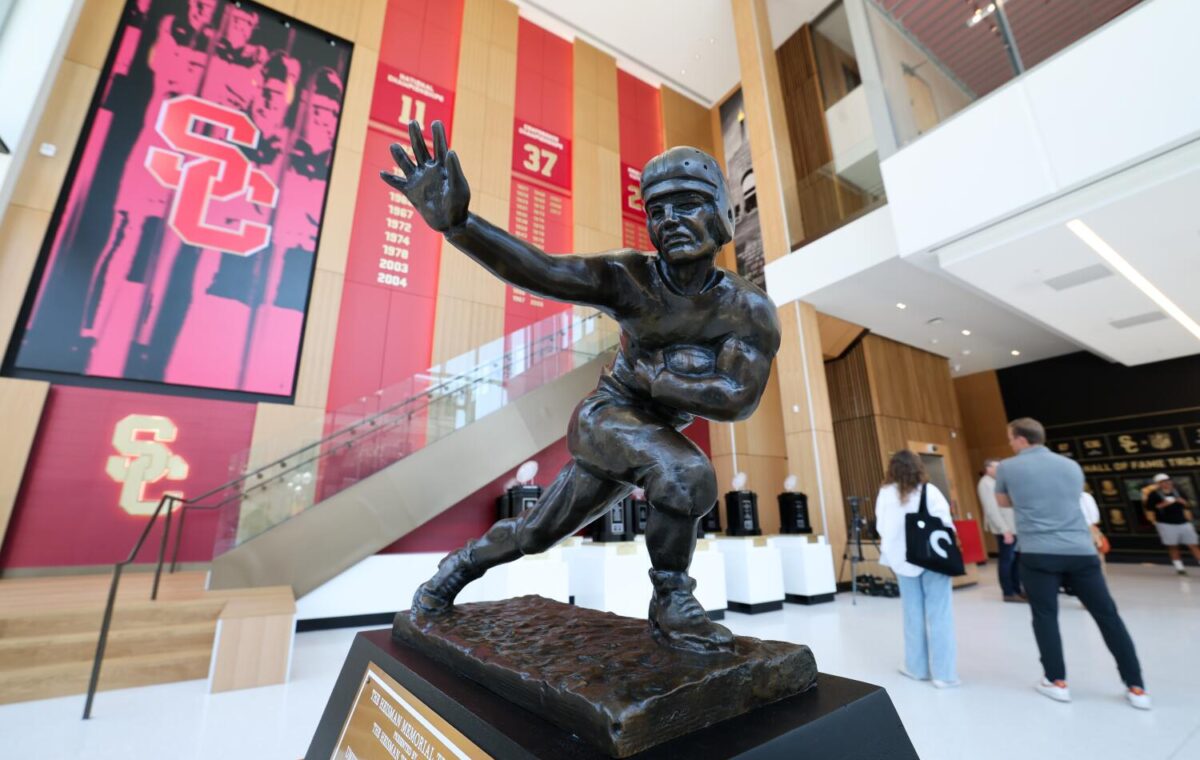
1. Bronze plaques of previous USC players adorn the wall of the Mark and Mary Stevens Trojan Legacy Wall at the USC Bloom Football Performance Center. 2. The weight room of the USC Bloom Football Performance Center. 3. A wall of USC players drafted by NFL teams at the Bloom Football Performance Center. 4. Trophies won by the USC football program on display at the Bloom Football Performance Center.
The real magic was that it happened at all, considering all that changed or had gone awry. The athletic director who first agreed to Riley’s facility request, Mike Bohn, resigned. The university president who signed off on it, Carol Folt, retired.
The cost of doing business in college football also went up exponentially with the advent of revenue sharing, all while the university was going through a financial crisis. None of which helped when it came to asking for $200 million in private donations.
Then there was the matter of physical space. The only option to build the facility was to demolish the Trojans’ longtime baseball field and displace the program for multiple seasons.
“Think of what Coach Stank and the baseball team, what they had to give up to make this work,” Riley said. “The importance of just getting everybody together and on the same page and pushing in the same direction, this building is one of the first real signs of that. Because this took everybody.”
Riley, in particular, proved to be “very influential” in the process, according to Jeff Fucci, USC’s senior associate athletic director for capital projects.
“Coach was tireless in making sure that this was something that was not going to just be a vision and something that was talked about and not followed through on,” Fucci said.