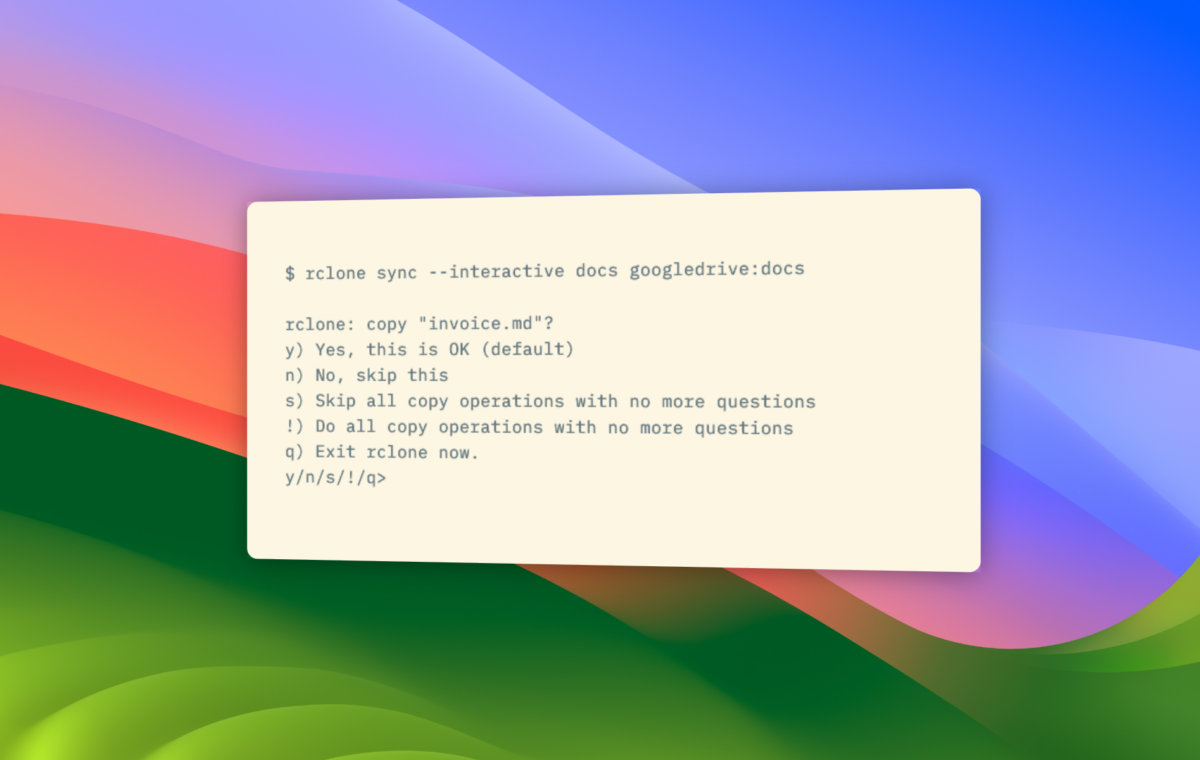
Google Drive’s free online storage is a popular, convenient way to share files across devices and keep copies in the cloud. As the backend store for Google Docs, Gmail, and Google Photos, it’s a service that many of us use, whether we like it or not—whether we even give it a moment’s consideration.
But the app is far from perfect: at 350MB, it’s taking up quite a lot of space just to keep some files in sync. It also replicates the web app’s UI, which means Google’s Material Design language, and a decidedly non-native feel. Worse yet, the app isn’t available for Linux. Maybe there’s a better way?
Unless you have strong privacy concerns, Google Drive is an ideal location for your documents, project files, scripts—pretty much any file, especially those that you might want to access from more than one machine.
Rclone will help you sync or access those files from your desktop, much like rsync helps you copy files locally or over a network. You can download it for macOS, Windows, or a variety of Linux distributions. While you can install it using a package manager, there’s little need to because the download is just a single executable.
Once installed, you can run the rclone command. The tool has many separate subcommands; check out the full list by running rclone with no arguments:
Initially, you’ll want to run rclone config, which will kick off an interactive process to get you set up. This is quite lengthy and produces a lot of output, but the defaults are mostly OK to go with. Look out for the initial storage option and make sure to pick “drive”—otherwise, you can leave most settings blank or at their defaults.
When asked for a name for your remote (Google Drive), try picking something short and easy. You’ll be typing this value with almost every rclone command, so something like “gd” is probably a better pick than “googledrive.”
Once you’ve got rclone up and running, you can test its basic operation with a command to list the top-level directories in your Google Drive:
Make sure to use the remote name that you configured earlier, followed by a colon.
You’re very likely to encounter an error that reads “This remote uses rclone's shared Google Drive client_id, which is being retired and will stop working during 2026.” There’s a guide explaining how to make your own client ID, which I highly recommend following; this approach is much more responsive.
Rclone has a whole host of listing commands with slightly different uses. Many of these are similar to the different modes of ls, for listing local files.
The lsjson command demonstrates a particular advantage of this entire approach, providing structured data in JSON format that you can use to automate all sorts of tasks relating to your shared files.
Once you’ve identified a file or directory you want to download, you can do so with the copy command. Use it like this to download the contents of a directory named docs to your current directory:
You'll need to quote the argument if it contains spaces, e.g. rclone copy 'remote:My Docs'.
You can also copy individual files. After working on one, or creating a new file you wish to store remotely, you can copy it up to the remote like this: