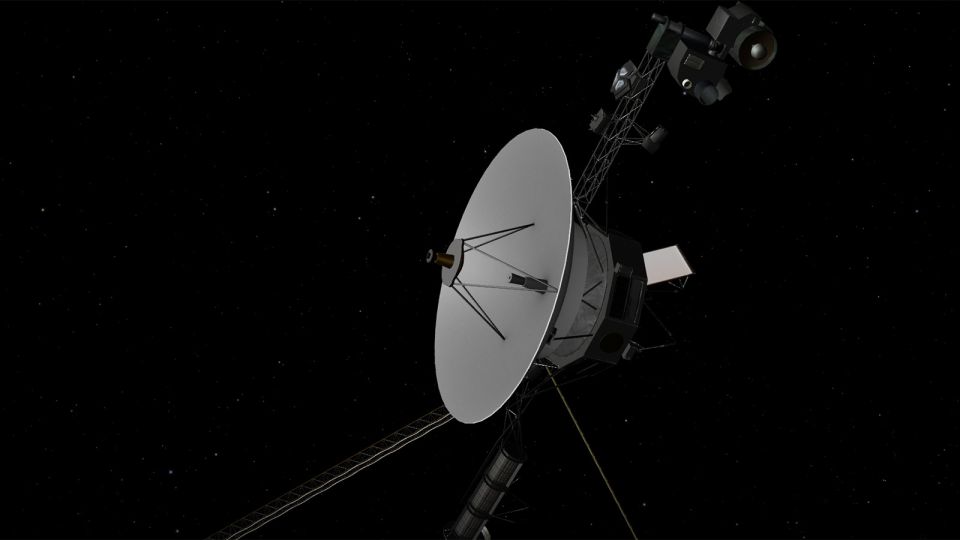
An ambitious effort to boost an aging probe on its journey through the uncharted territory of interstellar space seems to have found success.
Engineers at NASA's Jet Propulsion Laboratory in Pasadena, California, have spent the last few months implementing what they nicknamed the "Big Bang" fix to buy the historic Voyager 2 spacecraft more time to continue its science mission.
Voyager 2 is roughly 21.35 billion kilometers (13 billion miles) away from Earth, while its twin, Voyager 1, is about 25.40 billion kilometers (16 billion miles) away.
Launched weeks apart in 1977 to embark on revolutionary flybys of planets in our solar system, they are the farthest active spacecraft from Earth, traveling beyond the heliosphere, the sun's bubble of magnetic fields and particles that extends well beyond the orbit of Pluto.
But engineers have had to get creative to keep the probes operating far longer than their expected lifespan of five years, as each spacecraft's power supply has dwindled over time.
Both Voyager probes run on radioisotope thermoelectric generators, or devices that convert the heat provided by decaying plutonium into electricity. They lose an estimated 4 watts of power per year.
Throughout the years, the Voyager team has been forced to shut down systems, devices and instruments — and Voyager 2 was slated to power down another science instrument before the end of the year.
To avoid losing valuable insights from Voyager 2's unique position in space, engineers sent commands to the spacecraft to perform a simultaneous swap. This order directed the spacecraft to turn off some powered devices while switching on others that draw less power — while maintaining the crucial balance of keeping the spacecraft warm enough to keep functioning and capturing scientific data.
Now, Voyager 2 has enough power to keep its three remaining instruments operating for an extra year, according to NASA.
"This was a team effort, the culmination of a year of work, with almost every team member contributing," said Kareem Badaruddin, Voyager's mission manager at JPL, in an email. "Each of us love these spacecraft, and give generously of our time off-hours and weekends, so the feeling of realizing that we had extended the life of the spacecraft and science return by 2 years or more was fulfillment and delight — it had been a difficult task and our hard work was rewarded."
A Big Bang to save Voyager 1's mission is next on the team's list.
Given the age and distance of the Voyager probes, every step that engineers take to care for them is carefully calculated.
Turning off instruments and heaters in the frigid temperatures of interstellar space risks chilling the probes beyond repair. If the fuel lines freeze, the spacecraft would lose the ability to keep their antennae pointed toward Earth, and NASA teams would lose contact with them — effectively ending the missions.
The Voyager team took steps in May and June to test that the Big Bang wouldn't draw more power than expected or lower temperatures beyond acceptable limits.
It takes nearly 20 hours for a command to reach Voyager 2, and then the team has to wait the same amount of time to receive a response before moving forward.