A very fast solution, but only on paper for now
When you purchase through links on our site, we may earn an affiliate commission. Here’s how it works.
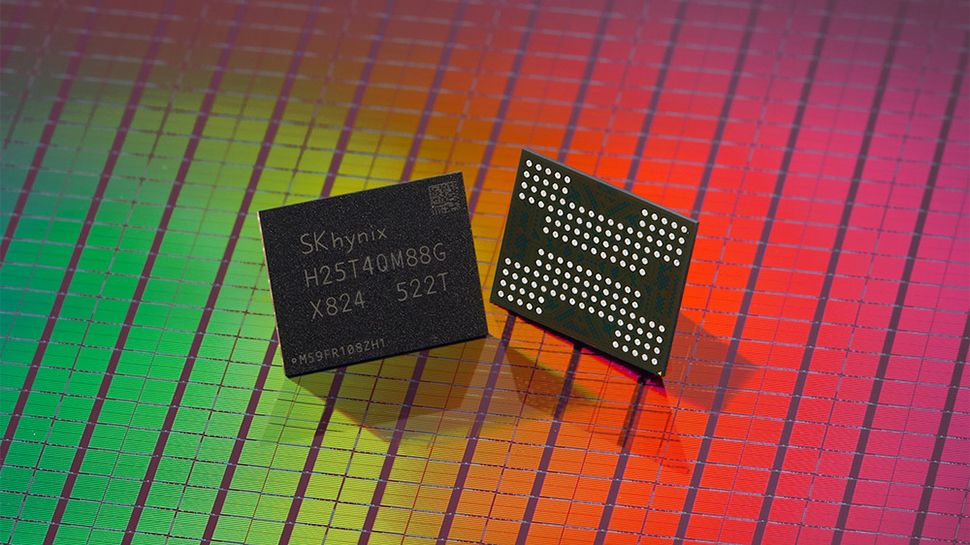
SK Hynix and SanDisk have published the first technical specification for High Bandwidth Flash.
Released through the Open Compute Project to coincide with the opening of the Future of Memory and Storage conference, it makes for an impressively fast milestone, arriving six months after the HBF workstream was convened at SanDisk's Milpitas headquarters and a year after the two companies first agreed to standardize the technology.
The solution, at least for now, exists only on paper, and has managed to draw two crucial partners to its consortium: Google and Tenstorrent.
High Bandwidth Flash's specification defines capacities up to 512GB across two stack configurations, 8-high and 16-high NAND dies, and sorts performance into three grades running from roughly 0.4TB/s to 3.0TB/s.
HBF's pitch, unlike its competition, focuses on capacity rather than raw speed. A 512GB HBF stack sits against roughly 48GB to 64GB for an HBM4 stack, which is between eight and ten times the capacity, while the top HBF grade's 3.0TB/s lands inside the 2.0 to 3.3TB/s band typical of HBM4.
It also adopts UCIe, the open chiplet interconnect standard, as the link between an HBF stack and a host processor, enabling the technology to be attached to GPUs and CPUs from different vendors.
What could be challenging is delivering on its promise within a reasonable time; however, SanDisk has been working to a public roadmap since August 2025: first samples of the memory itself in the second half of 2026, and samples of the first AI inference devices built with HBF in early 2027. Neither company updated that schedule with this week's announcement.
Sign up to the TechRadar Pro newsletter to get all the top news, opinion, features and guidance your business needs to succeed!
Industry expectations put actual commercialization somewhere between late 2027 and 2028, with the volume of data center demand that would justify the investment arriving closer to 2030, in a cycle that also involves partner testing followed by ramped-up production.
This is despite SanDisk's Hsu telling SDxCentral in May 2026 that working through the Open Compute Project (OCP) let the effort move faster and that "you won't have to wait too long", which is a reasonable thing to say about a standard and a slightly generous thing to say about a product still eighteen months from sampling inside a device.
SK Hynix is equally cagey when it comes to HBF's roadmap: the same document that announces HBF also unveils the company's tenth-generation 375-layer 4D NAND, claims a 2.5x improvement in performance per watt, and states plainly that mass production of enterprise SSDs built on it begins early next year; HBF gets no date mentioned at all.
One interesting thing is that Nvidia is not among the named participants, even though it dominates the AI accelerator market.
SK Hynix has, however, expanded a strategic partnership with Nvidia covering next-generation memory as recently as July 25, and that might be a sign that things could change, but there is no official confirmation from what is arguably the biggest AI player in the market just yet. Samsung, Micron and Kioxia are likewise absent, with Kioxia pursuing a different approach to the same problem.