I returned to Syria in the summer and found something new: the quiet miracle of ordinary life. On a July afternoon, I stood on the edge of al-Hatab Square in the old city of Aleppo, filming, transfixed. A group of boys was kicking a soccer ball around the square. One kicked it out into the street, out of the frame, where it bounced off a parked car. Another ball appeared immediately from the other side. They shouted, laughed, and kept playing. It was an ordinary scene, but I couldn’t look away.
The historic al-Hatab Square had been repaved a few years ago with broad, white slabs of limestone, ringed by a mix of gutted buildings and jarring white storefronts—the residue of nearly 14 years of war and the Assad regime’s failed attempts at reconstruction. For years, Syria had been defined by images of war: the deep bomb craters, the crumbled neighborhoods, the sprawling refugee camps. al-Hatab Square had been a fault line between regime and rebel territory in Aleppo during the particularly brutal years of 2013 to 2016. Many died crossing between the two sides. The regime’s aerial bombardment and the rebels’ underground explosions caused much of the destruction in the Jdeideh quarter, a UNESCO World Heritage Site that includes the al-Hatab Square.
I had watched the aftermath of bombings many times during the war: the pillars of smoke rising from the rubble, the White Helmets rushing to pull ash-covered bodies from the wreckage, the brokenness that was left behind. Now boys chased soccer balls across the square that was once a battlefield. I thought of a video produced by the advocacy group Syria Campaign in 2014 that imagined this scene in reverse: beginning in the moments after a bomb fell and rewinding until the bomb shot back into the sky with an explosive boom, the camera panning down to children playing soccer in a square. Just like this one.
In those moments in the square, you could squint and believe that fate had spared Syria the war. Yet all around me there were reminders; there was evidence. The yellowed stone planters that once held trees were gone. The old silver and gold shops, their facades blackened by time, were gone. What had once been dense and crowded was now open and disorienting. This was my fourth trip to Aleppo since the Assad regime fell in December 2024. Every visit evoked grief and fury, happiness and gratitude, disbelief and mourning. As time passed, these emotions grew quieter, and something new took their place.
Across the country, people offered wildly different accounts of how they felt 18 months after liberation. Some declared that nothing has changed. Others insisted, with equal conviction, that everything has. People complained about inflation, the fuel crisis, and the soaring cost of electricity. Some called the revolution a failure; others considered the new transitional government, led by President Ahmad Al-Sharaa, to be faultless. “What has changed?” “Things are worse than ever!” “I thought things would be so much better.” Somewhere between these lines lies the truth. No, things are not worse than ever. It is, mostly, a matter of expectations.
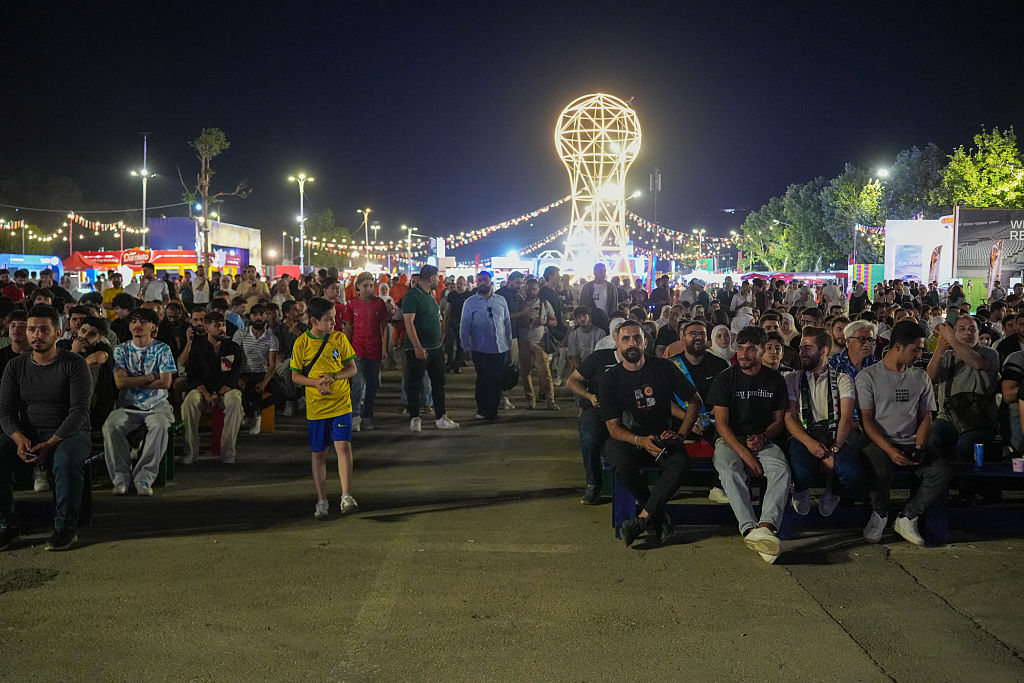
Still, as I witnessed scenes like the one in the square unfold across Syria, I found myself wondering: Can we finally live an ordinary life? Every day, I was struck by normalcy. The narrow streets of old Damascus were filled with crowds of shoppers. Cafes in the city were crowded with Syrians watching World Cup matches through the night.
Little girls roller skated on the grounds of a government sports complex in Damascus, in front of a former security center that once ruled the neighborhood through terror. The head of the complex told me the tracks, gyms, and saunas had once been used by Russian and Iranian soldiers during the war. Now I watched dozens of children running soccer drills on the field and doing knee-up laps in a karate class inside. These programs were offered to the community for free; the sports complex returned back to the people.
One evening at the citadel of Aleppo, more than 1,800 people gathered in the amphitheater for a musical performance. The Gardenia Choir, a Syrian women’s vocal ensemble, sang tunes that every Syrian child of the 1980s would recognize. A traditional singer from Aleppo performed qudud halabiyeh and muwashahat—Andalusian poems that have been sung for centuries. The crowd broke into carefree dance, singing along. Even the security guards joined in. As dusk settled, fireworks burst above us. I flinched, by instinct, then relaxed. For years, pops and booms had meant death from the sky.
I was moved by this lightness of being, by how fully people seemed to embrace joy, enacting it with their whole bodies. These fleeting moments felt like a release of pain and sorrow held too long. Can new memories of music, dance, and fireworks exploding into color over an ancient, battered city undo, or even weaken, the memory of bombs falling?
After all that has happened, it is no small thing to feel true joy in Syria. The normal feels radical. But a sense of normalcy is fragile and unevenly distributed. In Damascus, over the course of a single week in July, two bombings shook the city. The first bomb targeted a cafe outside the courthouse, killing nine people, most of them lawyers. Days later, two explosions injured 18 people near the Ministry of Tourism and the Four Seasons Hotel, where President Emmanuel Macron of France was visiting—the first head of state from the European Union to do so since the regime’s fall, a sign of Syria’s extraordinary reentry to the world. The bombings were a stark reminder of how easily life can still be shattered.
Soon after the bombings, the People’s Assembly, Syria’s new, transitional parliament, convened its first session since the fall of the Assad regime. Many Syrians remain critical of its delayed and flawed formation: one third of the assembly was appointed by the president, the rest chosen through regional electoral colleges led by committees assigned by the president. Yet, this parliament was not like the ones I had watched growing up, more theater than representation. Debate and disagreement with the Assad regime was not only unimaginable, but lethal.
From the first session, the differences of tone and practice were significant. President Ahmed al-Sharaa entered the chamber quietly and addressed the new members of the parliament without the choreographed applause of the past. No clapping after each sentence he spoke. No clapping at all.
For Syrians, this was a notable shift. The Assad regime cultivated idolatry and many had been happy to oblige it. A member of parliament once famously declared that Bashar al-Assad should rule not just Syria, but the entire universe, even as Assad dropped barrel bombs on his own people. The new ways of the parliament carried meaning and signified the beginning of a new era.
What was changing in Syria was not only what people were able to do, but what they were able to say. The shroud of silence and fear that enveloped Syria throughout the Assad decades was gone. Syrians were, finally, speaking freely about those dark decades.
In Hama, a city 130 miles north of Damascus, I visited the atelier of one of the last traditional weavers in the city. We drank coffee as he told stories of February 1982, when Hafez al-Assad put the rebellious city under siege and the regime’s army killed tens of thousands in a single month. Others in the shop shared stories of entire families being killed together in their homes. What felt radical was that we were in Hama, openly speaking about the stories of Hama.